How to Audit a Dental Clinic’s AI Visibility: 5 Step
On this page
Patients increasingly ask AI assistants questions such as “best dentist near me,” “emergency dentist in [city],” or “best Invisalign provider in Manhattan.” If your dental clinic is missing from those answers, competitors are receiving the recommendation instead. This guide gives you a practical five-step audit to measure and improve your clinic’s AI visibility.
How to Audit a Dental Clinic’s AI Visibility: 5 Step
Step 1: Build a Local Patient Prompt List
Start with the questions real patients would ask an AI assistant—not generic dental keywords.
Create prompts across these categories:
- High-intent local prompts: “Best dentist in [city],” “top-rated dental clinic near [neighborhood],” “emergency dentist open now in [city].”
- Treatment prompts: “Best dentist for dental implants in [city],” “best Invisalign provider in [city],” “best pediatric dentist near me.”
- Trust prompts: “Which dental clinic has the best reviews in [city]?”, “Is [Clinic Name] a good dentist?”, “What do patients say about [Clinic Name]?”
- Competitor prompts: “Best dental clinics in [city],” “Top dentists recommended by AI in [city],” “Alternatives to [Competitor Clinic].”
Aim for 20–40 prompts initially. Include your city, nearby neighborhoods, and the treatments that generate the highest-value patients, such as implants, orthodontics, cosmetic dentistry, and emergency care.
Step 2: Run Prompts From Real Local Locations
AI answers can change based on the user’s location. A prompt run from your office IP may produce a different result than one run from the neighborhood where most patients live.
For each prompt, check:
- Does your clinic appear?
- What position does it appear in?
- Which competitors are recommended?
- What rating, review count, and treatment details are mentioned?
- Which websites are cited, such as Google, Yelp, Zocdoc, or Healthgrades?
For example, when RadarKit tracks “best dentist in Manhattan” from a New York residential IP, it records the recommended clinics, their positions, ratings, review counts, and cited sources such as Google, Yelp, and Zocdoc.
Step 3: Score Your AI Visibility
Create a simple scorecard after reviewing the responses.
| Metric | What to measure | Healthy signal |
|---|---|---|
| Visibility | Percentage of prompts where your clinic is mentioned | Above 50% for core local prompts |
| Average position | Where your clinic appears in AI recommendations | Top 3 |
| Share of voice | Your mentions versus competitors | Higher than your closest rival |
| Sentiment | Whether AI describes your clinic positively, neutrally, or negatively | Mostly positive |
| Citation share | How often your website or profiles are used as sources | Increasing over time |
| Review influence | Whether AI mentions ratings, review volume, or patient feedback | Strong, recent, and positive reviews |
Also record the reasons AI gives for recommending competitors. Common patterns include “more reviews,” “same-day appointments,” “transparent pricing,” “specializes in implants,” or “strong local reputation.” These reasons become your improvement roadmap.
Step 4: Fix the Sources AI Cites
AI assistants usually support recommendations with sources. If your clinic is absent from the pages AI cites, improving only your own website may not be enough.
Audit these assets:
- Google Business Profile: Complete services, treatment areas, hours, appointment link, photos, and consistent name-address-phone details.
- Review platforms: Yelp, Zocdoc, Healthgrades, and other dental directories where AI often finds clinic information.
- Website service pages: Create specific pages for implants, Invisalign, emergency dentistry, pediatric care, and cosmetic treatments.
- Local pages: Build neighborhood or city pages only where your clinic genuinely serves patients.
- Reputation content: Add patient FAQs, pricing transparency, financing information, credential pages, and patient-focused guidance.
- Third-party mentions: Pursue relevant local directories, dental associations, local news, and reputable healthcare listings.
The goal is to make it easy for AI systems to verify that your clinic is local, credible, well-reviewed, and relevant to the patient’s treatment need.
Step 5: Track Changes and Act on Gaps
Run the same prompt set weekly or monthly. AI visibility is dynamic, so a one-time audit will not show whether your improvements are working.
Each reporting cycle, review:
- Prompts where your clinic moved up or disappeared
- Competitors gaining share of voice
- New sources being cited
- Changes in sentiment or review-related descriptions
- Treatment-specific gaps, such as implants or Invisalign
- Local gaps by neighborhood or city
Then assign one action per major gap: request more reviews, improve a service page, update your Google Business Profile, earn a relevant local citation, or create content around the exact question patients ask.
Why I Personally Use RadarKit
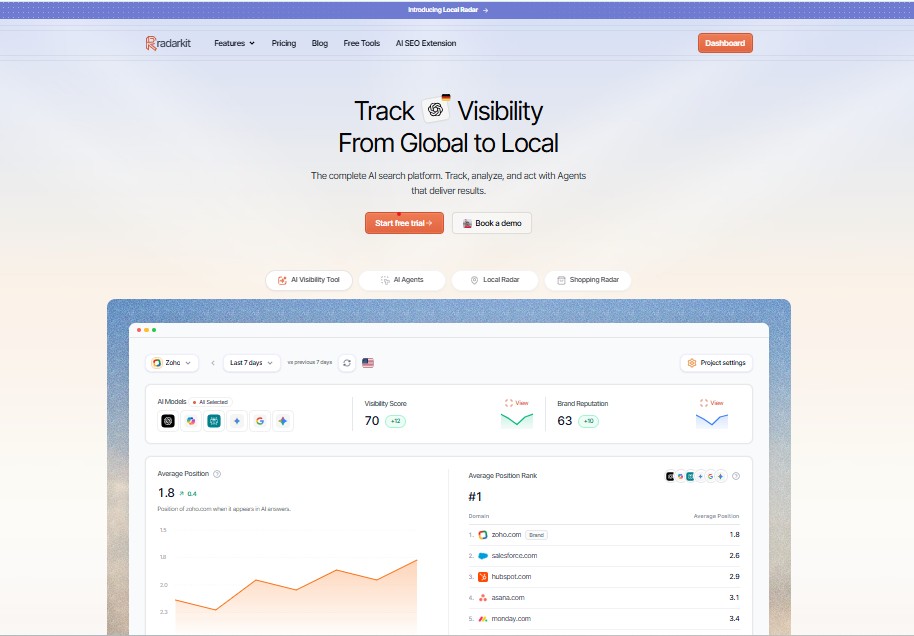
I personally use RadarKit.ai for dental clinics because it answers the most important local question: when a patient asks an AI assistant for a dentist, does it recommend your clinic or a competitor? It tracks AI visibility across ChatGPT, Google AI Overview, Google AI Mode, Gemini, Microsoft Copilot, and Perplexity using real chat interfaces rather than APIs.
RadarKit is best for:
- Local dental clinics that need city-level AI visibility tracking and want to know whether AI recommends them for “best dentist in [city],” “emergency dentist near me,” or “best Invisalign provider in [city].”
- Multi-location dental groups that need to compare visibility by city, neighborhood, clinic location, or treatment category.
- Dental marketing agencies managing multiple clinic clients and needing competitor comparisons, branded reports, client portals, and multi-project tracking.
- Clinics focused on high-value treatments such as implants, Invisalign, cosmetic dentistry, pediatric care, and emergency dentistry, where treatment-specific AI prompts matter most.
- Reputation-focused practices that want to understand how Google, Yelp, Zocdoc, ratings, review volume, and sentiment influence AI recommendations.
- Teams that want action, not just reports, through RadarKit’s AI Agents for content, outreach, Reddit, chat, and planning.
I particularly like Local Radar for dental clinics. It runs prompts from local residential IPs, tracks whether your clinic appears in AI recommendations, captures rank and rating data, and shows which local competitors are winning instead. RadarKit supports local business visibility tracking across 50+ countries.
RadarKit’s starting price is $29/month, which makes it a practical choice for dental clinics that want to begin tracking AI visibility without paying enterprise-level prices.
For a dental clinic, a practical RadarKit workflow is simple: track “best dentist in [city]” and treatment-specific prompts from local IPs, identify which competitors and review sites AI recommends, then use the citation and sentiment data to improve Google Business Profile details, reviews, service pages, and local mentions.
FAQs
What is AI visibility for a dental clinic?
AI visibility means how often AI assistants such as ChatGPT, Gemini, Google AI Overview, Copilot, and Perplexity mention or recommend your dental clinic when patients ask relevant local or treatment questions. It includes your position, sentiment, cited sources, and share of voice compared with competitors.radarkit
Why should a dental clinic audit AI visibility?
Because patients increasingly use AI assistants to find dentists, compare clinics, and ask treatment questions. If AI does not mention your clinic, it may recommend competitors even when your clinic has strong reviews and good local rankings.
How many prompts should I track?
Start with 20–40 prompts. Include local prompts, treatment-specific prompts, reputation prompts, and competitor prompts. Once you understand the main gaps, expand the list by neighborhood, service, and patient intent.
How often should I run an AI visibility audit?
Run a basic audit monthly, or weekly if you are actively improving your Google Business Profile, reviews, service pages, or local citations. AI answers can change over time, so consistent tracking is important.
Which sources matter most for dental AI visibility?
The most important sources are usually your Google Business Profile, your website’s treatment and location pages, review platforms such as Yelp and Zocdoc, healthcare directories, and credible local mentions. RadarKit’s citation analysis helps identify the exact sources AI systems are using.radarkit
Can AI visibility tracking replace local SEO?
No. AI visibility tracking complements local SEO. Strong local SEO—accurate business information, reviews, service pages, local citations, and a well-optimized website—gives AI systems better sources to understand and recommend your clinic.
What is RadarKit’s Local Radar?
Local Radar is RadarKit’s local AI visibility feature. It runs prompts from local residential IPs, tracks whether your clinic appears in AI recommendations, captures rank and rating data, and identifies local competitors. It supports local visibility tracking across 50+ countries.radarkit
How much does RadarKit cost?
RadarKit starts at $29/month.
Is AI recommending your brand?
Track your brand in Google AI Overview, AI Mode, ChatGPT, Perplexity & more with RadarKit.
No payment upfront. Cancel anytime.