How to Audit a Real Estate Agency’s AI Visibility: 5 Steps

On this page
An AI visibility audit shows whether buyers, sellers, renters, and investors find your real estate agency when they ask ChatGPT, Gemini, Perplexity, Claude, or Google AI for recommendations. The goal is not only to see whether your agency is mentioned, but to identify the prompts, competitors, citations, and local markets where you are missing.
Prospective clients increasingly ask AI assistants questions such as “Who are the best luxury real estate agents in Miami?” or “Which agencies specialize in first-time buyers in Dubai?” If your agency is not named, cited, or recommended, AI search can send that demand to competitors and portals.
A useful audit measures four outcomes: brand mentions, citations to your website, recommendations, and the accuracy of what AI says about your agency. A mention alone is not enough if the model recommends a competitor or provides outdated contact details.
How to Audit a Real Estate Agency’s AI Visibility: 5 Steps
1. Build a Buyer-Style Prompt Set
Create 20–30 prompts written the way a real client would search, not in industry jargon. Include agency discovery, neighborhood expertise, project or listing questions, and comparison prompts.
Examples include:
- “Who are the best real estate agencies in [city] for luxury homes?”
- “Which agencies help first-time buyers in [neighborhood]?”
- “What should I know before buying property in [city]?”
- “Compare [Agency A] and [Agency B] for waterfront properties.”
- “Tell me about [Agency Name] in [city].”
- “Which real estate agency has the best reviews in [area]?”
For local real estate, add the city, district, building, or micro-market to relevant prompts. AI answers can vary substantially by location, so national prompts will not show how your agency appears in a specific local market.
2. Test Across Major AI Platforms
Run the same prompts through ChatGPT, Gemini, Perplexity, Claude, and Google AI Overviews or AI Mode. Use a fresh, logged-out browser session where possible, because saved history and personalization can distort what a new prospect would see.
For each response, record:
- Whether your agency was named.
- Whether your website was cited.
- Which competitors were named.
- Which third-party sources were cited.
- Whether the information was accurate.
- Whether the tone was positive, neutral, or negative.
- Your position in any list of recommended agencies.
Run each important prompt at least three times, ideally on different days. AI responses vary, and one answer is an observation rather than a reliable visibility rate.
3. Score Mentions, Citations, and Accuracy
Use a scorecard with columns for date, platform, prompt, location, run number, brands named, sources cited, and score. A simple method is to score each response from 0–3: 0 for no mention, 1 for a passing mention, 2 for a positive mention or citation, and 3 for a clear recommendation.
| Signal | What to record | What it tells you |
|---|---|---|
| Mention | Is your agency named? | Basic brand awareness in AI answers. |
| Citation | Is your website used as a source? | Whether AI trusts your content enough to reference it. |
| Recommendation | Are you included in a shortlist? | Whether AI views you as a relevant choice. |
| Position | Where do you appear in the list? | How competitive your placement is. |
| Accuracy | Are services, location, and credentials correct? | Whether your public business data is consistent. |
| Sentiment | How is your agency described? | Reputation and messaging quality. |
Prioritize prompts where competitors appear but your agency does not. Those prompts reveal your most valuable content and authority gaps.
4. Audit the Sources AI Uses
When AI does not cite your site, identify what it does cite. Common sources include Google Business Profiles, Zillow, Realtor.com, LinkedIn, local news, review platforms, brokerage directories, Reddit, YouTube, and portal listings.
Check whether AI crawlers can access the pages that matter most: your homepage, agent profiles, neighborhood guides, market reports, listings, and contact pages. Make sure those pages are indexed, fast, mobile-friendly, and not blocked in robots.txt.
Also verify consistency across public profiles. Your agency name, phone number, address, service areas, specialties, licenses, and team details should match across your website, Google Business Profile, portal profiles, LinkedIn, and directories. Conflicting facts make it harder for AI systems to trust and represent your brand correctly.
5. Fix Gaps and Re-Test Monthly
Turn the audit into a prioritized action plan. Focus first on gaps that repeat across platforms and prompts.
High-impact fixes for a real estate agency include:
- Publish neighborhood pages with prices, inventory trends, schools, lifestyle details, and local insight.
- Create monthly market reports using real local data such as median price, days on market, inventory, and price per square foot.
- Rewrite agent and agency bios with specific credentials, transaction experience, service areas, languages, and specialties.
- Add structured data for RealEstateAgent, Organization, reviews, service area, and listings.
- Build buyer and seller guides for your city, neighborhoods, and property types.
- Request recent Google reviews that mention the neighborhood, property type, and client situation.
- Publish short neighborhood and listing videos on YouTube, where transcripts and descriptions can be indexed.
- Refresh market pages and dated statistics regularly, because AI citation relevance can decline over time.
Re-run the same prompt set monthly. Track mention rate, citation rate, recommendation rate, and competitor overlap to see whether your improvements are working.
Radarkit: Local AI Visibility Tracking
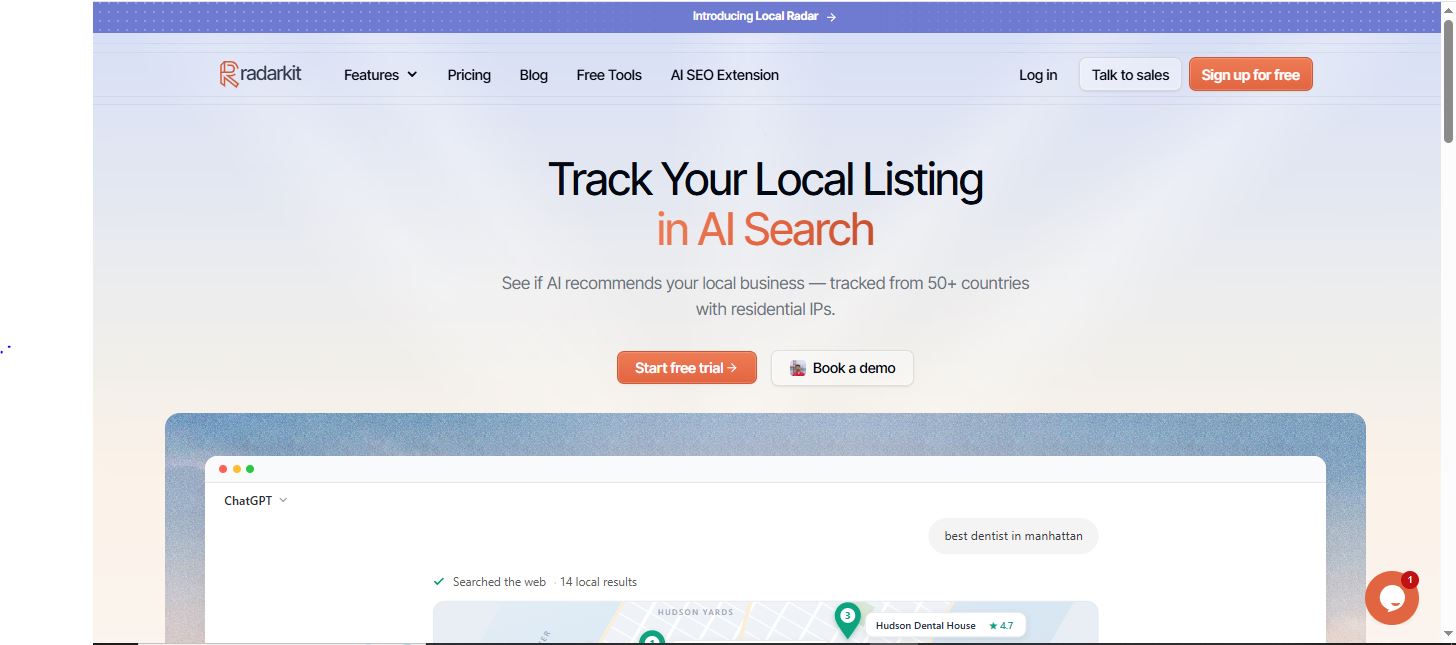
For agencies operating across multiple cities or countries, manual audits become difficult to scale. RadarKit is an AI visibility tracker built for localized monitoring: it runs prompts through real browser sessions using real-user 4G private proxies, so results reflect what customers see in specific markets rather than generic API responses.
RadarKit’s Local Radar tracks AI mentions, citations, rankings, and complete responses across 50+ countries, with city-level visibility available on higher plans. This makes it especially relevant for real estate groups with offices, listings, or clients in multiple markets.
Its starting price is $29/month for the Lite plan, which includes 15 tracked prompts, two projects, and a 72-hour refresh cycle. Growth is $79/month for 50 prompts, Pro is $139/month for 100 prompts, and Enterprise pricing is custom.
Why Real Estate Teams Use RadarKit
- Tracks visibility across ChatGPT, Gemini, Perplexity, Google AI Overviews, Google AI Mode, and Microsoft Copilot.
- Covers 50+ countries and locations, with 70+ locations on Enterprise.
- Shows brand mentions, cited URLs, rank within AI answers, sentiment, competitors, and full responses.
- Uses real-browser tracking through real-user 4G mobile and residential IPs for location-accurate results.
- Starts at $29/month and includes a 7-day free trial.
For a real estate agency, the best workflow is to run the five-step audit first, fix the highest-impact content and profile gaps, then use RadarKit to monitor local visibility across the cities and countries where you compete.
FAQs
What is AI visibility for a real estate agency?
AI visibility is how often AI platforms mention, cite, or recommend your agency when users ask real estate questions about your city, neighborhood, property type, or services. It includes both brand mentions and links to your website.
How is AI visibility different from SEO?
SEO focuses mainly on ranking in traditional search results, while AI visibility focuses on whether your brand appears inside AI-generated answers. Both matter: strong SEO content, local profiles, reviews, and structured data often help AI systems find and cite your agency.
Which AI platforms should a real estate agency audit?
Start with ChatGPT, Gemini, Perplexity, Claude, Google AI Overviews, and Google AI Mode. These platforms are commonly used for research-style questions and can surface different competitors and sources.
How many prompts should we track?
A focused agency can begin with 15–30 prompts covering brand queries, local discovery, neighborhood expertise, buyer and seller needs, and competitor comparisons. RadarKit’s Lite plan supports 15 tracked prompts, while Growth and Pro plans support 50 and 100 prompts respectively.
How often should we audit AI visibility?
Run a detailed manual audit quarterly and monitor priority prompts monthly. AI answers can change frequently, so recurring tracking is more useful than a one-time check.
Is AI recommending your brand?
Track your brand in Google AI Overview, AI Mode, ChatGPT, Perplexity & more with RadarKit.
No payment upfront. Cancel anytime.