How to Audit a Home Service Business’s AI Visibility: 5 Steps
On this page
Home service customers increasingly ask AI assistants questions such as “best plumber near me,” “emergency AC repair in Dallas,” or “top-rated roofers in Tampa.” If AI does not mention your business in those answers, you may lose high-intent leads before a customer ever visits your website. This article gives you a practical five-step audit to measure, diagnose, and improve your AI visibility.
AI visibility means how often and how prominently your business appears across a selected set of prompts and AI platforms. There is no universal score, so prompt-level answers, locations, and AI models matter more than one vanity metric. Tools such as Radarkit make this repeatable, with Local Radar, citation analysis, competitor tracking, and pricing starting at $29/month.
Why AI Visibility Matters
AI search changes the customer journey for plumbers, HVAC companies, electricians, roofers, cleaners, landscapers, and other local service providers. Instead of comparing ten search results, a homeowner may receive a short answer naming only a few businesses and then call one immediately.
For local businesses, the key questions are:
- Does AI recommend your company for high-intent local prompts?
- Which competitors appear instead of you?
- Which websites, review platforms, and directories does AI cite?
- Does your visibility change by city, neighborhood, or service area?
- Are reviews, ratings, and local business profiles helping or hurting your recommendations?
Winning AI recommendations requires more than being cited; it requires strong local signals, useful content, reputation, and consistent business information.
How to Audit a Home Service Business’s AI Visibility: 5 Steps
Step 1: Build a Local Prompt List
Create prompts based on the exact questions customers ask before hiring a home service company. Include your main services, emergency needs, locations, and comparison questions.
Use these prompt formats:
- Service + city: “Best HVAC repair company in Phoenix”
- Service + neighborhood: “Emergency plumber in South Austin”
- Near me prompts: “Top-rated roofers near me”
- Problem prompts: “My AC is blowing warm air—who should I call?”
- Trust prompts: “Which local electrician has the best reviews?”
- Comparison prompts: “Is [Your Business] or [Competitor] better for drain cleaning?”
- Buying-intent prompts: “Affordable water heater installation in Tampa”
Start with 15–30 prompts per location. For a multi-location business, create a separate prompt set for each city or service area.
Step 2: Test the Major AI Platforms
Run your prompts across the platforms customers use most. At minimum, test:
- ChatGPT
- Google AI Overviews
- Google AI Mode
- Gemini
- Perplexity
- Copilot
For every response, record whether your business was mentioned, where it appeared, and which competitors were named. Also record the cited sources, because they show which profiles, directories, review sites, and website pages influence the answer.
| Data point | What it tells you |
|---|---|
| Mentioned or not mentioned | Your baseline AI visibility |
| Position in answer | Whether you appear early enough to matter |
| Competitors named | Who is winning your local prompts |
| Cited sources | Where to build authority and listings |
| Review signals | Whether reputation affects recommendations |
| Location variation | Which cities or neighborhoods need work |
Step 3: Audit Your Local Business Signals
AI systems rely on consistent local signals to decide which businesses to recommend. Audit your Google Business Profile, website, reviews, and major directories.
Check the following:
- Business name, address, phone number, hours, and service areas
- Google Business Profile categories, services, photos, posts, and Q&A
- Recent reviews, ratings, review keywords, and owner responses
- Dedicated service pages for each major service
- City or neighborhood landing pages for each location you serve
- Emergency availability, licensing, warranties, financing, and pricing details
- Consistency across Google, Yelp, Angi, HomeAdvisor, BBB, and industry directories
If competitors are recommended more often, compare their review volume, review recency, service-page depth, local content, and directory presence against yours.
Step 4: Measure Share of Voice and Find Gaps
Calculate your AI share of voice:
\text{AI Share of Voice} = \frac{\text{Prompts where your business appears}}{\text{Total prompts tested}} \times 100For example, if your plumbing company appears in 9 of 30 local AI answers, your AI share of voice is 30%.
Then segment results by:
- Service: repair, installation, maintenance, emergency
- Location: city, neighborhood, ZIP code, or service area
- Platform: ChatGPT, Google AI Overviews, Gemini, Perplexity, and Copilot
- Prompt type: “near me,” emergency, pricing, comparison, and trust
- Competitor: which businesses repeatedly appear beside or above you
A common pattern is strong visibility for broad prompts such as “plumber near me” but weak visibility for specific, high-value services such as “sewer line repair” or “tankless water heater installation.” Those gaps become your content and local-SEO priorities.
Step 5: Fix, Track, and Repeat
AI visibility is not a one-time project. Re-test your prompts monthly, review new AI answers, and track whether your changes improve mention rate and position.
Prioritize these fixes:
- Create or improve city and service landing pages
- Add FAQs that answer real customer questions
- Earn more recent reviews and respond to them consistently
- Update Google Business Profile services, categories, photos, and posts
- Build listings on the sources AI frequently cites
- Publish pricing, emergency-service, warranty, and comparison content
- Track competitor mentions, citations, and share of voice
Visibility measurement should be repeated rather than treated as a single audit, because AI answers and brand prominence can change over time.
Tool Starting Prices
| Tool | Starting price | Best for |
|---|---|---|
| Radarkit | $29/month | Local AI recommendations, competitor tracking, citations, and 50+ country tracking |
| OtterlyAI | $29/month | Entry-level AI brand and prompt monitoring |
| Ahrefs Brand Radar | $50/month | SEO teams that want AI visibility alongside broader SEO data |
| Scrunch AI | $250/month | Technical brands and enterprise teams |
For most single-location home service companies, an entry-level tool is enough to begin. Multi-location brands and agencies should prioritize more prompts, daily refreshes, competitor benchmarking, reporting, and local tracking.
Radarkit: Local Radar for Home Service Businesses
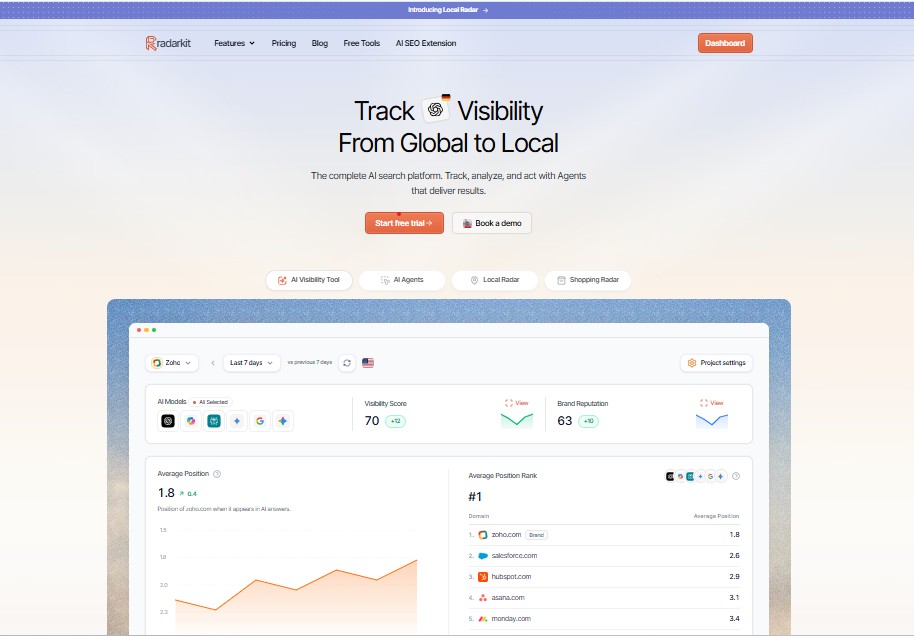
Radarkit is particularly useful for home service businesses because its Local Radar tracks how AI recommends local companies for city, neighborhood, and “near me” searches. It reports appearance rate, average position, rating, review count, and every other business AI recommends alongside yours.
Radarkit sends prompts to six AI engines through real chat interfaces and records the full response. It covers ChatGPT, Google AI Overviews, Google AI Mode, Perplexity, Gemini, and Copilot.
Radarkit Pricing
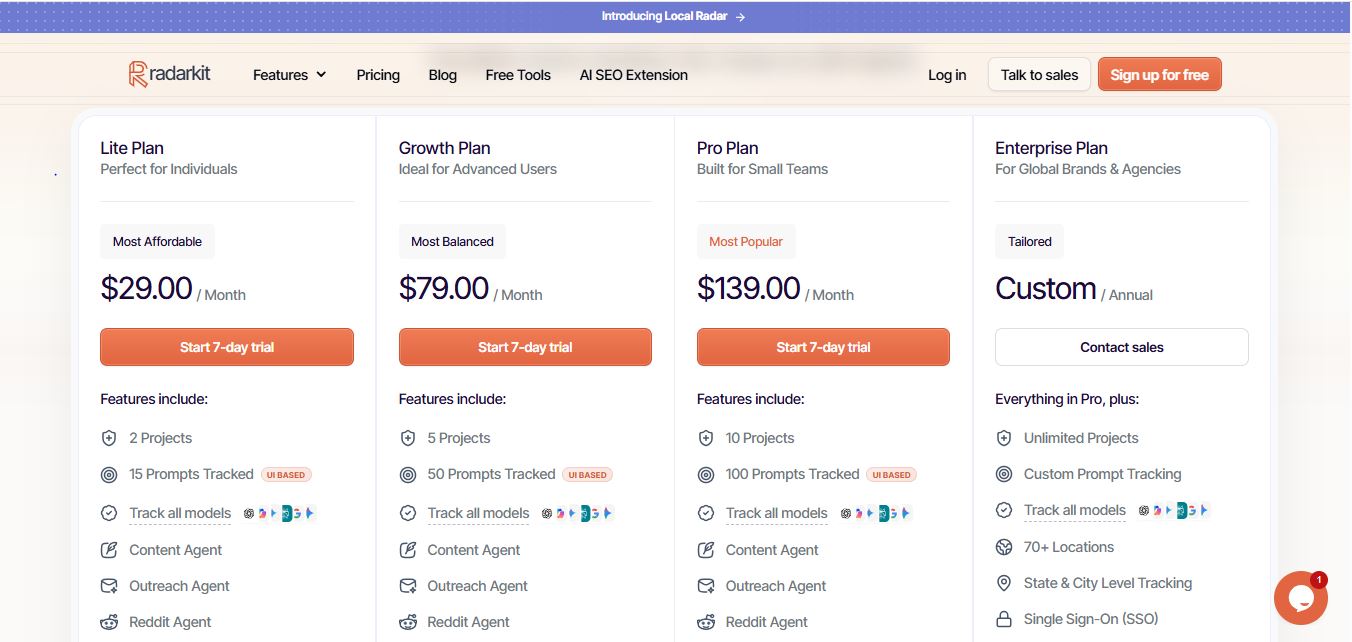
| Plan | Starting price | Projects | Prompts | Refresh | Locations |
|---|---|---|---|---|---|
| Lite | $29/month | 2 | 15 | Every 72 hours | 50+ |
| Growth | $79/month | 5 | 50 | Daily | 50+ |
| Pro | $139/month | 10 | 100 | Daily | 50+ |
| Enterprise | Custom annual pricing | Unlimited | Custom | Daily or weekly | 70+, with state and city tracking |
Every paid plan includes Local Radar, six AI engines, citation analysis, competitor tracking, API access, and a client portal. Radarkit also offers a 7-day free trial.
Why It Fits Home Services
For a plumber, HVAC company, roofer, electrician, or cleaning company, Radarkit can show:
- How often AI recommends your business for local service prompts
- Whether you appear above or below competitors
- Which competitors are named in the same AI answers
- How visibility differs across more than 50 countries and locations
- Which review, rating, and citation signals may affect recommendations
For example, a roofing company could track prompts such as “best roof repair company in Tampa,” “roofers near me,” and “emergency roof leak repair Tampa.” If a competitor appears in 7 of 10 AI answers while your company appears in only 2, you can prioritize reviews, local landing pages, citations, and service-specific content for that market.
FAQs
What is AI visibility for a home service business?
AI visibility is how often your business appears when customers ask AI platforms for local service recommendations. For example, if someone asks, “Who is the best HVAC repair company in Phoenix?” your goal is to be mentioned prominently in the answer.
Why should plumbers, HVAC companies, and roofers audit AI visibility?
Because homeowners increasingly use AI search before contacting a provider. If AI recommends competitors instead of your business, you can lose high-intent leads even if your website ranks well in traditional search.
How often should I audit AI visibility?
Run a full audit once, then review results monthly. Competitive markets and multi-location businesses benefit from weekly monitoring because AI answers, competitors, reviews, and citations can change quickly.
What prompts should a home service business track?
Track prompts that reflect real buying intent, such as “best plumber near me,” “emergency AC repair in Dallas,” “top-rated roofers in Tampa,” and “who should I call for a burst pipe?” Include every major service, city, neighborhood, and emergency scenario you want to win.
Which AI platforms should I check?
Monitor ChatGPT, Google AI Overviews, Google AI Mode, Gemini, Perplexity, and Copilot. These platforms can return different businesses, sources, and recommendations for the same local prompt.
Is AI recommending your brand?
Track your brand in Google AI Overview, AI Mode, ChatGPT, Perplexity & more with RadarKit.
No payment upfront. Cancel anytime.