How to Track Franchise AI Visibility: 5 Steps
On this page
Franchise AI visibility measures how often AI assistants recommend individual franchise locations, describe the brand accurately, and cite trusted sources when customers ask local buying questions. Because every franchisee operates in a different city and competes with different local businesses, tracking must be done by location—not only at the brand level.
A strong franchise tracking program gives headquarters a portfolio-wide view while giving each franchisee clear, location-specific actions.
How to Track Franchise AI Visibility: 5 Steps
Step 1: Standardize Brand and Location Data
Before tracking anything, create one source of truth for the franchise brand and every location. AI systems may mention the brand using different names, abbreviations, or local variations, so include all common brand aliases in your tracking setup.
For each franchise location, document:
- Official location name and parent brand
- Full address, phone number, and service area
- Google Business Profile link
- Location page URL
- Primary product or service categories
- Key competitors in that market
- Review profiles and major local directories
Keep this information consistent across the franchise website, Google Business Profiles, directories, and franchisee-run pages. Inconsistent data makes it harder for AI to understand and recommend the correct location.
Step 2: Build a Franchise Prompt Framework
Use a repeatable prompt structure that works across every franchise location. Change only the city, neighborhood, or store name so results remain comparable.
Start with these prompt types:
- Local discovery: “Best [franchise category] in [city].”
- Near-me intent: “Where can I get [product/service] near [neighborhood]?”
- Brand trust: “Is [Franchise Location] good for [customer need]?”
- Accuracy: “What are [Franchise Location]’s hours, address, and services?”
- Competitive: “Compare [Franchise Location] and [Local Competitor] for [category] in [city].”
Aim for 10–20 prompts per location at first. Include category, problem, comparison, and branded questions so you can see both discovery visibility and accuracy.
Step 3: Track Results by Location and AI Platform
Run each prompt across the AI platforms your customers use, such as ChatGPT, Gemini, Perplexity, Copilot, Google AI Mode, and Google AI Overviews. Use private or logged-out sessions, and repeat high-priority prompts at least three times because AI responses can vary.
For every prompt, record:
- Whether the franchise location was mentioned
- Its position in the AI recommendation
- Whether the brand website, location page, Google Business Profile, or reviews were cited
- Which local competitors appeared
- Whether the business details were accurate
- The sentiment of the description
- The third-party sources AI relied on
Organize the data by franchisee, city, region, prompt, AI platform, and date. This structure lets headquarters compare locations while still preserving the local context behind each result.
Step 4: Score Franchisees and Identify Gaps
Create a consistent scorecard so every franchisee is measured the same way. The goal is not to punish low-performing locations, but to identify where corporate support, local content, listings, or review generation can make the biggest difference.
Track these core metrics:
| Metric | What It Shows |
|---|---|
| Mention rate | How often the location appears in AI answers |
| Citation rate | How often AI cites the brand or location’s trusted sources |
| Average position | Where the location ranks among recommendations |
| Accuracy score | How often AI provides correct hours, address, services, and policies |
| Competitor share | How often local competitors are recommended instead |
| Source coverage | Whether AI cites the location page, reviews, and important directories |
Segment results by region, franchisee tenure, market size, and AI platform. A location may perform well in ChatGPT but poorly in Google AI Overviews, which usually points to a different content or citation gap.
Step 5: Create a Franchisee Action Plan
Turn each report into a short action plan with owners, deadlines, and measurable outcomes. The best franchise reports tell each franchisee exactly what to fix next—not just where they rank.
Common actions include:
- Correcting inaccurate hours, addresses, services, or product details.
- Improving the franchise location page with local FAQs, services, photos, and structured data.
- Updating Google Business Profiles and major local directories.
- Encouraging recent customer reviews on the platforms AI cites most often.
- Creating content for local questions where competitors currently win.
- Pursuing mentions in city guides, local media, community sites, and relevant roundups.
Run a baseline first, then review weekly for competitive markets or monthly for stable markets. Trends matter more than a single AI response, so keep the prompt set consistent unless you deliberately start a new baseline.
RadarKit for Franchise AI Visibility
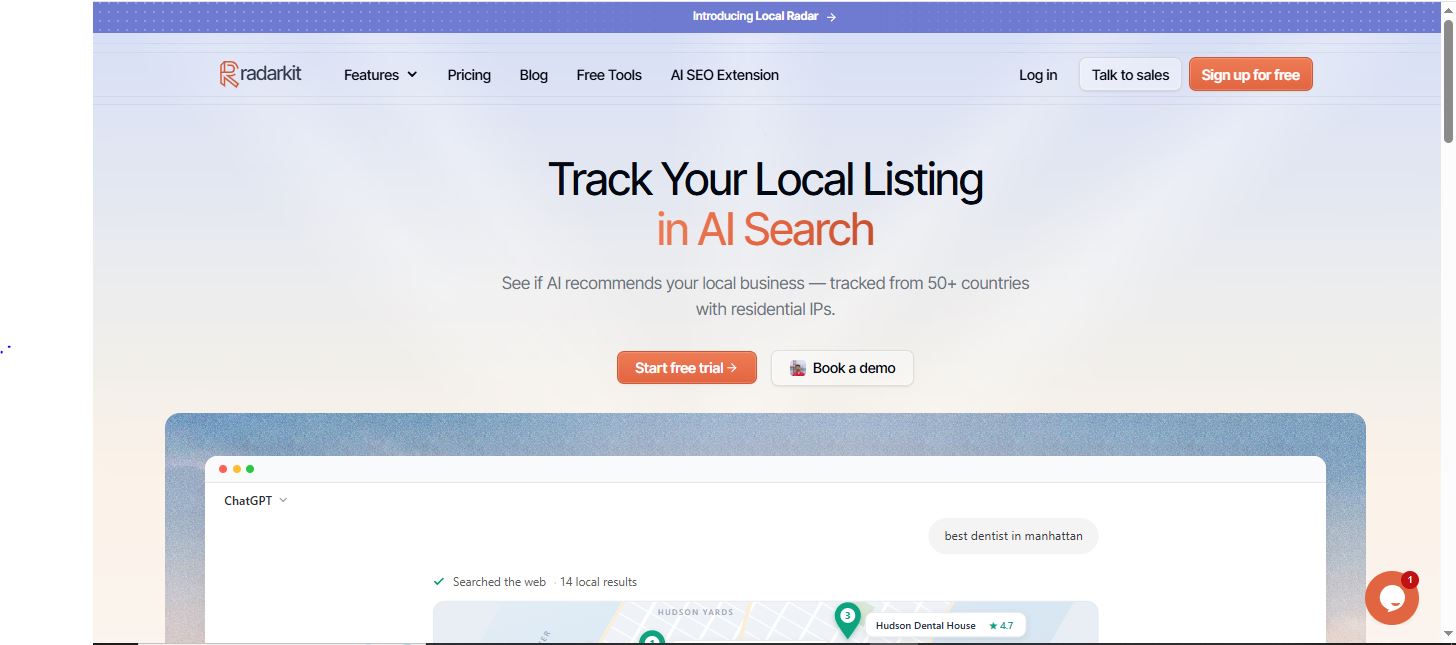
I personally use RadarKit for franchise AI visibility tracking because its Local Radar makes it easier to monitor location-level AI recommendations, competitor positions, ratings, review counts, and citation sources across multiple markets.
RadarKit tracks major AI surfaces, including ChatGPT, Gemini, Perplexity, Copilot, Google AI Mode, and Google AI Overviews. It runs prompts through residential IPs in selected cities, helping franchisors see the location-specific answers local customers are likely to receive.
Coverage and Starting Price
RadarKit’s standard plans include Local Radar coverage across 50+ countries. Enterprise extends coverage to 70+ locations and adds state- and city-level tracking, custom prompt tracking, unlimited projects, and API access.
| Plan | Starting Price | Best For |
|---|---|---|
| Lite | $29/month | Small franchise brands testing AI visibility with 2 projects and 15 prompts |
| Growth | $79/month | Growing franchises needing 5 projects and 50 tracked prompts |
| Pro | $139/month | Larger franchises tracking 10 projects and 100 prompts |
| Enterprise | Custom annual pricing | Multi-market franchises needing 70+ locations, custom tracking, and API access |
For a small franchise system, the $29/month Lite plan is a practical starting point. It includes Local Radar, local business tracking, competitor monitoring, and coverage across 50+ countries, with a 7-day free trial available.
FAQs
What is franchise AI visibility?
Franchise AI visibility is how often AI assistants mention, recommend, and accurately describe individual franchise locations when customers ask local questions. It includes both brand-level visibility and location-specific performance.
Why track AI visibility by franchise location?
AI answers change by city, neighborhood, competition, reviews, and local sources. A brand may be strong in one market but invisible in another, so location-level tracking reveals where franchisees need support.
Which prompts should franchises track?
Track local discovery, near-me, brand trust, accuracy, and competitor prompts. Examples include “best [franchise category] in [city],” “is [location] good for [need],” and “compare [location] and [competitor] in [city].”
How many prompts should each franchisee track?
Start with 10–20 prompts per location. Expand to 30 or more once you identify the questions that drive the most customer interest in each market.
How often should franchisors review AI visibility?
Run a baseline first, then review weekly for competitive markets or monthly for stable markets. Trends over time are more useful than one-off AI answers.
Is AI recommending your brand?
Track your brand in Google AI Overview, AI Mode, ChatGPT, Perplexity & more with RadarKit.
No payment upfront. Cancel anytime.