How to Audit a Hotel’s AI Visibility: 5 Steps
On this page
Travelers increasingly begin hotel research in AI tools such as ChatGPT, Gemini, Perplexity, Google AI Overviews, and Copilot. A hotel AI visibility audit shows whether your property appears in those recommendations, why competitors are chosen instead, and which fixes will improve your chances of being recommended.
This matters because many travelers now use AI to plan trips and begin booking journeys. Yet most hotels remain invisible in AI-generated recommendations, making visibility a major competitive gap.
What Hotel AI Visibility Means
AI visibility measures how often AI assistants mention, recommend, or position your hotel when travelers ask discovery questions such as “best family hotels in Orlando” or “pet-friendly hotels near downtown Austin.” Unlike traditional search, AI often returns only a short list of hotels, so missing that list can remove your property from consideration entirely.
AI systems use signals from guest reviews, OTA listings, local business profiles, hotel websites, travel guides, and third-party editorial content. Consistency and trust across these sources are critical: hotels with comprehensive, high-trust, multisource information are more likely to be favored by recommendation algorithms.
How to Audit a Hotel’s AI Visibility: 5 Steps
Step 1: Build a Real Guest Prompt Set
Create 30–50 prompts based on how guests actually research hotels. Do not limit your audit to branded searches; include discovery-stage questions asked before a guest knows which hotel to choose.
| Prompt category | Examples |
|---|---|
| Destination discovery | “Best boutique hotels in Lisbon,” “top luxury resorts in Bali” |
| Location-based | “Hotels near Disneyland with free shuttle,” “hotels near Mumbai airport with early check-in” |
| Guest-need based | “Pet-friendly hotels in Austin with free parking,” “romantic hotels in Paris with Eiffel Tower views” |
| Audience-based | “Best family resorts in Cancun,” “business hotels in Singapore near Marina Bay” |
| Comparison prompts | “Is [Hotel A] better than [Hotel B] in Chicago?” “Best alternative to [Competitor Hotel] in Dubai” |
For each prompt, record the destination, guest intent, expected competitors, priority amenities, and the booking channel you want to influence. This creates a repeatable benchmark rather than a one-time test.
Step 2: Test Prompts Across AI Engines
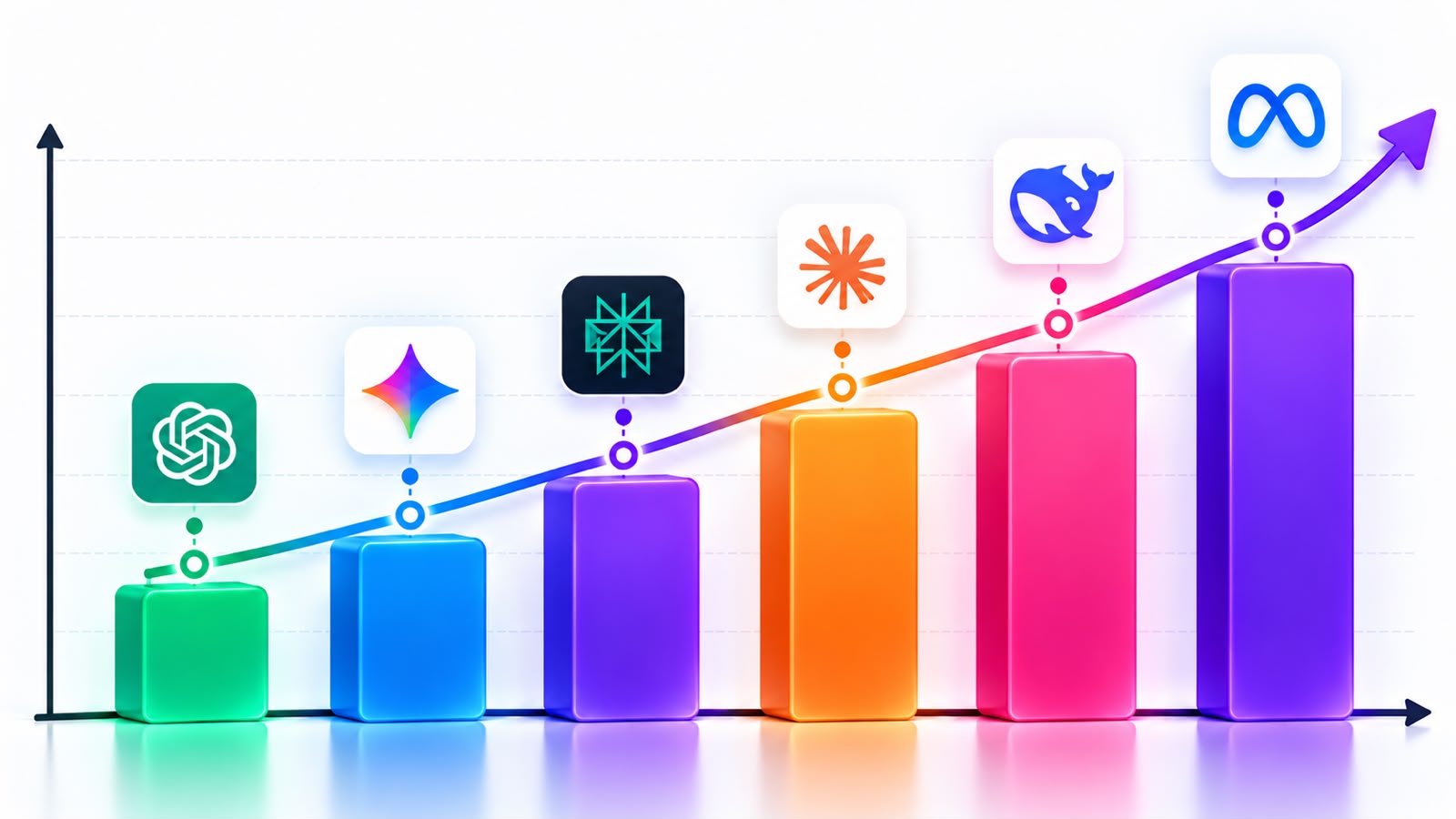
Run the same prompts across major AI surfaces:
- ChatGPT
- Gemini
- Perplexity
- Google AI Overviews
- Google AI Mode
- Microsoft Copilot
Results differ by platform. In one hotel AI visibility study, Gemini named hotels in 64.6% of searches, Google AI Mode in 64.5%, ChatGPT in 63.5%, Google Maps in 56.4%, and Google AI Overviews in 10.4%.
For every response, capture:
| Metric | What to record |
|---|---|
| Mention rate | Whether your hotel appears |
| Position | Where it appears in the recommendation list |
| Context | Whether it is recommended, listed, or compared |
| Competitors | Which hotels appear instead or above you |
| Citations | Which websites support the answer |
| Accuracy | Whether amenities, policies, and location details are correct |
Calculate a simple baseline:
\text{AI Visibility Score} = \frac{\text{Prompts where hotel appears}}{\text{Total priority prompts}} \times 100If your hotel appears in 12 of 40 priority prompts, your visibility score is 30%.
Step 3: Audit the Sources AI Trusts
When your hotel is missing, look beyond your website. AI systems often rely heavily on third-party evidence, especially reviews and booking platforms.
One study found ChatGPT named 83.8% of hotels with 2,500 or more Google reviews, compared with 52.1% of hotels with fewer than 50 reviews. Booking sites represented 34.6% of ChatGPT citations and 69.2% of Gemini citations, while hotel chain websites represented only 6.9% and 7.9% respectively.
Audit these sources:
- Google Business Profile: Categories, attributes, photos, services, location accuracy, and review responses.
- OTAs: Booking.com, Expedia, Agoda, Hotels.com, and regional booking platforms.
- Review platforms: TripAdvisor, Google Reviews, Yelp, and local review sites.
- Hotel website: Room types, dining, parking, accessibility, airport transfers, pet policy, and meeting spaces.
- Local coverage: Tourism boards, travel blogs, local directories, and “best hotels in…” articles.
- Social proof: Guest photos, influencer mentions, and recent destination-specific coverage.
If AI repeatedly cites a competitor’s travel-guide feature or detailed OTA listing, treat that as a distribution and credibility gap—not only a website SEO issue.
Step 4: Fix the Gaps That Block Recommendations
Prioritize fixes based on their likely impact on AI recommendations.
Make hotel data consistent
Ensure your hotel name, address, phone number, amenities, policies, and room details match across your website, Google Business Profile, OTAs, and review platforms. Conflicting information—such as “free airport shuttle” on your site but not on booking platforms—can reduce AI trust.
Improve review volume and quality
Request reviews after positive guest moments, respond to recent feedback, and address recurring complaints. Review volume and recency strongly influence AI visibility; hotels with more Google reviews are named far more often in ChatGPT responses.
Create AI-friendly content
Build dedicated pages for high-intent topics:
- “Hotels near [landmark]”
- “Pet-friendly hotel in [city]”
- “Hotel with airport shuttle in [city]”
- “Family rooms in [destination]”
- “Romantic hotel packages in [destination]”
- “Meeting and event hotel in [city]”
Use clear headings, concise answers, structured amenities, FAQs, and links to booking pages. Avoid hiding important information in images, sliders, or PDFs.
Earn third-party mentions
Pitch tourism boards, local publications, travel writers, niche blogs, and relevant roundup articles. Because AI often cites OTA and editorial sources more than hotel-owned pages, off-site credibility is essential.
Step 5: Track Results Monthly
AI answers change frequently, so repeat the audit monthly—or weekly for highly competitive destinations and seasonal markets.
Track:
- Mention rate by AI platform
- Average position when mentioned
- Share of voice versus competitors
- Most-cited sources
- Prompt categories where visibility is declining
- Changes after content, review, listing, or citation improvements
- AI-referral traffic, branded search demand, direct bookings, and OTA conversions
AI visibility can influence demand even when the booking happens later. Travelers who prompt ChatGPT about a hotel are more than twice as likely to visit its website within seven days, and AI-influenced traffic often returns through branded search before booking.
Using Radarkit for Hotel AI Visibility
Manual testing is useful for one property, but hotel groups and agencies need repeatable tracking across cities, languages, and AI platforms. Radarkit is an AI search visibility platform that tracks brand and local-business visibility across ChatGPT, Google AI Overviews, Google AI Mode, Gemini, Perplexity, and Microsoft Copilot.
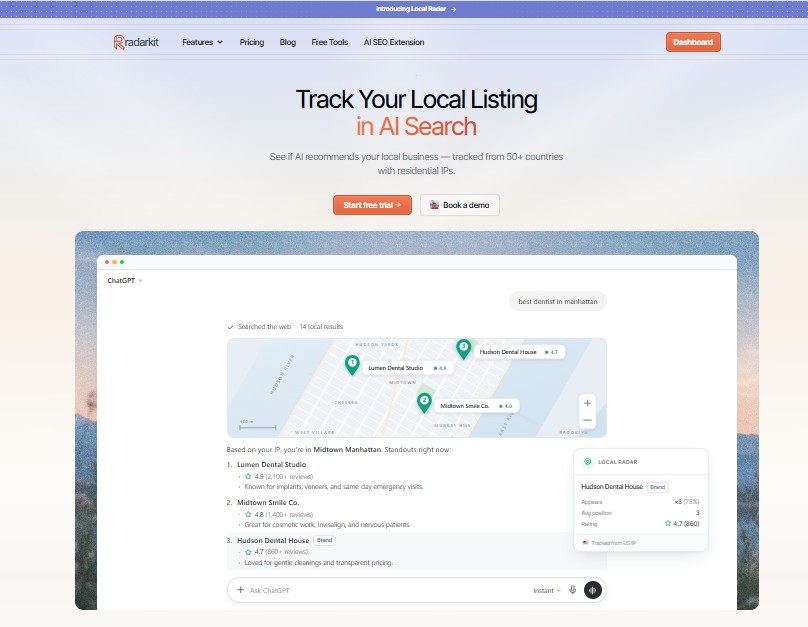
Radarkit’s Local Radar helps hotels monitor:
- Whether AI recommends the hotel in a specific city or neighborhood
- Appearance rate and average position in AI answers
- Competitor hotels recommended instead
- Review ratings, review counts, and local ranking signals
- Citation sources behind each recommendation
- Visibility changes by country, city, and prompt type
Radarkit Pricing
Radarkit’s Lite plan starts at $29 per month. Growth starts at $79 per month, Pro at $139 per month, and Enterprise pricing is custom.
| Plan | Starting price | Best suited for |
|---|---|---|
| Lite | $29/month | One hotel testing AI visibility and local recommendations |
| Growth | $79/month | Independent hotels tracking more prompts and competitors |
| Pro | $139/month | Multi-property groups and agencies |
| Enterprise | Custom pricing | Hotel chains, management companies, and large portfolios |
The Lite plan includes AI visibility tracking, Local Radar, local business tracking, competitor monitoring, AI traffic analytics, API access, and 50+ locations.
Local Radar in 50+ Countries
Radarkit’s Local Radar supports hotel AI visibility tracking in 50+ countries, while Enterprise plans expand coverage to 70+ locations. It uses residential IP geotargeting, so you can see the AI answer a traveler would receive in a particular market.
This is valuable because hotel recommendations can vary by geography. A traveler in the United States asking about “best hotels near the Eiffel Tower” may see different recommendations and citations than a traveler asking from India, Germany, Brazil, or the UAE.
FAQs
What is hotel AI visibility?
Hotel AI visibility is the degree to which AI assistants mention, recommend, or position your hotel when travelers ask relevant questions. It includes both whether you appear and where you appear in the answer.
How is AI visibility different from Google rankings?
Google rankings show where your website appears in search results. AI visibility shows whether AI tools include your hotel in conversational recommendations, often alongside competitors and cited sources. A hotel can rank well in Google but still be absent from AI-generated shortlists.
Which AI platforms should hotels track?
Start with ChatGPT, Gemini, Perplexity, Google AI Overviews, Google AI Mode, and Microsoft Copilot. Coverage matters because visibility varies significantly by platform; one study found hotel mentions in 64.6% of Gemini searches but only 10.4% of Google AI Overview searches.
How many prompts should a hotel audit?
Use 30–50 prompts for a single hotel. A larger hotel group should expand the set by destination, guest type, language, and competitor category so results can be compared across properties.
How often should a hotel audit AI visibility?
Run a full audit monthly. For competitive city-center markets, resort destinations, or during peak booking seasons, weekly tracking is better because AI answers and competitor positioning can change quickly.
Do reviews affect AI hotel recommendations?
Yes. Review volume, ratings, recency, and response quality are important trust signals. Research found ChatGPT named 83.8% of hotels with 2,500+ Google reviews versus 52.1% of hotels with fewer than 50 reviews.
Do OTAs help hotels appear in AI answers?
Yes. Booking platforms are major citation sources for AI systems. In one study, booking sites accounted for 34.6% of ChatGPT citations and 69.2% of Gemini citations, so accurate and complete OTA listings are essential.
What should a hotel fix first?
Start with data consistency: correct your Google Business Profile, OTA listings, website amenities, policies, and review responses. Then improve review volume, create location and amenity pages, and pursue relevant third-party mentions.
Can a small independent hotel compete with large chains?
Yes. Independent hotels can compete by being highly specific: strong local reviews, detailed amenity pages, accurate listings, unique experiences, and coverage in local travel content. AI often rewards clarity, relevance, and trust—not just brand size.
What is Radarkit’s starting price?
Radarkit starts at $29 per month for the Lite plan. Higher tiers include Growth at $79 per month, Pro at $139 per month, and custom Enterprise pricing.
Does Radarkit support hotel tracking in multiple countries?
Yes. Radarkit’s Local Radar supports tracking in 50+ countries, with Enterprise plans expanding coverage to 70+ locations. This helps hotels understand how AI recommendations differ by traveler market.
How long does it take to improve AI visibility?
Some improvements, such as correcting listing data or adding clear amenity pages, can show impact within weeks. Review growth, third-party citations, and stronger AI recommendation placement usually take one to three months of consistent work.
Final Takeaway
A hotel does not need to be famous to appear in AI recommendations—but it must be clear, consistent, well-reviewed, and present in the sources AI trusts. Audit your prompts, measure mention rate and position, repair inconsistent data, strengthen reviews and third-party credibility, and track results monthly. Radarkit makes this scalable starting at $29/month, with Local Radar coverage across 50+ countries.
Is AI recommending your brand?
Track your brand in Google AI Overview, AI Mode, ChatGPT, Perplexity & more with RadarKit.
No payment upfront. Cancel anytime.