5 Local Prompts for Real Estate AI Tracking

On this page
Local AI tracking starts with the exact questions buyers, sellers, renters, and investors ask AI assistants about a specific city, neighborhood, or property type. These five prompts help a real estate agency measure whether it is mentioned, cited, recommended, and positioned ahead of local competitors.
Real estate is location-specific: an agency may be recommended in one neighborhood but absent from another, even within the same city. Tracking prompts that include a real location and buyer intent reveals which local markets, services, and competitor comparisons need attention.
Run each prompt in ChatGPT, Gemini, Perplexity, Claude, and Google AI Mode or AI Overviews. Record whether your agency is named, whether your website is cited, which competitors appear, where you rank in any list, and whether the information is accurate.
5 Local Prompts for Real Estate AI Tracking
1. Agent Recommendation Prompt
Use this prompt to measure whether AI recommends your agency for a high-intent local buyer or seller.
“Who are the best real estate agents in [neighborhood], [city] for [first-time buyers / luxury homes / sellers / investors]?”
This is one of the most valuable prompts because it reflects a prospect actively looking for an agent. Track your mention rate, rank in the recommendation list, and the competitors named alongside you.
What to watch for: Your agency’s absence, a competitor appearing above you, or AI citing portals and review sites instead of your own website.
2. Neighborhood Expertise Prompt
Use this prompt to test whether AI sees your agency as a credible local market expert.
“What are the best neighborhoods in [city] for [families / young professionals / retirees / investors], and which real estate agencies know these areas well?”
This prompt connects neighborhood research with agency discovery. It is especially useful for agencies that publish local guides, market reports, school information, commute details, and lifestyle content.
What to watch for: Whether AI cites your neighborhood pages, market reports, or local content—and whether competitors are positioned as the local experts instead.
3. Property Search Prompt
Use this prompt to measure visibility for buyers searching for a specific property type and budget.
“Where can I find [apartments / villas / townhouses / waterfront homes] for sale in [city or neighborhood] under [price range]?”
This prompt is useful because it combines location, property type, price intent, and search-platform discovery. It shows whether AI recommends your listings, your website, or a competing portal.
What to watch for: Whether your listing pages are cited, whether portals dominate the answer, and whether your agency is mentioned as a source of local inventory.
4. Agency Comparison Prompt
Use this prompt to understand how AI compares your agency with direct local competitors.
“Compare [Your Agency] and [Competitor Agency] for [luxury homes / rentals / commercial property / relocation] in [city or neighborhood].”
Comparison prompts reveal competitive positioning, sentiment, and the sources AI uses to form its judgment. They are particularly important when a competitor consistently appears in recommendation answers but your agency does not.
What to watch for: Incorrect claims, missing credentials, negative framing, outdated service areas, and missing citations to your agency’s website or reviews.
5. Reputation and Review Prompt
Use this prompt to monitor how AI describes your reputation and client experience.
“Is [Your Agency Name] a trusted real estate agency in [city]? What do reviews say about [Your Agency Name]?”
This prompt helps you catch reputation issues before they affect leads. AI may pull from Google reviews, directories, news coverage, social profiles, and third-party real estate platforms, so consistency across those sources is essential.
What to watch for: Whether AI accurately describes your specialties, service areas, licensing, client feedback, and recent transactions.
How to Track the Results
For every prompt, run it at least three times in each AI platform and log the results in a simple scorecard. AI answers can vary between runs, so repeated testing gives a more reliable view of visibility.
| Metric | Why it matters |
|---|---|
| Mention rate | Shows how often your agency appears at all. |
| Citation rate | Shows whether AI links to your website or content. |
| Recommendation rate | Shows whether AI includes you in a shortlist. |
| Average position | Shows how competitive your placement is. |
| Competitor overlap | Shows which rivals appear in the same answers. |
| Sentiment | Shows whether AI describes your agency positively, neutrally, or negatively. |
| Accuracy | Shows whether AI has correct business and service information. |
Start with these five prompts for each city, neighborhood, and office you serve. Once you identify the biggest gaps, expand into more granular prompts for specific property types, price ranges, languages, relocation needs, and investment queries.
Radarkit for Local Prompt Tracking
RadarKit is well suited to tracking these local prompts across multiple cities and countries. Its Local Radar monitors AI visibility using real-browser sessions and real-user 4G private proxies, helping agencies see results as local customers experience them.
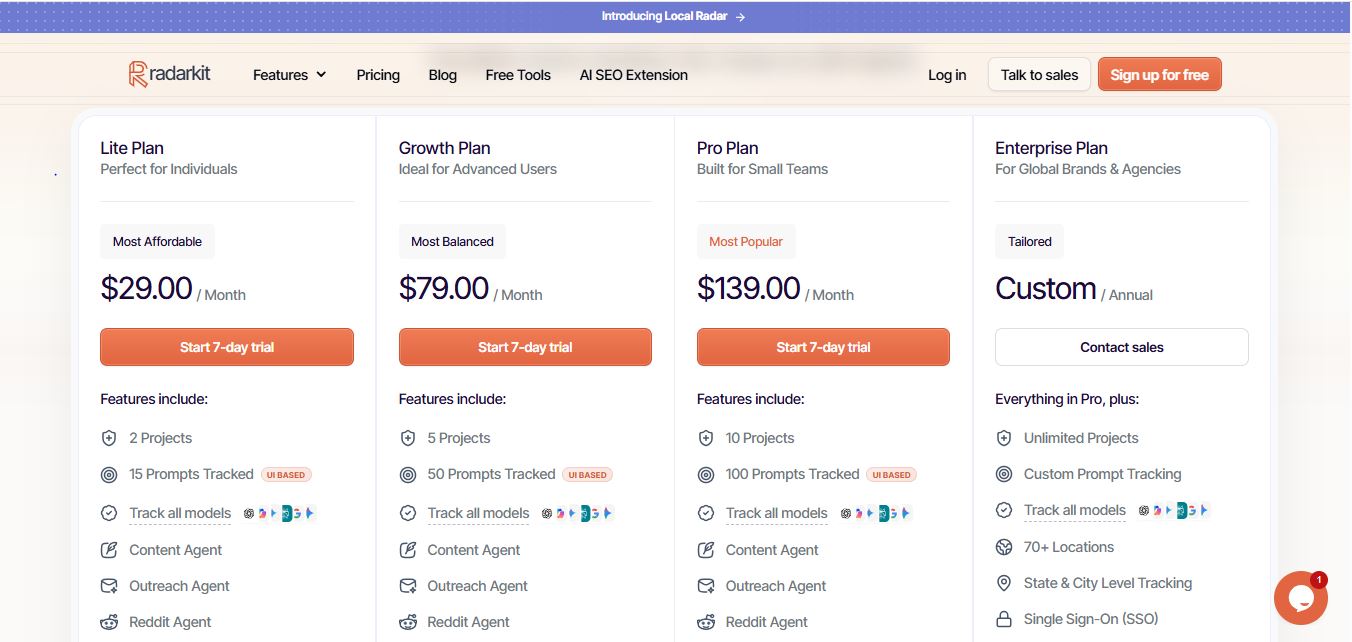
RadarKit tracks brand mentions, citations, rankings, sentiment, competitors, and full AI responses across 50+ countries and locations. Its starting price is $29/month, making it a practical option for real estate agencies that want recurring local AI visibility tracking rather than occasional manual checks.
FAQs
What are local AI tracking prompts?
Local AI tracking prompts are real customer-style questions that include a city, neighborhood, property type, budget, or service need. They show how AI assistants describe and recommend real estate agencies in a specific market.
Why should real estate agencies track AI prompts?
Because buyers and sellers increasingly use AI to research agents, neighborhoods, listings, and market conditions. Tracking prompts helps agencies see whether they are visible when prospects ask high-intent questions.
Which AI platforms should we test?
Start with ChatGPT, Gemini, Perplexity, Claude, Google AI Overviews, and Google AI Mode. Different platforms may name different competitors and cite different sources.
How often should we run these prompts?
Run priority prompts at least monthly, and test important prompts three times per platform. AI answers can vary, so repeated testing gives a more reliable visibility score.
What should we record for each prompt?
Record the date, platform, location, prompt, whether your agency was mentioned, whether your website was cited, competitors named, your position, sentiment, and accuracy.
Is AI recommending your brand?
Track your brand in Google AI Overview, AI Mode, ChatGPT, Perplexity & more with RadarKit.
No payment upfront. Cancel anytime.