

Surfer SEO Alternatives for Agencies can mean two different things. Some teams want another place to write and optimize pages. Others want to know whether those pages help a client appear in ChatGPT, Google AI Overviews, Perplexity, and other AI answers.
This list focuses mainly on the second need. The tools below help agencies track prompts, brand mentions, citations, competitors, and, in some cases, AI crawler activity. When comparing Surfer SEO Alternatives for Agencies, keep that distinction in mind: an AI visibility platform may add an important service without replacing every part of Surfer’s writing workflow.
Best Surfer SEO alternatives at a glance
Prices below are starting prices shown on vendor pages in September 2026. They refer to different products and billing terms, so check the pricing notes in each review before comparing costs.
| Tool | Best for | Starting price |
| Radarkit AI | AI visibility tracking, content actions, and client reporting | $29/month |
| SE Ranking (SE Visible) | Dedicated AI visibility with an option to use SE Ranking for SEO | SE Visible: $99/month |
| Promptwatch | Prompt tracking and AI crawler insights | $95/month |
| Profound | Enterprise AI search analysis | Custom ongoing pricing; free seven-day trial |
| Scrunch AI | AI agent traffic and agent-focused site delivery | $300/month, month-to-month |
| Peec AI | AI share-of-voice and agency reporting | Check current agency pricing |
| OtterlyAI | Brand mentions, citations, and GEO audits | $29/month |
| Semrush AI Visibility Toolkit | AI visibility within a Semrush workflow | Toolkit: $99/month |
| Ahrefs Brand Radar | Broad AI visibility research | Brand Radar AI: from $199/month |
| Nightwatch | Rank tracking alongside AI visibility | From €79/month, billed yearly |
This table makes it easier to narrow down Surfer SEO Alternatives for Agencies, but price alone will not tell you which one fits. A five-client team needs to check project limits, prompt allowances, reporting access, and the AI platforms included in each plan.
10 Best Surfer SEO Alternatives for Agencies
The useful question is not simply which tool tracks the most AI platforms. It is which one fits the work your agency sells. A client may need a monthly visibility report, a content plan based on citations, a technical review of AI crawler access, or one dashboard for SEO and AI search.
The reviews below separate those jobs. The pros and cons describe practical fit and plan limits, not hands-on test results.
Radarkit AI: Best for agency AI visibility tracking
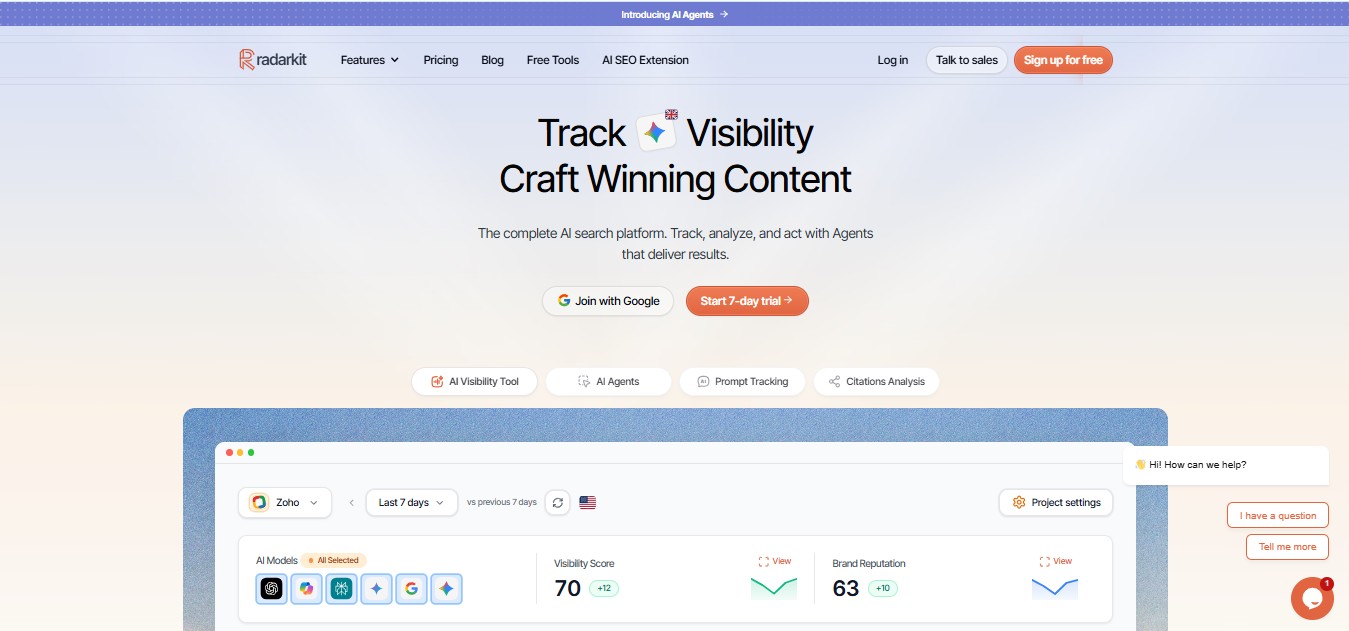
Radarkit brings AI visibility data and follow-up work into the same workflow. It monitors responses through the user-facing interfaces of ChatGPT, Google AI Mode, Google AI Overviews, Microsoft Copilot, Gemini, and Perplexity, then helps teams examine the prompts and sources behind a client’s results.
That practical link between measurement and action makes Radarkit one of the most relevant Surfer SEO Alternatives for Agencies building an AI search service. A strategist can find a buying question where a client is absent, review the sources appearing in answers, and turn the finding into a content or outreach task. Client reporting stays connected to the same work.
Key features
- AI visibility tracking: Track your brand’s presence in AI-generated responses across ChatGPT, Perplexity, Gemini, Copilot, Google AI Mode, and Google AI Overviews.
- Prompt tracking: Monitor important commercial, informational, comparison, local, product, and category-based prompts relevant to your business.
- Competitor share of voice: Compare your brand’s visibility with competitors and see how frequently each brand appears across your tracked prompts.
- Citation analysis: Discover the domains and specific URLs that AI platforms cite, allowing you to examine which pages are earning those mentions.
- Citation-type analysis: Analyze the types of content AI platforms reference, including listicles, reviews, guides, forums, product pages, communities, and other sources.
- Query fan-out data: Explore related searches and follow-up queries generated around your main AI prompts to uncover additional content opportunities.
- Local and country tracking: Track AI visibility across 50+ locations on standard plans, with expanded city and state-level tracking available for enterprise users.
- AI traffic analytics: Connect AI visibility insights with website traffic data to understand how AI search exposure relates to performance.
- Content Agent: Turn visibility insights into article ideas, content briefs, optimization recommendations, and improvements based on the data collected.
- Outreach Agent: Discover potential citation, backlink, and publisher opportunities using competitor research and source analysis.
- Reddit Agent: Find relevant Reddit conversations and support workflows focused on communities that can influence AI visibility.
- Chat Agent: Interact with your tracked data through quick questions and discover opportunities without manually reviewing multiple reports.
- Google Search Console integration: Combine Google Search Console performance data with your AI visibility research for a broader view of search performance.
- Google Analytics integration: Analyze website traffic alongside AI search visibility to better understand the impact of AI-driven discovery.
- WordPress integration: Connect your content workflow with WordPress to make publishing and content management easier.
- Client Portal: Provide clients with access to selected reports and insights while keeping your internal workspace private.
- Branded PDF reporting: Generate professional, agency-ready PDF reports using the reporting allowances available with your plan.
- MCP and API access: Connect Radarkit data with custom workflows, dashboards, reports, and compatible AI-powered tools.
Pricing
Lite costs $29/month for two projects and 15 tracked prompts, with checks every 72 hours. Growth costs $79/month for five projects and 50 prompts, while Pro costs $139/month for 10 projects and 100 prompts. Growth and Pro list daily checks; Enterprise has custom pricing and limits.
For agencies comparing Surfer SEO Alternatives for Agencies on cost, the project allowance matters as much as the entry price. Lite offers room for a small number of accounts; Growth and Pro give teams more capacity for ongoing client reporting.
Pros and Cons
| Pros | Cons |
| Combines tracking, citation research, actions, and client reporting. | Lite refreshes every 72 hours rather than daily. |
| Includes six named AI search experiences across standard plans. | Agencies with larger client portfolios may need Pro or a custom plan. |
| Offers a low starting price for a multi-project agency workflow. | Prompt allowances should be mapped to each client before choosing a plan. |
Best for
Agencies building an AI visibility service that includes tracking, content recommendations, and regular client reporting. Growth is a practical starting point if daily updates matter; Pro offers more room for clients and prompts.
SE Ranking (SE Visible): Best for combining SEO and AI visibility workflows
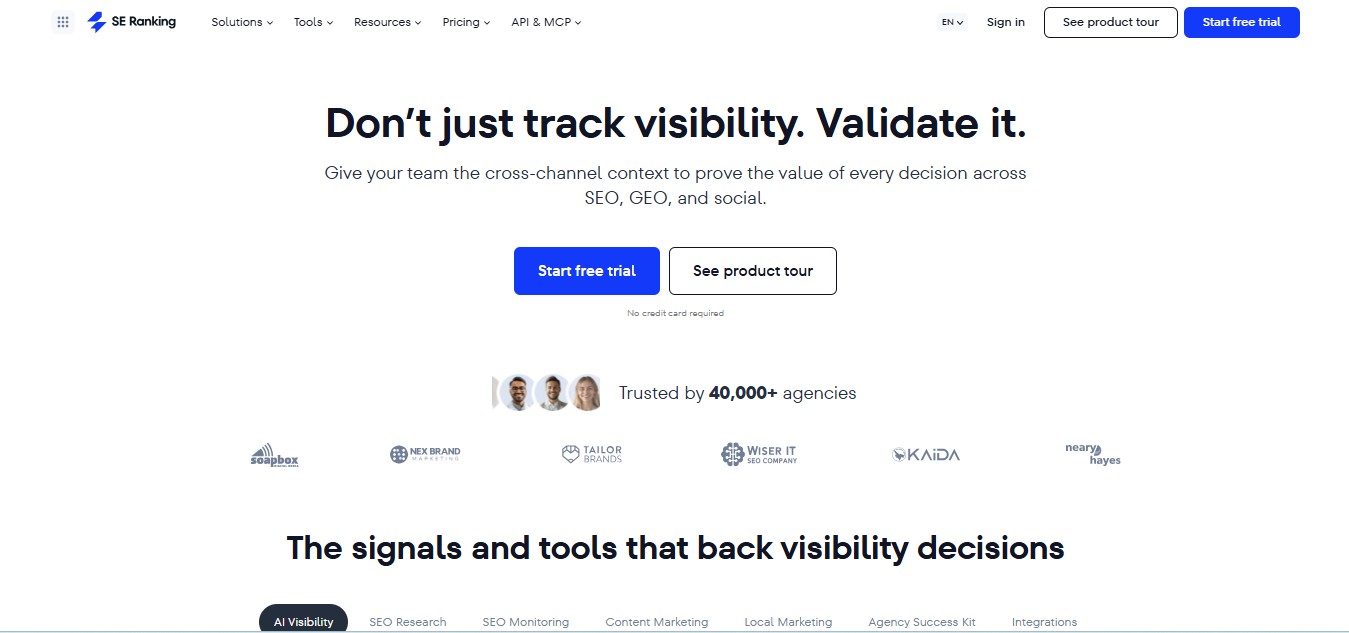
There are two products to keep straight here. SE Visible is SE Ranking’s dedicated AI visibility platform. The main SE Ranking subscription covers a broader SEO and GEO workflow, including rank tracking, research, audits, and prompt tracking. They have different prices and plan limits.
That difference is important when evaluating Surfer SEO Alternatives for Agencies. SE Visible helps an agency study how client brands appear in AI answers. The wider SE Ranking platform is relevant when the team also wants to manage conventional SEO tasks under the same vendor. ar view of how several client brands appear across the same set of AI experiences.
Key features
- Daily AI response tracking: Recheck selected prompts across five supported experiences.
- Competitor benchmarking: Compare brand visibility and sentiment on the prompts and topics that matter to a client.
- Source analysis: Find the domains and URLs AI answers cite, then review them by topic or engine.
- Multi-client management: Keep brands in separate projects and use dashboards to discuss progress.
- SEO suite option: SE Ranking’s main plans add conventional rank tracking, keyword research, website audits, and GEO features.
Pricing
SE Visible Basic costs $99/month for 200 prompts and three projects. Core is $189/month for 450 prompts and five projects; Plus is $355/month for 1,000 prompts and 10 projects. These are the monthly prices displayed on the SE Visible site.
The separate SE Ranking subscription starts at $129/month for Core and $279/month for Growth on monthly billing. Its pricing page also lists an AI Search add-on at $89/month. Do not assume that an SE Visible subscription includes the main SE Ranking suite, or that SE Ranking’s Agency Pack applies to SE Visible.
Pros and Cons
| Pros | Cons |
| Clear prompt and project allowances on SE Visible plans. | SE Visible and SE Ranking require a careful product-by-product price comparison. |
| Useful source and competitor views for client conversations. | SE Visible lists coverage for seven countries and five languages. |
| Option to build a broader SEO and AI search workflow with SE Ranking. | SE Ranking’s Agency Pack does not currently extend to SE Visible. |
Best for
SE Visible suits agencies that want a focused AI visibility dashboard. The main SE Ranking product is worth considering when the agency also needs a broader SEO toolkit. Among Surfer SEO Alternatives for Agencies, this pairing works best when the team is clear about which product will deliver each client service.
Promptwatch: Best for prompt tracking and AI crawler insights
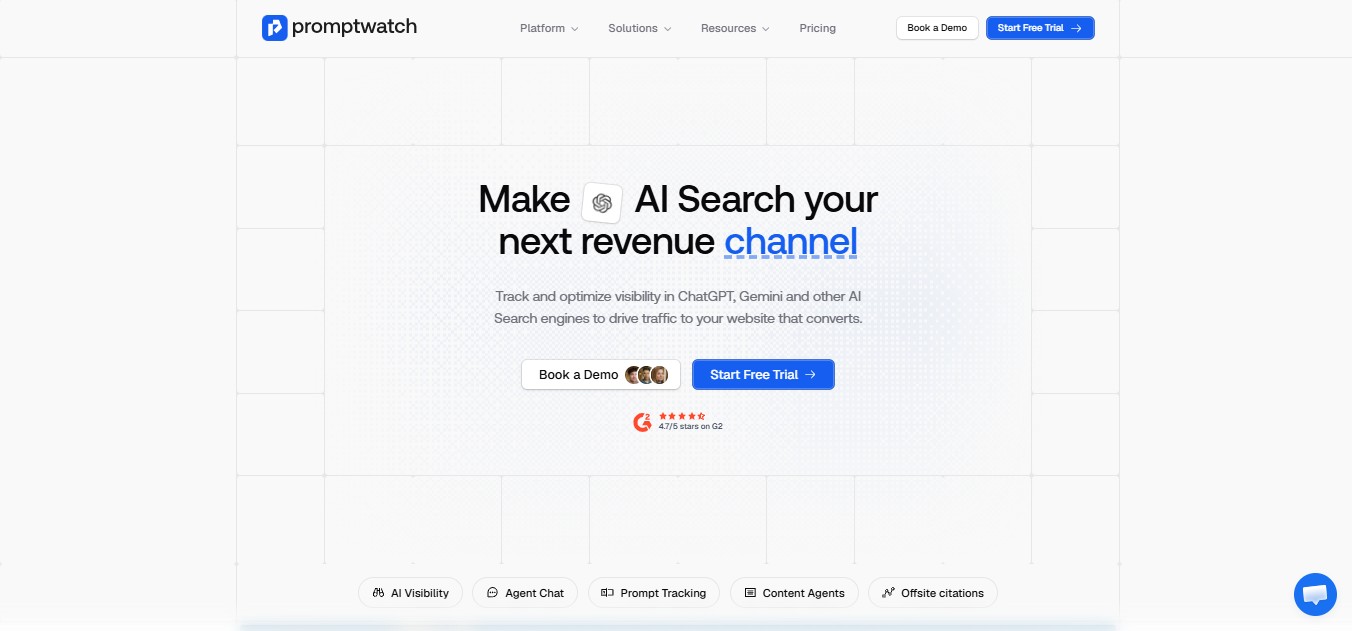
Promptwatch joins two views that are often reviewed separately: what an AI assistant says about a client, and what AI crawlers do on the client’s website. It tracks prompt-level visibility and citations, while its Agent Analytics features examine crawler visits and page activity.
For an agency, that can lead to a useful sequence of questions. Is a page accessible to an AI crawler? Does it appear in cited sources? Is the client mentioned in the resulting answer? Promptwatch also offers content gap analysis and agents for turning findings into briefs or articles.
Key features
- Prompt monitoring: Follow mentions, visibility, sentiment, and share of voice across selected AI models.
- Crawler analytics: Examine which AI agents request client pages and monitor crawler activity.
- Citation and off-site analysis: Review the third-party sources, including community and video sources, that influence tracked answers.
- Content gap workflow: Identify unanswered prompts and build briefs or content around measured gaps.
- API and MCP access: Listed on its paid brand plans for teams building reporting workflows.
Pricing
Promptwatch lists brand plans at $95/month for Essential, $245/month for Professional, and $579/month for Business. They include one, two, and five projects respectively, with 50, 150, and 350 prompts. Its pricing page also has an agency view, so agencies should check that offer before treating the brand plans as their final cost.
Pros and Cons
| Pros | Cons |
| Connects AI answers with crawler and citation data. | The entry plan includes one project. |
| Offers content-oriented next steps alongside monitoring. | Higher project and prompt volumes require higher tiers. |
| Supports technical and editorial teams working on the same client. | Agency-specific pricing should be checked separately from brand pricing. |
Best for
Promptwatch is a good fit when an agency’s AI search service includes technical reviews of crawler access as well as prompt reporting. Among Surfer SEO Alternatives for Agencies, its crawler view is especially useful when a client asks why existing pages are not appearing in AI answers.
Profound: Best for enterprise AI search analysis
Profound is designed for organizations running AI search analysis across brands, regions, and teams. Its Answer Engine Insights product tracks visibility, citations, sentiment, and competitor presence, while FactCheck helps identify claims about a brand that need review.
Its broader platform also includes Prompt Volumes, agent workflows, and centralized client management for agency partners. That scope makes Profound a sensible option when AI visibility is a substantial service line rather than an occasional report.
Key features
- Answer Engine Insights: Compare brand presence, sentiment, citations, and competitors across tracked AI answers.
- FactCheck: Identify claims about a client’s brand and the sources associated with them.
- Prompt Volumes: Explore the questions people ask AI platforms to inform what an agency tracks.
- Agents and shared workspaces: Build repeatable work around research, content, and reporting.
- Enterprise controls: The listed Enterprise package includes tailored tracking, API access, SSO, and support options.
Pricing
Profound’s current public pricing page shows a free seven-day trial with 50 unique prompts checked daily across ChatGPT, Gemini, and Google AI Overviews. Ongoing Enterprise pricing is custom. The page mentions an Agency Growth offering but does not provide a clear current public price for it, so an agency should request a quote rather than rely on an older figure.
Pros and Cons
| Pros | Cons |
| Detailed analysis of brand presence, sources, and accuracy. | Ongoing pricing requires a quote. |
| Agency portal and enterprise-oriented collaboration. | Trial limits are much narrower than the tailored Enterprise package. |
| Prompt research and agent workflows can support a large service team. | A smaller agency may need fewer platform and governance features. |
Best for
Profound fits agencies serving larger organizations that need tailored AI search analysis and shared workflows. It is one of the Surfer SEO Alternatives for Agencies to examine when the client engagement calls for enterprise-level depth rather than a lightweight monitoring plan.
Scrunch AI: Best for AI agent analytics
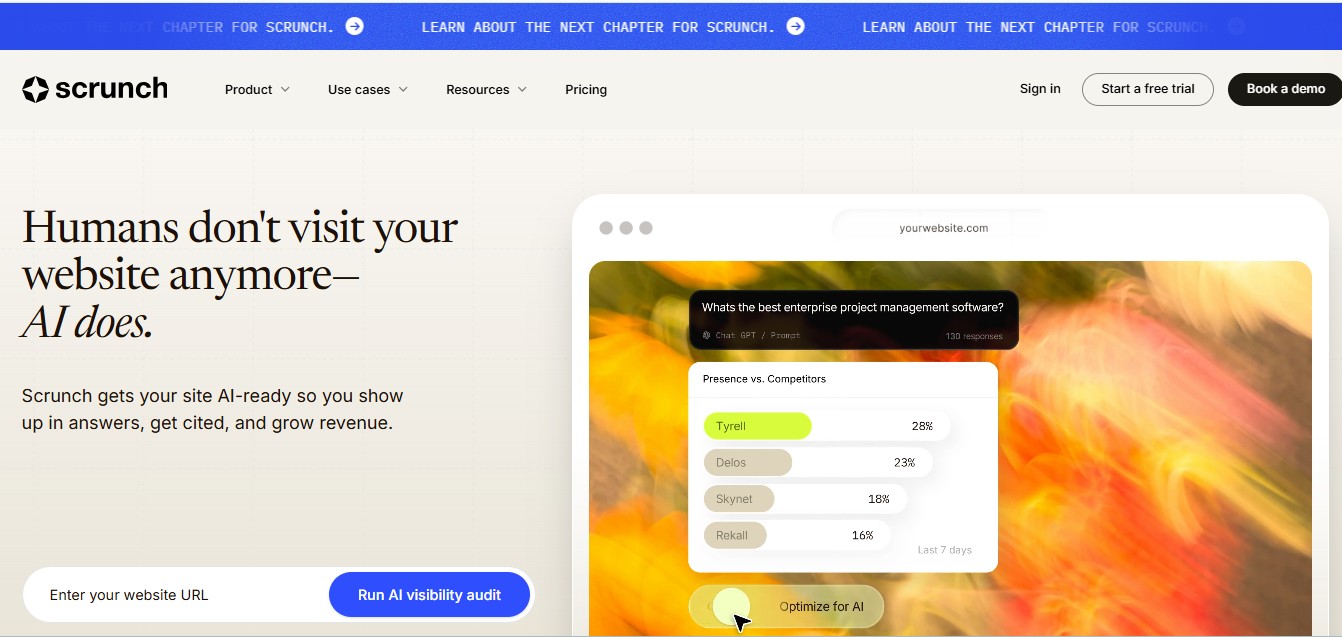
Scrunch looks at AI visibility from both the answer and website sides. It monitors prompts, citations, competitors, and rankings, while its agent traffic tools show how AI bots interact with a site.
Its distinctive product is the Agent Experience Platform, or AXP. Scrunch describes it as a way to serve an AI-friendly version of website content to retrieval agents without changing the page that human visitors see. That is a different kind of work from editing a page inside a content optimizer, and agencies should assess it with both their content and technical teams.
Key features
- Prompt Manager: Organize and monitor questions across AI platforms.
- Persona and topic views: Compare results for different audiences and themes.
- Citation and competitor analysis: See which sources appear in answers and where brands gain attention.
- Agent traffic monitoring: Review AI bot visits and related site activity.
- Page Audits and AXP: Find content or access issues, with an option for agent-focused content delivery.
Pricing
Starter costs $300/month on monthly billing, or $250/month when billed annually. It includes 350 custom prompts, three users, and five page audits. Growth costs $500/month monthly, or $417/month billed annually, with 700 custom prompts, five users, and 10 page audits. Enterprise pricing is custom.
Pros and Cons
| Pros | Cons |
| Pairs answer monitoring with AI agent traffic data. | Its starting monthly price is higher than several lighter trackers here. |
| Offers persona-based analysis and page audits. | Published page-audit allowances differ by plan. |
| AXP gives technical teams an additional way to work on agent access. | An AXP project calls for closer site and implementation review than monitoring alone. |
Best for
Scrunch is best for agencies that want to do more than monitor AI mentions. Of the Surfer SEO Alternatives for Agencies here, it is particularly relevant when an engagement includes bot behavior, site audits, and technical work on how agents access content.
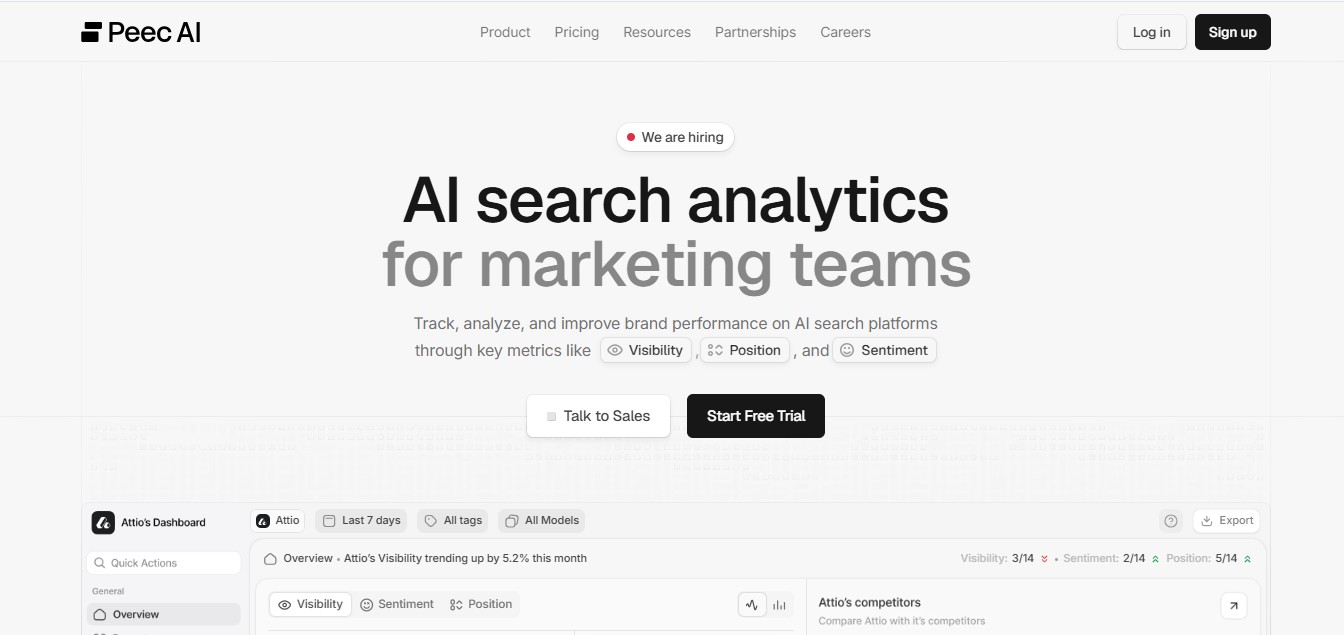
Peec AI is well suited to the client question, “How often do we appear compared with the other brands in our category?” It measures visibility, position, sentiment, and share of voice, then lets teams examine the prompts and cited sources behind those numbers.
The agency offering adds a useful operational layer. Credits can be allocated across client projects, with model choices set by project, and pitch projects let teams prepare an initial view for a prospective client. This gives agencies more flexibility than assigning every brand the same prompt list.
Key features
- Share-of-voice tracking: Put a client’s mentions in context against tracked competitors.
- Prompt organization: Group questions by topic, intent, market, or audience.
- Source analysis: Review the domains and URLs used or cited in AI answers.
- Agency credit allocation: Distribute tracking capacity across client projects and selected models.
- Reporting options: Use shareable views, exports, and supported data connections for client dashboards.
Pricing
Peec lists Starter, Pro, and Advanced brand plans with 50, 150, and 350 prompts respectively. Its separate agency plans are Essential with 10,000 credits, Growth with 25,000 credits, Scale with 65,000 credits, and a custom Comprehensive tier. Check its current pricing before budgeting for an agency subscription.
Peec defines one credit as one prompt checked on one model for one day. Credits act as allocated tracking capacity across projects, not a balance that is spent once and disappears.
Pros and Cons
| Pros | Cons |
| Strong fit for competitor and share-of-voice reporting. | Agency pricing takes more work to compare with flat prompt plans. |
| Flexible allocation across client projects. | The number of prompts depends on models and tracking frequency. |
| Pitch projects support new-client research. | A current public currency price was not confirmed for this review. |
Best for
Peec suits agencies selling recurring competitor and share-of-voice reports across several accounts. It stands out among Surfer SEO Alternatives for Agencies when flexible allocation matters more than buying the same fixed prompt package for every client.
OtterlyAI: Best for monitoring brand mentions in AI answers
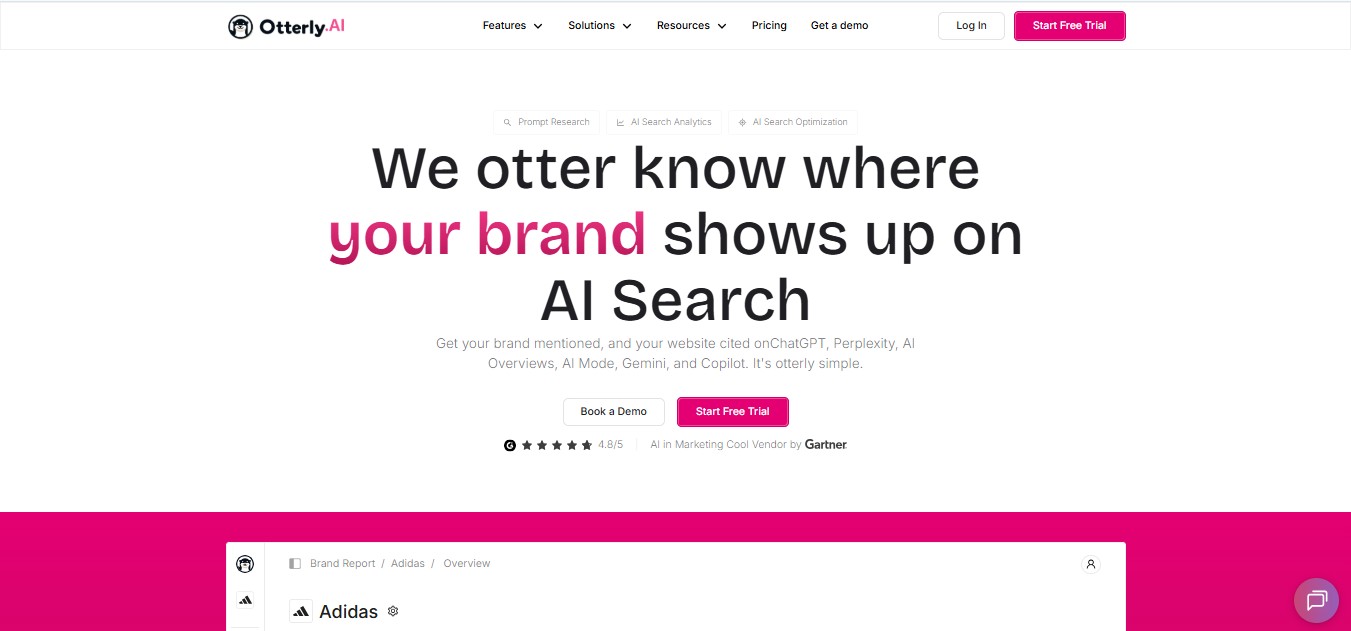
OtterlyAI covers the core monitoring questions clearly: Is a client named in an AI answer, is its website cited, and which sources appear instead? It also has prompt research, competitor benchmarking, crawlability checks, and content audits, so the reporting can lead to specific page-level work.
Its agency program is worth examining separately from the base plan. Eligible Standard and Premium partners can get additional prompts and pitch workspaces, while separate workspaces help keep client data organized.
Key features
- Brand and citation tracking: Monitor mentions and cited domains or URLs in AI answers.
- Prompt research: Find questions related to a brand, keyword, or website.
- GEO audits: Check crawler access and review pages for content improvements.
- Client workspaces: Separate reporting and tracking for different brands.
- Agency partner benefits: Listed benefits include more prompts on qualifying plans and prospect pitch workspaces.
Pricing
Lite is $29/month with 15 prompts. Standard is $189/month with 100 prompts, and Premium is $489/month with 400 prompts. The four AI experiences included in the base pricing are ChatGPT, Google AI Overviews, Perplexity, and Microsoft Copilot. Google AI Mode, Gemini, and Claude are priced as add-ons, so include them in a budget if clients need that coverage.
Pros and Cons
| Pros | Cons |
| Covers mentions, citations, prompt research, and GEO audits. | Additional AI engines can raise the total monthly cost. |
| Workspaces and agency partner options support client delivery. | Lite has a small prompt allowance for a multi-client agency. |
| Published prices make it straightforward to estimate a base plan. | Partner benefits require the relevant plan and application. |
Best for
OtterlyAI works well for agencies that want to begin with brand and citation monitoring, then add prompt research and audits. When comparing Surfer SEO Alternatives for Agencies, include the cost of any extra engines your clients expect to see in reports.
Semrush AI Visibility Toolkit: Best for agencies already using Semrush
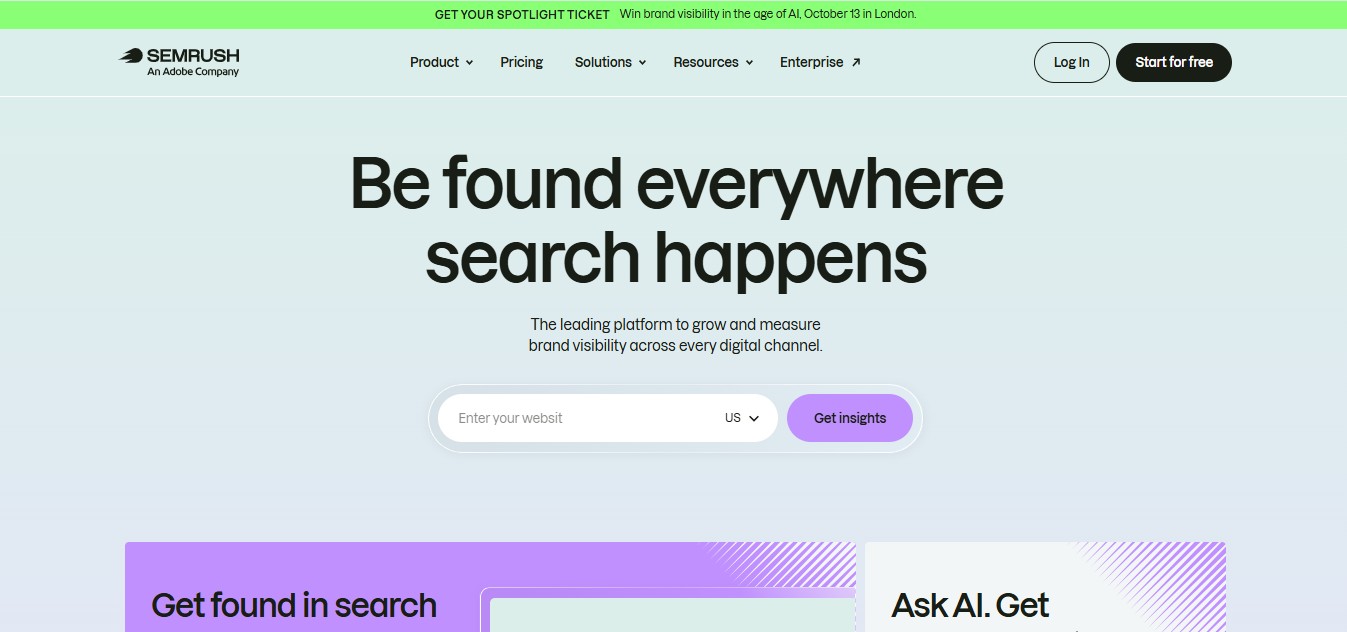
Semrush offers AI visibility as a dedicated toolkit and within broader SEO and AI Search plans. Its reports cover brand visibility, competitor research, prompt discovery, sentiment, and selected-prompt tracking. The Site Audit also checks issues relevant to AI crawler access.
This is a natural option for an agency whose team already plans SEO campaigns in Semrush. A strategist can connect a client’s keyword and site work with the topics and prompts where that client appears in AI answers.
Key features
- Visibility Overview: Review a brand’s presence and related prompts across Semrush’s AI response data.
- Prompt Research: Find topics and assess their estimated demand and difficulty.
- Brand Performance: Examine share of voice, sentiment, and how a brand is described.
- Daily prompt tracking: Follow selected questions over time.
- AI Search Site Audit: Check for site issues that may affect AI crawler access.
Pricing
The dedicated AI Visibility Toolkit is listed at $99/month. Its published allowance includes 25 tracked prompts and one domain for Brand Performance; additional domains and prompt capacity are available at extra cost.
For agencies seeking a combined SEO and AI Search subscription, Semrush lists Starter at $199/month, Pro+ at $299/month, and Advanced at $549/month on monthly billing. Those plans list 50, 100, and 200 daily tracked prompts respectively. Check which subscription route fits your existing account rather than adding the standalone and bundle prices together by default.
Pros and Cons
| Pros | Cons |
| Links AI search analysis with an established SEO workflow. | The standalone toolkit’s 25-prompt and one-domain limits may be tight for agencies. |
| Includes prompt research and site-level checks. | Extra domains, prompts, or user access can change the total price. |
| Combined plans offer higher prompt allowances. | Standalone and bundled pricing need to be compared separately. |
Best for
Semrush is a practical choice for agencies already committed to its SEO tools. Among Surfer SEO Alternatives for Agencies, it makes the most sense when AI visibility is an addition to an established Semrush workflow rather than a reason to buy a whole new suite.
Ahrefs Brand Radar: Best for broad AI brand visibility research
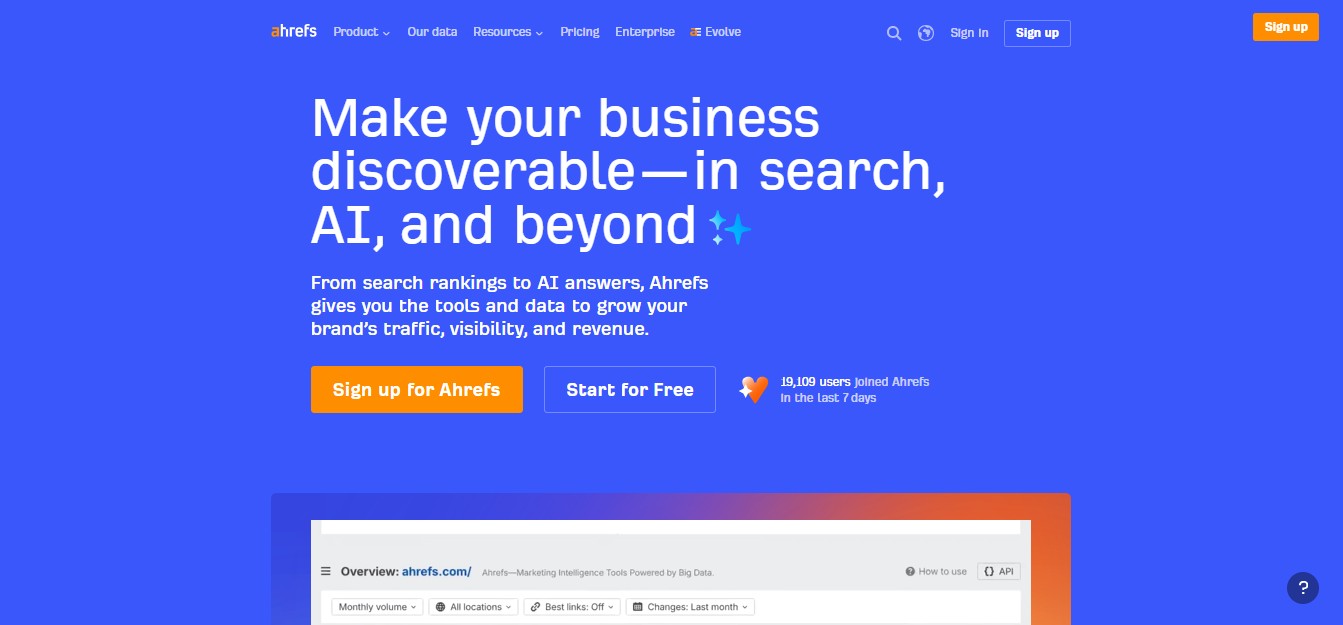
Ahrefs Brand Radar has two distinct approaches. Its AI Visibility Index lets a team research how brands appear across a large collection of search-backed prompts without first building a custom tracking list. Custom Prompts lets the agency monitor the exact questions a client cares about.
That distinction matters for research. The index can help identify unexpected competitors, cited pages, and topic opportunities across a category. Custom tracking is better suited to a niche client’s buying questions or campaign-specific prompts.
Key features
- AI Visibility Index: Research mentions, citations, and share of voice across Ahrefs’ indexed prompts.
- Custom Prompts: Track chosen buyer questions by platform and location.
- Citation research: Identify pages and domains linked in AI answers.
- Search-demand context: Connect AI visibility research with topics informed by Ahrefs’ search data.
- Wider Ahrefs workflow: Use separate SEO tools for keyword, site, and competitor analysis when included in the chosen subscription.
Pricing
Ahrefs lists Brand Radar AI from $199/month as a standalone option. Its main SEO plans start at $129/month for Lite, which includes a small Custom Prompts allowance. Custom-prompt packages also start at $50/month, but that is not the same purchase as the full Brand Radar AI Visibility Index.
Pros and Cons
| Pros | Cons |
| Useful for researching a category before choosing prompts to track. | The full AI Visibility Index and custom-prompt packages have different prices. |
| Connects mentions with cited sources and search-demand context. | Indexed coverage may be less useful for a very small niche than custom prompts. |
| Fits agencies already doing SEO research in Ahrefs. | Agencies should check prompt checks and potential overage costs. |
Best for
Ahrefs Brand Radar fits agencies doing broad competitor research and market discovery. It is one of the Surfer SEO Alternatives for Agencies to consider when the first task is learning which AI questions and cited sources deserve ongoing attention.
Nightwatch: Best for combining rank tracking with AI visibility
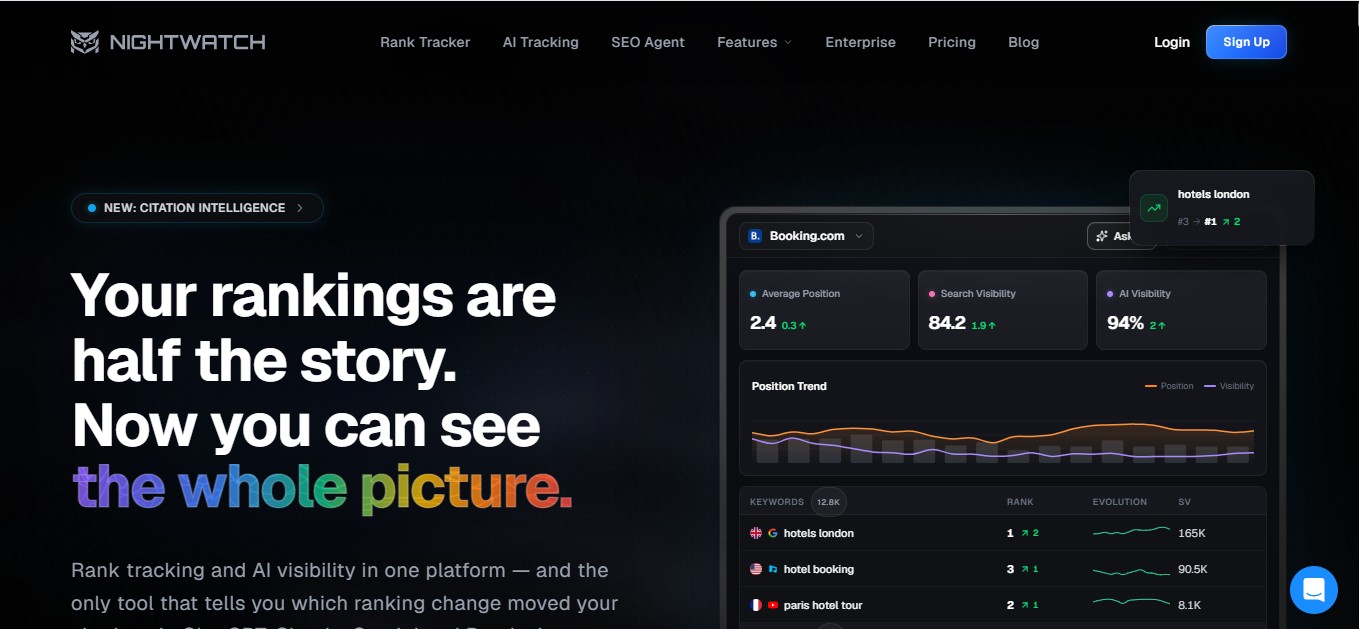
Nightwatch gives search teams a shared place to look at conventional rankings and AI answer visibility. It tracks search positions by location, while its AI tools monitor prompts, brand mentions, sentiment, and citations.
Its Citation Intelligence view is intended to connect AI citations with search ranking data. That makes it useful for an agency already reporting local or organic rankings and looking to add AI search to the same client conversation. A ranking change and a citation change appearing together are useful signals to investigate, not proof that one caused the other.
Key features
- Daily rank tracking: Monitor traditional search performance, including local locations.
- AI prompt tracking: Check how brands appear across supported AI experiences.
- Citation Intelligence: Review cited sources alongside ranking information.
- Content Studio: Research, draft, and score SEO content within the wider toolkit.
- Agency reporting: White-label reports and Looker Studio integration are listed from Professional upward.
Pricing
Nightwatch’s displayed yearly-billed rates are €79/month for Starter, €159/month for Professional, and €399/month for Agency. They include 50, 150, and 500 AI prompts respectively, alongside 500, 2,500, and 7,500 tracked keywords. The page also offers monthly billing, so check its current month-to-month prices if you do not want an annual commitment.
Pros and Cons
| Pros | Cons |
| Brings rank and AI visibility reporting into one toolkit. | The quoted rates require annual billing. |
| Includes content and site tools as well as tracking. | White-label reporting starts above the Starter tier. |
| No per-seat fees on the published plans. | Agencies focused only on AI mentions may not need its full rank-tracking capacity. |
Best for
Nightwatch is best for agencies whose core service is still SEO or local rank tracking. Among Surfer SEO Alternatives for Agencies, it offers a straightforward way to add AI visibility to a rankings conversation clients already understand.
Content optimization vs. AI visibility tracking: What does your agency need?
A content optimizer helps a writer improve a page before it goes live. An AI visibility tracker answers a different question: when someone asks an AI platform a relevant question, does the client appear, and which pages or third-party sources shape the response? Several tools in this list include content features, but their main selling point is broader visibility analysis.
Consider a client publishing a new “best CRM for nonprofits” guide. A content workflow helps the team draft and refine the guide. AI visibility tracking then lets the agency monitor related prompts, check whether the client is mentioned or cited, compare competing brands, and decide whether the next task is a page update, a new guide, or outreach to a source that appears often.
The right choice among Surfer SEO Alternatives for Agencies depends on which part of that process is missing. If writers mainly need an editing environment, assess that requirement directly. If account managers need to explain a client’s presence in AI answers, prioritize prompt coverage, citations, and reporting.
How to choose the right Surfer SEO alternative for your agency
Start with the deliverable you promise clients, then check the limits behind each price.
- Count clients and prompts together: A plan with many prompts but few projects may not fit a multi-client agency. A small prompt allowance can also become tight across several services or markets.
- Check the exact AI platforms included: Some vendors include several experiences in the base plan, while others price additional engines separately or let you choose a fixed number.
- Decide how much explanation clients need: Mentions show where a brand appears. Citations, source data, and crawler information help the team discuss what to investigate next.
- Inspect reporting access: Client portals, shareable dashboards, white-label reports, exports, and additional user seats can affect how much manual work the agency does each month.
- Compare the real bill: Keep standalone products, annual rates, agency packages, extra engines, and add-ons separate until you have priced the setup your clients actually need.
A short pilot can make Surfer SEO Alternatives for Agencies easier to judge. Use the same client, market, and core questions in each tool you test. Then compare the usefulness of the resulting data, the reporting workflow, and the cost of running it across your full client roster.
Final Verdict
Radarkit AI is the best overall choice for the agency use case in this article if the goal is to monitor AI answers, study citations, turn findings into content or outreach tasks, and report progress to clients in one place. Its published $29/month entry plan includes two projects and a Client Portal, while Growth and Pro add daily tracking and more capacity. That is a strong combination for an agency starting or expanding an AI visibility service, not a claim that it wins every category.
That does not make it the best answer for every job. Profound is better suited to tailored enterprise programs, Scrunch offers a distinct approach to agent-focused site work, Ahrefs Brand Radar is useful for broad category research, and Nightwatch fits agencies centered on rank tracking. For teams choosing among Surfer SEO Alternatives for Agencies to build a practical AI visibility service, Radarkit offers the strongest overall balance of workflow and accessible starting price.
FAQ
Can an AI visibility tool fully replace Surfer SEO?
Not necessarily. The tools here primarily measure AI mentions, citations, prompts, and competitors. Some add content creation, audits, or scoring, but an agency that relies on a particular writing-editor workflow should check that capability on its own.
Which Surfer SEO alternative is best for a small agency starting AI visibility reporting?
Radarkit AI and OtterlyAI both publish $29/month entry plans, but their included features and limits differ. Radarkit lists two projects, 15 prompts, and a Client Portal on Lite; OtterlyAI lists 15 prompts and one workspace on Lite, with some AI engines available as add-ons.
Which tool is best for enterprise AI search analysis?
Profound is a strong fit when an agency needs tailored prompt coverage, multiple teams, agent workflows, and enterprise controls. Scrunch is another option when AI bot activity and agent-focused site delivery are central to the engagement. Both should be evaluated against a specific client scope.
Should agencies track mentions or citations?
Track both. A mention tells you whether the client’s brand appears in an answer. A citation tells you whether an AI answer links to the client’s site or another source. Reviewing them separately can reveal whether the next task belongs on the client’s website or with an external publication.
Why do AI visibility tool prices vary so much?
The entry price may cover different numbers of projects, prompts, models, users, or daily checks. One listed price might buy a standalone AI index, another an SEO suite, and another a plan with extra engines sold as add-ons. Compare the full setup for your client roster rather than only the lowest number on the page.
Why do the prices of Surfer SEO Alternatives for Agencies vary so much?
One price may cover a few tracked prompts, while another includes more projects, models, users, or SEO tools. Some advertised monthly rates require annual billing. Compare the complete plan needed for your clients, not just the lowest number in a pricing table.
