

SEOmonitor vs Nightwatch for AI Rank Tracking is now a more important comparison than a standard rank-tracker comparison. Google rankings still matter, but people also ask questions inside Google AI Overviews, Google AI Mode, ChatGPT, Gemini, Claude, Perplexity, and other AI answer engines.
A business can rank well in Google Search and still have limited visibility in AI-generated answers. At the same time, a site may appear as a cited source in an AI response even when it is not ranking in the first few organic positions. That is why SEO teams need to review keyword rankings, citations, brand mentions, prompt performance, local results, and AI answer placement together.
SEOmonitor is built around agency SEO workflows, forecasting, keyword management, rank tracking, and reporting. Nightwatch combines traditional rank tracking with detailed local tracking and AI visibility monitoring. RadarKit takes a more AI-search-focused approach, helping teams track how a brand appears, gets cited, and competes across major AI answer platforms.
This guide compares SEOmonitor vs Nightwatch for AI Rank Tracking in detail, then explains why RadarKit is a practical alternative for teams that want AI visibility tracking without losing sight of local context, citations, and content opportunities.
SEOmonitor vs Nightwatch: AI Rank Tracking at a Glance
| Feature | SEOmonitor | Nightwatch |
| Main focus | Agency SEO workflow, rank tracking, forecasting, reporting | Local rank tracking, AI visibility, reporting |
| AI tracking | AI Search Tracking alongside keyword and SERP data | AI answer and citation monitoring |
| Traditional rank depth | Daily Dynamic Depth Crawling, plus weekly top-100 competitor crawl | Daily tracking across search engines, devices, and locations |
| Local tracking | Country and city-level options | Country, city, ZIP code, and postcode-level tracking |
| AI engines covered | ChatGPT, Gemini, Perplexity, plus Google AI Overview data within rank tracking | ChatGPT, Claude, Gemini, Perplexity, Google AI Overviews, and AI Mode |
| Reporting | Agency reporting, forecasting, dashboards, exports | White-label reports, scheduled delivery, client reports, Looker Studio |
| Pricing model | Keyword-based usage model, with AI tracking charged per active LLM | Published plans based on keywords, prompts, sites, and AI response limits |
| Best for | Agencies that sell SEO planning and performance forecasts | Local SEO teams and agencies that need precise location and AI answer data |
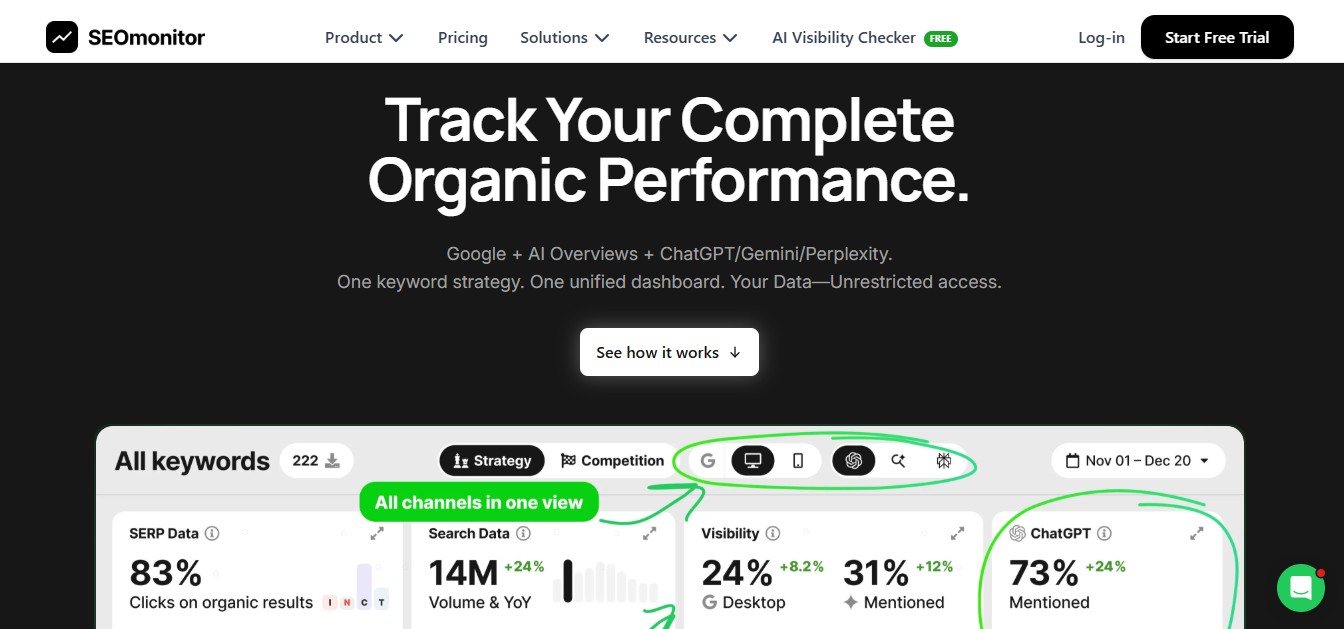
SEOmonitor supports AI Search Tracking for ChatGPT, Gemini, and Perplexity. Its platform also provides Google AI Overview-related rank data, including domain-presence indicators for desktop and mobile results.
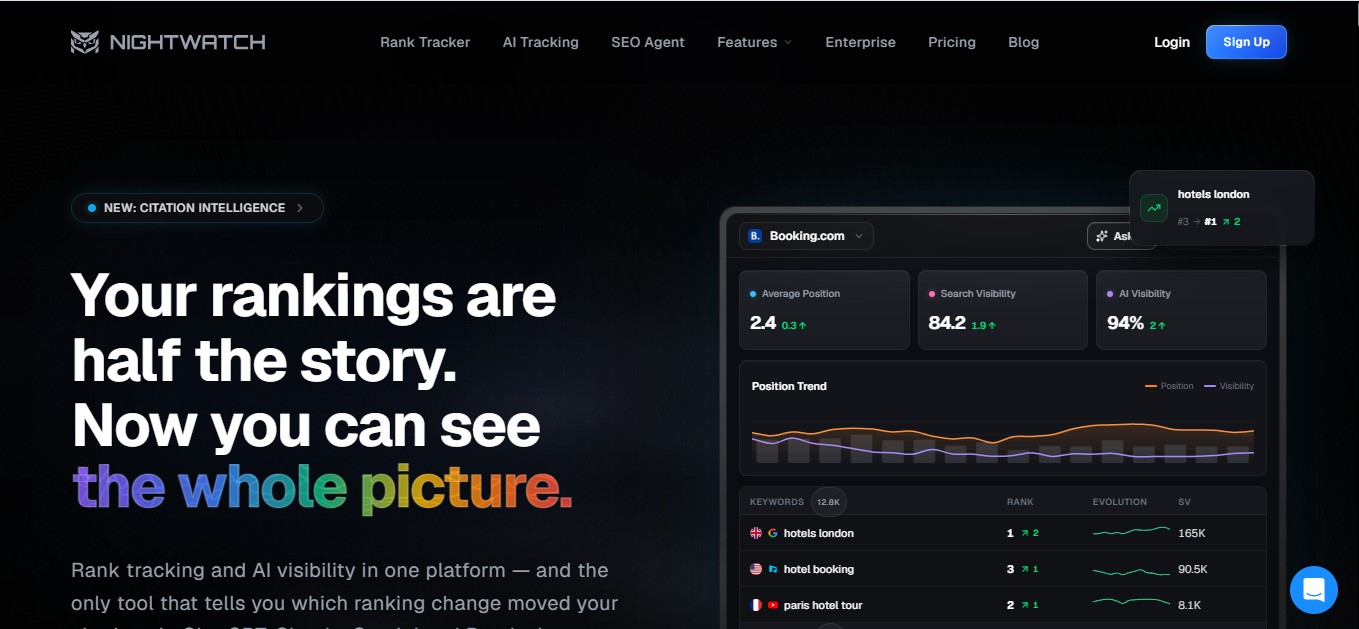
Nightwatch positions its AI tracking around major answer engines, including ChatGPT, Claude, Gemini, Perplexity, Google AI Overviews, and Google AI Mode. It also emphasizes local rank tracking and citation intelligence.
What Is AI Rank Tracking?
AI rank tracking is the process of monitoring whether a brand, website, product, service, or competitor appears in AI-generated search answers. Instead of checking only a numbered Google position, it evaluates how AI tools respond to a real question or prompt.
For example, a normal keyword tracker may show that a page ranks at position 6 for “best local SEO tools.” AI rank tracking can show whether ChatGPT names the brand, whether Perplexity cites its website, whether Gemini recommends it, and which competing brands appear in the same response.
A strong AI rank tracking setup can measure:
- Brand mentions in AI answers
- Website citations and linked sources
- Citation placement and context
- Inclusion in AI-generated recommendations
- Competitor mentions and share of voice
- Prompt-level visibility changes
- Local AI visibility by market or location
- Changes in AI-generated product or service recommendations
AI rank tracking should support organic SEO reporting, not replace it. Traditional rankings show how pages perform in search results. AI visibility shows whether the brand is present when users receive a summarized answer instead of a list of blue links.
14 Key Differences Between SEOmonitor and Nightwatch for AI Rank Tracking
1. Core Product Positioning
SEOmonitor is an agency-first SEO platform. Its main workflow centers on rank tracking, forecasting, keyword grouping, research, performance reporting, and campaign management.
Nightwatch is a rank-tracking platform that places stronger emphasis on precise local monitoring, multi-location workflows, AI visibility, citation monitoring, and client-ready reports. It works well for SEO teams that need to follow rankings at a granular location level.
For agencies that present projected traffic, expected outcomes, and campaign plans to clients, SEOmonitor has a natural fit. For teams managing businesses across many cities, service areas, ZIP codes, or postcodes, Nightwatch is usually the better match.
2. AI Search Platforms Tracked
SEOmonitor’s AI Search Tracking currently supports ChatGPT, Gemini, and Perplexity. The platform lets users monitor AI visibility alongside conventional SERP tracking, and its Google rank data includes AI Overview-specific visibility information.
Nightwatch tracks visibility across ChatGPT, Claude, Gemini, Perplexity, Google AI Overviews, and Google AI Mode. Its Citation Intelligence feature is designed to help teams identify when their domain is cited or mentioned in AI-generated answers.
The platform list matters, but it should not be the only buying factor. AI search products change quickly, so review the live product pages before choosing a plan or publishing a comparison.
3. Traditional Keyword Rank Tracking
SEOmonitor uses Dynamic Depth Crawling for daily primary-device updates. It follows the tracked site wherever it ranks, while a weekly full top-100 crawl supports competitor data collection.
That top-100 depth is useful when an agency wants to identify pages that are moving from page three to page two, or from lower positions toward page one. It gives teams more context than checking only the top 10 positions.
Nightwatch provides daily keyword tracking across major search engines, locations, and device types. Its workflow is especially useful when rankings change based on a searcher’s city, country, language, device, or local intent.
4. AI Visibility Data and SERP Snapshots
SEOmonitor is well suited to teams that want historical search evidence. It combines daily rank data, AI Overview data, AI Search Tracking, and stored SERP information that can support client reviews and campaign reporting.
The platform’s AI Search Snapshots provide a one-time processing view of campaign keywords. Its paid AI Search Tracking add-on adds automated updates, trend charts, exports, and continuous visibility monitoring for a brand and its competitors.
Nightwatch focuses more directly on prompt-level AI response monitoring. This is helpful when a team wants to know whether a selected prompt produces a mention, citation, recommendation, or competitor appearance.
For a quarterly client meeting, SEOmonitor’s historical SERP reporting can make changes easier to explain. For an AI visibility review focused on prompts and citations, Nightwatch provides a more direct monitoring view.
5. Local Rank Tracking Granularity
SEOmonitor supports geographic rank tracking and is suitable for city-level SEO work. It can help agencies monitor campaigns for businesses that serve specific locations.
Nightwatch goes further into local precision with country, city, ZIP code, and postcode tracking. It also maintains a large verified location database.
This gives Nightwatch an advantage for local SEO agencies, franchises, clinics, restaurants, home-service businesses, real estate businesses, and multi-location brands. If rankings differ sharply between neighborhoods or nearby postal areas, location precision becomes a major part of the decision.
6. Keyword and Prompt Limits
SEOmonitor uses a flexible, usage-based structure. Daily keyword tracking is billed in blocks of 1,000 tracked keywords across the account rather than by campaign.
Its AI Search Tracking is priced by active AI model. Each 1,000-keyword block costs €19 per active LLM per month, so tracking the same set of keywords across ChatGPT, Gemini, and Perplexity creates three billed AI tracking units.
Nightwatch uses published plan limits:
| Nightwatch plan | Daily tracked keywords | AI prompts |
| Starter | 500 | 50 |
| Professional | 2,500 | 150 |
| Agency | 7,500 | 500 |
| Enterprise | 20,000+ | Custom |
The fixed Nightwatch structure makes capacity planning easier for small and mid-sized teams. SEOmonitor can work better when an agency needs a tailored volume across campaigns and keyword portfolios.
7. Pricing Model
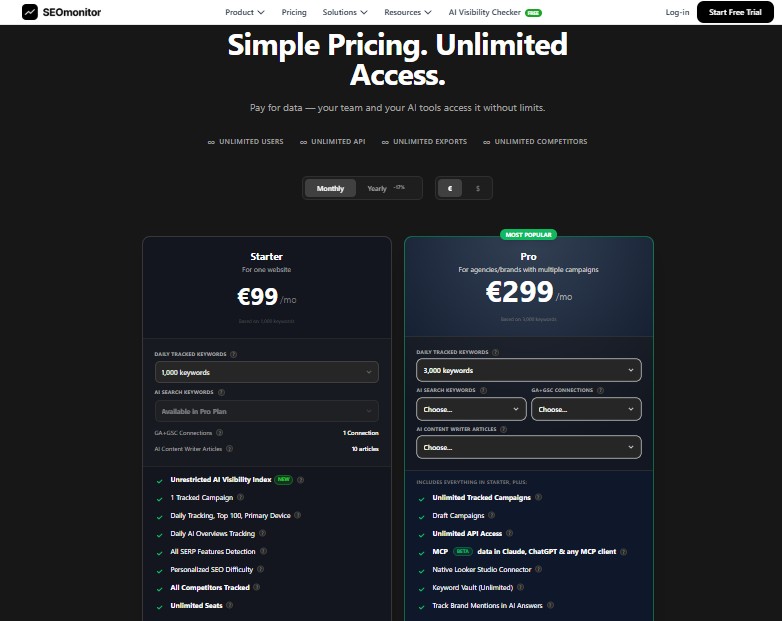
SEOmonitor prices core rank tracking based on daily keyword volume. Its AI Search Tracking is a paid add-on priced per 1,000 keywords and active LLM. That structure lets agencies match spend with their account size, but it requires careful planning when tracking many keywords across several AI models.
Nightwatch has public annual-billing prices:
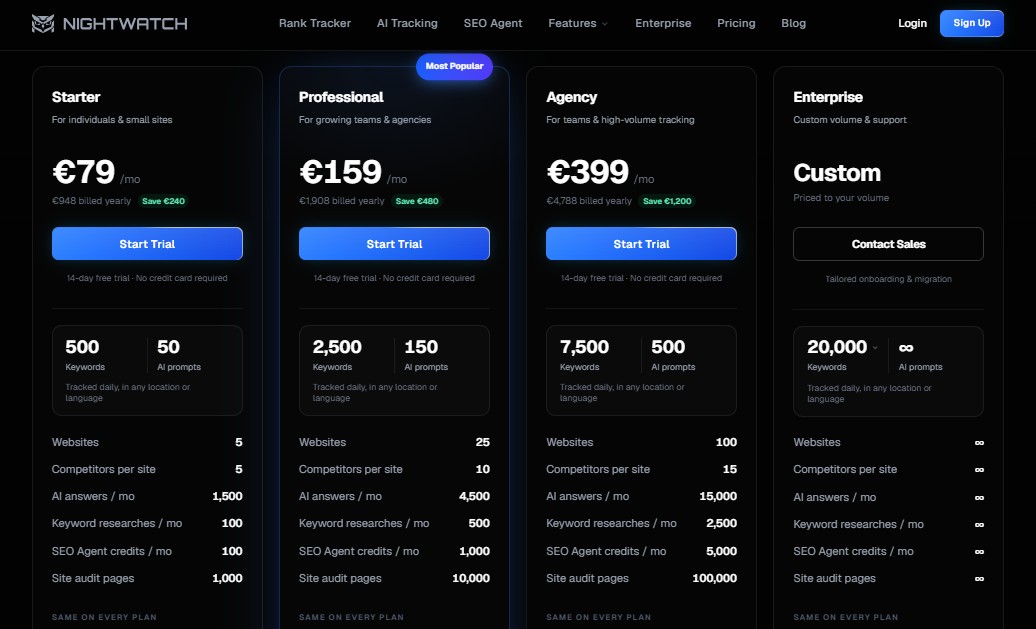
| Nightwatch plan | Monthly price, annual billing |
| Starter | €79 per month |
| Professional | €159 per month |
| Agency | €399 per month |
| Enterprise | Custom pricing |
Nightwatch’s published pricing helps buyers estimate costs before a sales conversation. SEOmonitor’s model can be attractive for agencies that want a more customized mix of tracking, reporting, forecasting, and AI monitoring.
Compare the total number of keywords, prompts, locations, sites, competitor limits, reports, seats, and AI responses before deciding. The lowest monthly price does not always represent the lowest cost for your workflow.
8. Forecasting and SEO Planning
SEOmonitor has a major advantage in forecasting and structured SEO planning. Agencies can use its forecasting data to estimate potential traffic outcomes, group keywords, build targets, and connect SEO work to expected performance.
Nightwatch is more focused on observing live ranking performance, local visibility, AI citations, and reporting. It is a strong choice for teams that need to measure what is happening now.
For an agency selling SEO roadmaps based on projected traffic and keyword opportunities, SEOmonitor is the more suitable option. For teams focused on daily performance monitoring across locations and AI engines, Nightwatch has a clearer workflow.
9. Competitor Monitoring
SEOmonitor helps teams compare keyword visibility and competitor movement in tracked SERPs. Its weekly top-100 crawl contributes competitor data even when daily tracking prioritizes the site’s own ranking positions.
Nightwatch allows teams to compare traditional rankings, local performance, AI mentions, and citation activity. Its plan structure also includes competitor limits that increase as the account moves from Starter to Professional and Agency.
Both tools can uncover opportunities, but they approach the task differently. SEOmonitor is useful for portfolio-level keyword and visibility analysis. Nightwatch is particularly useful when competitors appear in local results or AI-generated answers for important prompts.
10. Reporting and Client Management
SEOmonitor is designed around agency workspaces, dashboards, reporting, planning, and forecast communication. It also supports exports, Google Sheets, API access, and Looker Studio imports.
Nightwatch offers white-label reporting, scheduled reports, client reporting tools, and Looker Studio access on higher plans. Its Professional plan includes white-label reports, Looker Studio, API access, and unlimited seats.
SEOmonitor works well for agencies that want to explain strategy, forecasted outcomes, and long-term SEO progress. Nightwatch suits agencies that want polished recurring reports covering local positions, AI citations, and current visibility.
11. Data Freshness and Update Frequency
SEOmonitor refreshes primary-device keyword data daily through Dynamic Depth Crawling. It also runs weekly top-100 crawls for competitor information and keeps historical tracking records.
SEOmonitor’s AI Search Tracking add-on provides weekly automated updates, trend charts, exports, and ongoing monitoring across active LLMs.
Nightwatch includes daily keyword tracking and daily AI prompt monitoring on its public plans. That cadence can help teams observe changes in AI answers and ranking shifts without waiting for weekly updates.
Daily updates matter because search results can move quickly, especially in competitive local markets. AI answers may also change based on model updates, query wording, region, current web information, or citation availability.
12. Integrations and API Access
SEOmonitor connects with Google Analytics, Google Search Console, Google Sheets, Looker Studio, exports, and its API. It has also expanded AI tracking exports and API functionality using a unified data structure for Google, AI Overviews, and supported AI platforms.
Its API can return keyword-level AI Search data for ChatGPT, Gemini, or Perplexity. It also provides AI Overview rank endpoints with brand-presence indicators for desktop and mobile results.
Nightwatch supports Google Analytics, Looker Studio, API access, white-label capabilities, and an SEO MCP server. API and Looker Studio availability depend on the plan.
Integrations matter because rankings alone do not show business impact. Connecting rank data with traffic, conversions, leads, and revenue helps agencies explain which visibility gains create measurable results.
13. Team Seats and Agency Scalability
SEOmonitor is made for agency collaboration. It supports unlimited users, API access, exports, and competitor monitoring as part of its current pricing model.
Nightwatch includes unlimited seats on standard plans. Its pricing scales through keyword, prompt, site, competitor, AI response, and usage limits rather than per-user fees.
Nightwatch is appealing for agencies that want to give access to account managers, analysts, freelancers, and clients without adding seat costs. SEOmonitor remains a strong agency choice for teams that need deeper forecasting and portfolio management.
14. Best Use Cases and Target Audience
Choose SEOmonitor when forecasting, top-100 keyword depth, client reporting, campaign planning, and keyword portfolio management are central to the agency’s service.
Choose Nightwatch when local precision, daily prompt monitoring, AI citations, multi-location rank tracking, and predictable plan limits are more important.
SEOmonitor vs Nightwatch for AI Rank Tracking comes down to workflow priorities. SEOmonitor is stronger for structured, forecast-led SEO management. Nightwatch is stronger for businesses that need local rank precision and broad AI answer monitoring in one reporting workflow.
Pricing Breakdown: SEOmonitor vs Nightwatch
| Tool | Plan | Monthly price | Keyword tracking | AI tracking | Best for |
| SEOmonitor | Rank Tracker | Usage-based | Daily keywords billed in blocks of 1,000 | AI Search Tracking add-on | Agencies with custom campaign volumes |
| SEOmonitor | AI Search Tracking | €19 per 1,000 keywords, per LLM, monthly | Works with tracked campaign keywords | ChatGPT, Gemini, Perplexity | Teams that want AI visibility alongside rank tracking |
| SEOmonitor | Enterprise / custom setup | Custom | High-volume configurations | Custom scope based on selected AI models | Large agencies and enterprise teams |
| Nightwatch | Starter | €79/month, billed annually | 500 keywords | 50 AI prompts | Small teams and local businesses |
| Nightwatch | Professional | €159/month, billed annually | 2,500 keywords | 150 AI prompts | Growing SEO teams and agencies |
| Nightwatch | Agency | €399/month, billed annually | 7,500 keywords | 500 AI prompts | Agencies with multiple client accounts |
| Nightwatch | Enterprise | Custom | 20,000+ keywords | Custom prompts and AI responses | Large organizations |
SEOmonitor’s model is more flexible for agencies with custom keyword portfolios, forecasting requirements, and AI model selection. Its AI Search Tracking cost grows based on how many keywords and LLMs a team monitors.
Nightwatch offers a more predictable public structure. Its pricing tiers show the included daily keywords, AI prompts, sites, competitors, AI responses, and team access before purchase.
Always check the latest product pages before publishing pricing information. AI tracking allowances, models, and reporting access can change as platforms add new capabilities.
Best Alternative to SEOmonitor and Nightwatch
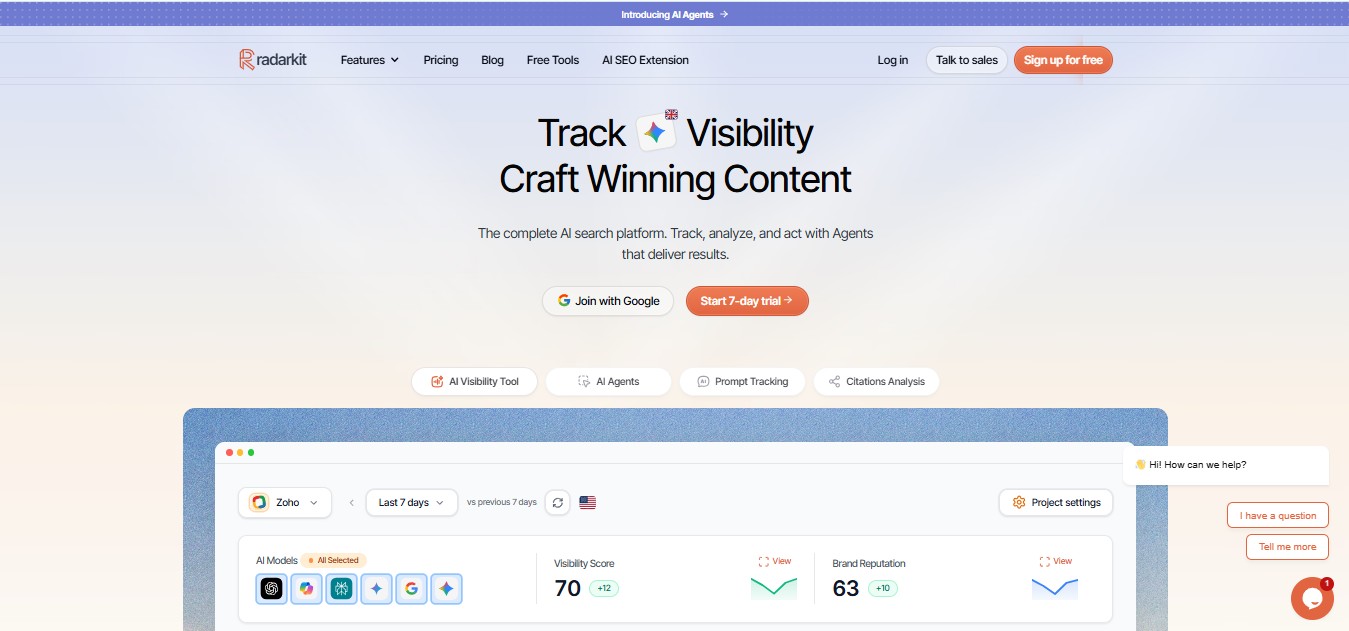
RadarKit is the strongest alternative when AI search visibility is the main priority. Unlike a traditional rank tracker that later adds AI features, RadarKit is built around measuring brand visibility in AI answer engines and turning that data into practical content, citation, and competitor actions.
RadarKit tracks major AI environments, including ChatGPT, Perplexity, Gemini, Google AI Overviews, Google AI Mode, and Copilot. It uses real browser sessions and regional proxies to help teams review AI responses in ways that better reflect location-specific user experiences.
It also includes features that are helpful for AI search campaigns:
- AI visibility scoring across selected prompts
- Brand mention and citation tracking
- Competitor comparison and share-of-voice analysis
- Citation context analysis
- Local AI visibility checks
- Google Analytics 4-based traffic analysis
- Content and outreach agents
- API, MCP, reporting, and client portal options
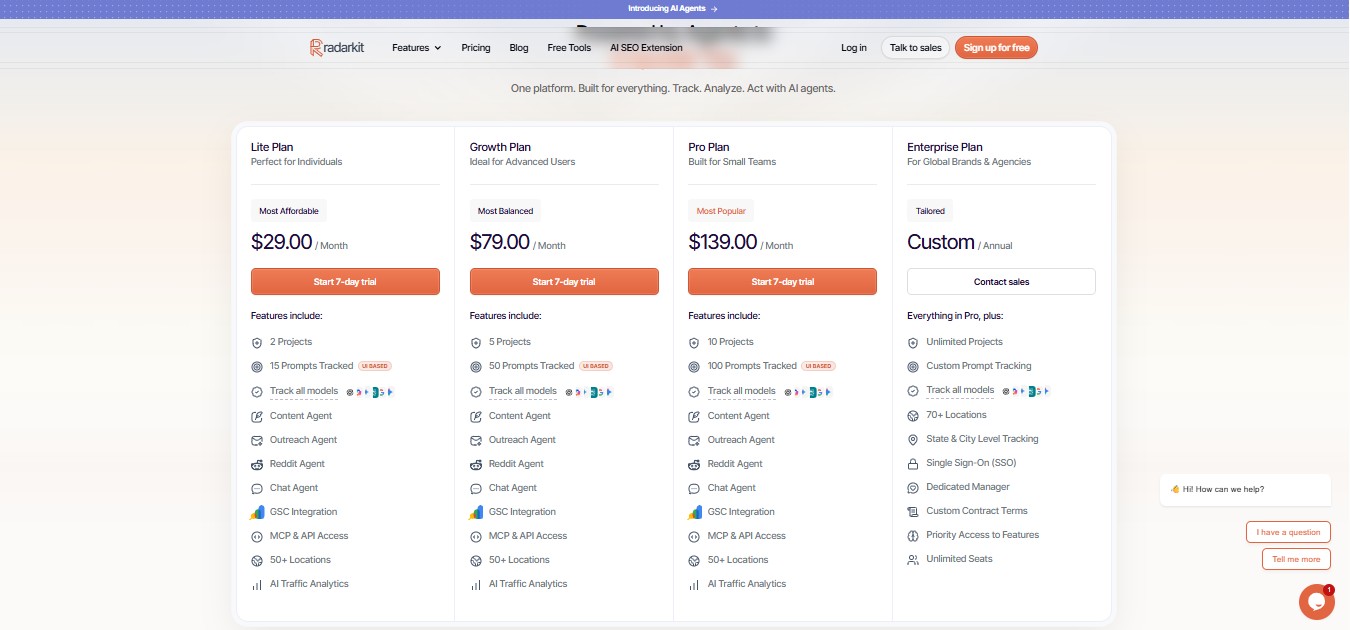
RadarKit pricing starts at $29 per month for its Lite plan, which includes 2 projects and 15 prompts. Growth costs $79 per month and includes 5 projects, 50 prompts, and daily refreshes. Pro costs $139 per month with 10 projects and 100 prompts, while Enterprise plans are available for custom requirements.
| Tool | Best strength | Best use case |
| SEOmonitor | Forecasting and agency campaign planning | Agencies selling traffic projections and SEO roadmaps |
| Nightwatch | Local rank precision and broad AI answer tracking | Multi-location businesses and local SEO agencies |
| RadarKit | AI-first visibility, citation analysis, local AI tracking, and action-focused workflows | Brands and agencies focused on ChatGPT, AI Overviews, Perplexity, Gemini, and other AI answer engines |
RadarKit is not a replacement for every traditional rank-tracking requirement. If an agency needs extensive top-100 organic keyword reporting and detailed forecast modeling, SEOmonitor remains a sensible choice. If highly granular local organic rankings are the main requirement, Nightwatch remains a strong option.
However, for teams prioritizing AI visibility, citations, brand mentions, local AI responses, and content actions in one platform, RadarKit offers a focused and affordable option.
Final Verdict
SEOmonitor vs Nightwatch for AI Rank Tracking is not a one-size-fits-all decision. SEOmonitor is a strong fit for agencies that need forecasting, keyword grouping, daily Dynamic Depth Crawling, historical SERP evidence, structured campaign management, and forecast-led client reporting.
Nightwatch is a strong fit for teams that need detailed local SEO tracking, daily keyword updates, AI answer monitoring, ZIP code and postcode precision, unlimited seats, white-label reports, and clear public plans.
For a forecasting-led SEO agency, SEOmonitor is the better fit. For local SEO agencies, multi-location businesses, and teams that want traditional keyword tracking with broad AI answer monitoring, Nightwatch is a practical choice.
For businesses that want an AI-first platform, RadarKit is the best AI rank tracking tool to choose. It focuses on how brands appear in real AI answers, where they receive citations, which competitors are visible, and what content or outreach actions can improve AI search visibility. Its lower entry price and AI-specific workflow make it especially suitable for brands, freelancers, and agencies building visibility across AI answer engines.
FAQ
What is the main difference between SEOmonitor and Nightwatch?
SEOmonitor focuses on agency SEO management, forecasting, keyword portfolio management, top-100 tracking, client reporting, and campaign planning. Nightwatch focuses more on local rank tracking, AI answer visibility, citation monitoring, prompt tracking, and location-level precision.
Does Nightwatch track AI search results?
Yes. Nightwatch tracks AI visibility across ChatGPT, Claude, Gemini, Perplexity, Google AI Overviews, and Google AI Mode. Its AI tracking can help teams monitor citations, brand mentions, competitor appearances, and selected prompt responses.
Does SEOmonitor track AI Overviews?
Yes. SEOmonitor offers AI Overview-specific rank data for desktop and mobile. Its reporting can show whether a tracked domain appears in AI Overview results.
Which tool is better for local SEO?
Nightwatch is generally better for highly detailed local SEO tracking because it supports country, city, ZIP code, and postcode-level monitoring. This makes it useful for multi-location businesses and agencies working across specific service areas.
Which tool is better for SEO agencies?
SEOmonitor is a strong option for agencies that need forecasting, keyword portfolio management, historical SERP data, campaign planning, and client reporting. Nightwatch is a strong option for agencies that need local tracking, daily AI monitoring, unlimited seats, white-label reporting, and clear capacity-based plans.
How much does Nightwatch cost?
Nightwatch Starter costs €79 per month when billed annually. Professional costs €159 per month, Agency costs €399 per month, and Enterprise pricing is custom. The plans include 500, 2,500, and 7,500 daily tracked keywords respectively, along with 50, 150, and 500 AI prompts.
How does SEOmonitor charge for AI rank tracking?
SEOmonitor’s AI Search Tracking is a paid add-on. It costs €19 per month for each 1,000 tracked keywords and each active AI model. For example, tracking 1,000 keywords across ChatGPT, Gemini, and Perplexity is billed as three 1,000-keyword AI tracking units.
Is RadarKit a good alternative to SEOmonitor and Nightwatch?
Yes, especially for teams focused on AI visibility rather than only traditional keyword rankings. RadarKit tracks brand mentions, citations, competitors, local AI responses, and AI-search performance across platforms such as ChatGPT, Gemini, Perplexity, Copilot, Google AI Overviews, and Google AI Mode. Its plans start at $29 per month.
