

Comparing peec ai alternatives for local businesses starts with a simple question: can the tool show whether customers in your service area are being recommended your business? Brand mentions are useful, but a local business also needs to understand which competitors appear, which sources get cited, and whether each location is represented correctly.
Peec AI tracks visibility, position, sentiment, and source citations across AI search. It also supports country and prompt-tag filtering, daily monitoring, and reporting integrations. For teams that want city-based monitoring, map-grid reports, or local SEO management alongside AI tracking, another platform may be a closer fit.
This guide compares RadarKit, BrightLocal, Local Falcon, Otterly AI, and Profound using their published features and pricing. RadarKit is our first recommendation for businesses prioritizing AI-search tracking and follow-up content work, provided their chosen plan includes the geographic controls they need. BrightLocal and Local Falcon offer distinct advantages for traditional local SEO workflows.
Pricing was checked on October 1, 2026. This comparison is based on product information, not a hands-on performance benchmark.
Peec AI Alternatives at a Glance
| Tool | Best fit | Distinctive capability | Starting price | Buying consideration |
| RadarKit | AI-search monitoring and follow-up work | Local Radar, citation insights, and agents | $29/month for Lite | City-level tracking requires custom Enterprise pricing. |
| BrightLocal | AI visibility alongside local SEO | Per-location scores connected to rankings, listings, reviews, and citations | $31/month displayed for one location with annual billing | Tracks up to 20 prompts per location across three AI platforms. |
| Local Falcon | Service-area and map-grid analysis | Geo-grid scans, Share of AI Voice, and Falcon AI recommendations | $24.99/month | Credit use depends on scan settings and frequency. |
| Otterly AI | Brand and website monitoring across AI search | Prompt research, link citation analysis, and GEO audits | $29/month for Lite | Some AI engines require paid add-ons. |
| Profound | Larger marketing teams managing broad AI programs | Answer Engine Insights, Prompt Volumes, Agent Analytics, and agents | Custom Enterprise pricing for brands | Its free trial is time-limited. |
For context, Peec AI’s monthly prices are $95 for Starter, $245 for Pro, and $495 for Advanced. Starter includes 50 prompts, three selected models, unlimited users, daily tracking, and one project. These tools package usage differently, so the lowest price alone does not tell the full story.
Why Local Businesses Look for Peec AI Alternatives
Local businesses do not all need the same type of visibility report. A single-location clinic might want to know whether it appears for a handful of service questions. A franchise needs separate results for each branch. A service-area business may care more about how visibility changes across nearby neighborhoods.
The strongest reason to compare peec ai alternatives for local businesses is workflow fit, not simply subscription cost. RadarKit emphasizes AI recommendations and follow-up work, BrightLocal connects AI scores to local SEO tasks, and Local Falcon visualizes geographic coverage. Those approaches answer different business questions.
It also helps to separate mentions from citations. An AI answer can name a business without linking to its website, or cite a page without recommending the business behind it. Peec AI distinguishes brand mentions from source usage, and a useful comparison should preserve that distinction.
Reporting frequency and scope matter too. Fifteen carefully chosen prompts can support a focused starting project, while a multi-location campaign may require separate questions for services, cities, and customer needs. Check how each platform allocates its allowance before committing.
5 Best Peec AI Alternatives for Local Businesses
The five tools below serve different priorities. RadarKit leads this list for an AI-first workflow that combines monitoring with content and outreach support. The other options remain useful when listings management, map-grid coverage, content audits, or enterprise reporting are the main requirement.
RadarKit: Best for City-Level AI Search Tracking
Key features
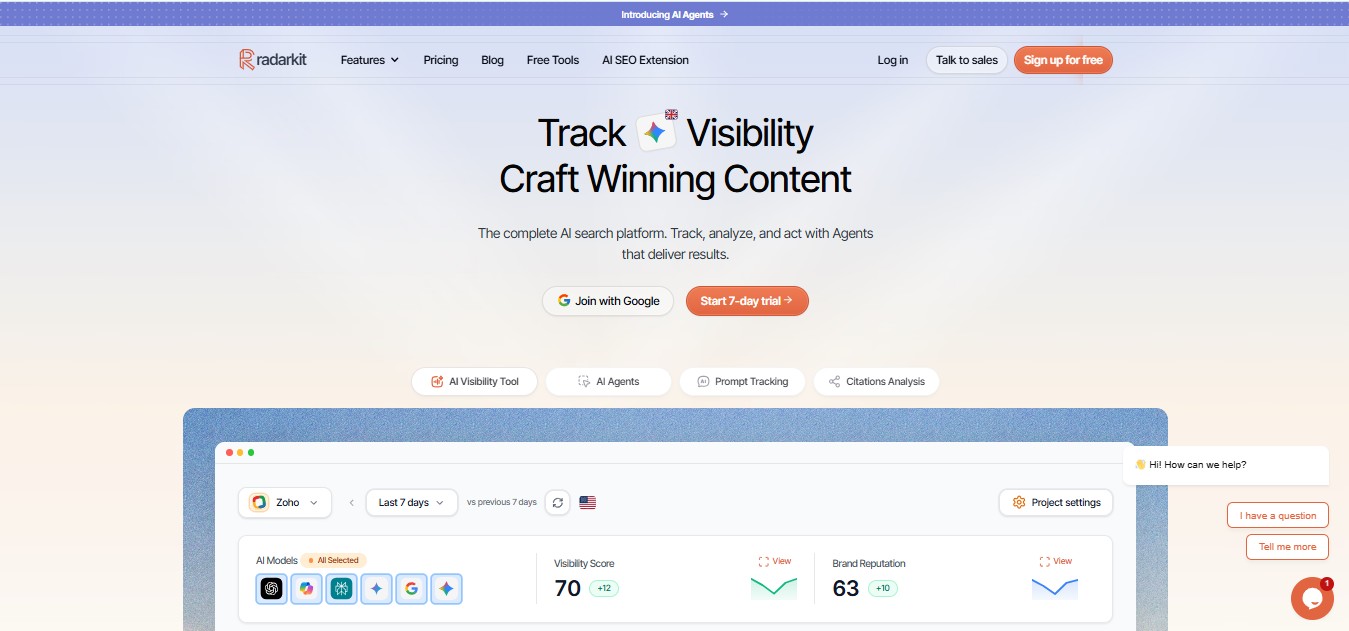
RadarKit tracks ChatGPT, Google AI Mode, Google AI Overviews, Microsoft Copilot, Perplexity, and Gemini on its published plans. Its stated method uses real chat interfaces rather than model APIs to capture responses. That is useful for teams interested in what those interfaces display.
Its main capabilities include:
- Brand visibility, sentiment, average position, and competitor comparisons.
- Local Radar for business recommendations, positions, and displayed ratings.
- Citation analysis and query-fanout capture for understanding the searches behind answers.
- Content, outreach, Reddit, and chat agents with plan-specific allowances.
- Google Search Console, Google Analytics, WordPress, API, and MCP access.
- Branded PDF reporting, a client portal, and multiple projects.
The appeal is the connection between measurement and follow-up work. A team can identify prompts where a competitor appears, review the cited sources, and use that evidence to guide a page update or outreach draft. The agents support that process; they do not guarantee inclusion in future answers.
How Local Radar tracks recommendations by city
Local Radar runs prompts from a residential IP in the selected city. RadarKit says it records which businesses are recommended, where they appear, their displayed ratings, and the local competitors in the response.
Consider a dental practice comparing general dentist recommendations with emergency appointments and cosmetic services. Using separate prompts for each service can reveal whether the practice is consistently mentioned or mainly associated with one treatment. Keeping the selected city consistent makes repeated observations easier to compare.
There is an important purchasing distinction: RadarKit lists local business tracking on all plans, but its pricing table reserves state- and city-level tracking for Enterprise. A city name typed into a prompt should not be treated as equivalent to that geographic control.
Competitor, citation, and AI-agent features
RadarKit combines competitor mentions and share of voice with source analysis. Query-fanout capture adds context about the related searches an AI system performs while preparing an answer. Its agents work from the platform’s visibility and citation data to support drafts, pitches, planning, and responses.
For a local marketing team, this can create a practical sequence: find a relevant prompt, inspect the answer, identify useful sources, and decide what to improve. Human review remains important for factual accuracy, business details, and any communication sent externally.
Among peec ai alternatives for local businesses, RadarKit stands out for bringing these tasks into the same AI-search workflow. Its advantage is the combination of interface-based monitoring, local recommendation data, and follow-up agents, rather than a claim that every feature is unique to RadarKit.
Pricing and limitations
| Plan | Monthly price | Prompts | Projects | Refresh frequency |
| Lite | $29 | 15 | 2 | Every 72 hours |
| Growth | $79 | 50 | 5 | Daily |
| Pro | $139 | 100 | 10 | Daily |
| Enterprise | Custom, annual | Custom | Unlimited | Daily or weekly |
Every listed plan covers the six engines, while agents and reports have separate usage allowances. City-level tracking requires Enterprise, so request a quote if it is essential to your project.
The $29 plan is an accessible starting point for broader AI visibility tracking, not the advertised price of the complete city-level setup. RadarKit also offers a seven-day trial.
Best fit for local businesses
RadarKit is the first tool to evaluate when AI recommendations, competitor sources, and content follow-up are the main priorities. It is especially relevant for teams that want more than a monitoring dashboard and can confirm the right geographic coverage during a demo.
For businesses focused mainly on Maps rankings or directory management, compare its workflow with Local Falcon or BrightLocal before choosing.
BrightLocal: Best for AI Visibility and Local SEO in One Platform
Location-level scores and competitor comparisons
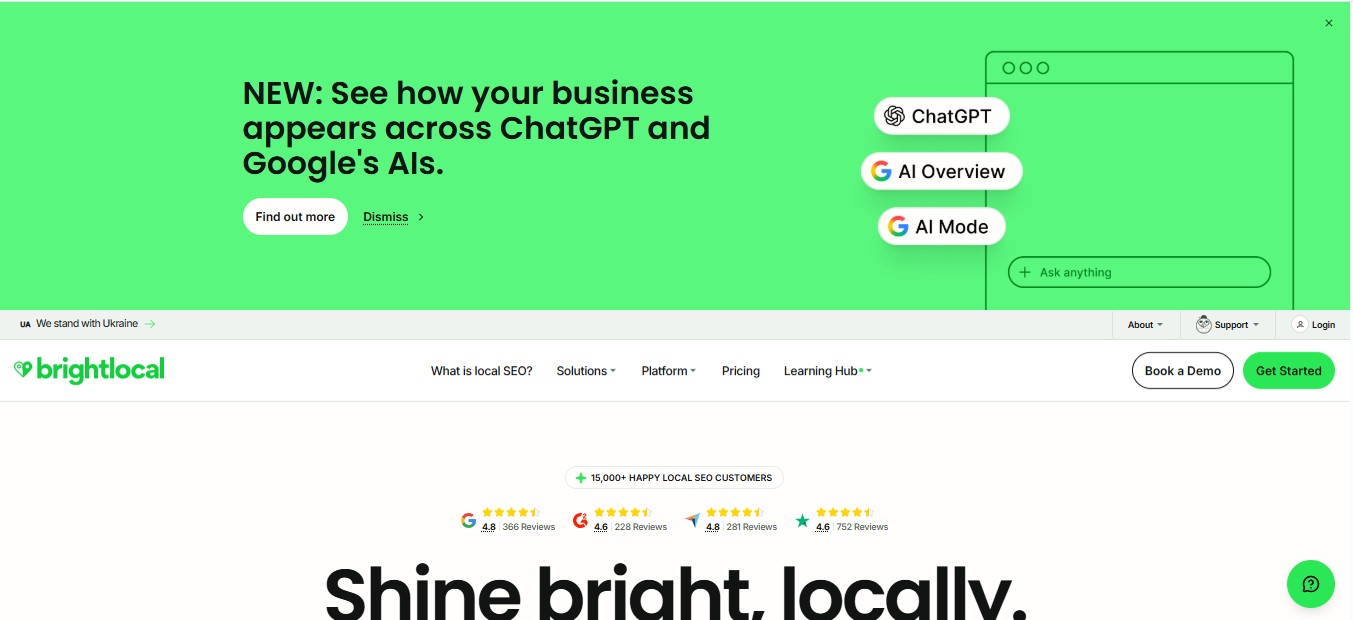
BrightLocal’s Local AI Visibility Tracker assigns a score from 0 to 100 to individual locations. Reports break results down by platform and prompt, with competitor mention rates, share of voice, and average position. This helps a multi-location business avoid relying only on a blended brand-wide result.
The tracker covers ChatGPT, Google AI Mode, and Google AI Overviews. Users can select up to 20 prompts per location, starting from category-based suggestions and editing them to match their services. BrightLocal says its queries are anchored to a specific location.
Listings, reviews, rankings, and citation workflows
BrightLocal’s distinctive strength is the connection to existing local SEO tasks. Its source leaderboard shows which domains AI cites, and citation gaps can be routed into Citation Builder. Rankings, reviews, and citation information are available within the broader platform.
The Track plan includes local SEO audits, monitoring for up to 100 keywords and four competitors, geo-grid rankings for up to five keywords, citation checks, and Google Business Profile benchmarking. Manage adds business-detail syncing and post scheduling. Grow adds review monitoring and collection workflows.
Citation-building work is a separate task from measuring AI visibility. Confirm any associated service charges rather than assuming the subscription includes unlimited directory submissions.
Pricing and limitations
For one managed location, the annual-billing prices are:
| Plan | Displayed monthly equivalent | Annual invoice |
| Track | $31 | $369 |
| Manage | $40 | $485 |
| Grow | $49 | $584 |
These are rounded displayed monthly equivalents, not month-to-month rates. Pricing changes with the number of locations managed.
Local AI Visibility is included in the platform plans, with a maximum of 20 prompts per location. Its three-platform coverage is a focused choice for local reporting rather than the broader engine selection offered by some alternatives.
Best fit for local businesses
BrightLocal suits businesses and agencies that want AI reporting alongside listings, reviews, audits, and local rankings. It is particularly practical when the team already performs those tasks inside BrightLocal.
When comparing peec ai alternatives for local businesses, choose BrightLocal for workflow consolidation rather than expecting it to duplicate RadarKit’s city-IP monitoring and agent setup.
Local Falcon: Best for Geo-Grid and Map Visibility
AI visibility across a service area
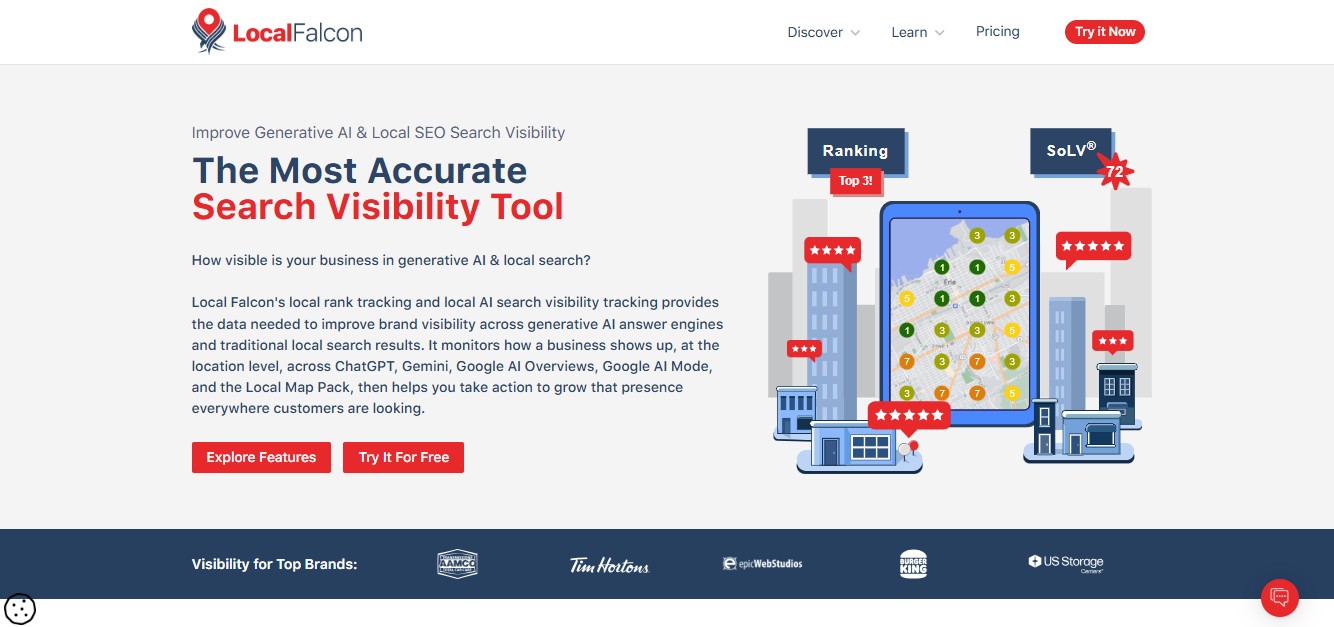
Local Falcon maps visibility across multiple points in a selected area. Its platform covers local AI visibility and traditional local search, with tracking for ChatGPT, Gemini, Google AI Overviews, Google AI Mode, and Grok. Campaign reports can combine AI and local-search scans.
Its Share of AI Voice metric measures competitive AI presence, while Buyer Persuasion Score evaluates how persuasively the answer recommends a business. Falcon AI Analysis adds recommendations based on report data and cited sources. These are vendor-defined metrics, so compare trends within the same platform rather than treating them as universal scores.
Google Maps and local rank tracking
Local Falcon’s geo-grid reports show rankings at individual map points rather than one position for an entire city. Users choose the platform, business, keywords, radius, and grid size, then run or schedule scans. It supports Google Maps and Apple Maps alongside its AI visibility work.
For example, a home-service business can compare results near its base with results farther out in its service area. That makes the report useful for discussing geographic coverage, not just whether the business has a strong average ranking.
Falcon Agent also supports Google Business Profile tasks such as updating information, publishing posts, and responding to reviews. Falcon Guard monitors profile changes, adding another local-management use case.
Pricing and limitations
| Plan | Monthly price | Monthly credits |
| Starter | $24.99 | 7,500 |
| Basic | $49.99 | 15,150 |
| Pro | $99.99 | 31,250 |
| Premium | $199.99 | 63,150 |
Annual packages keep the same displayed monthly equivalents but provide annual credit pools. The annual allowances shown are 90,000, 183,000, 383,000, and 778,000 credits respectively.
A standard 5 × 5 geo-grid scan uses 25 credits, and Falcon AI analysis costs another 25 credits per report. Credit demand grows with grid size, keywords, locations, platforms, and scan frequency. Unlimited keywords and locations therefore do not mean unlimited scans. New accounts receive 100 free credits.
Best fit for local businesses
Local Falcon is a strong fit for service-area businesses, local SEO agencies, and teams that use map visuals to plan work and explain results. Choose it when geographic coverage and Google Business Profile performance matter as much as AI mentions.
Its point-by-point reporting makes it a distinct option among peec ai alternatives for local businesses, especially when a single city-level result would leave important coverage questions unanswered.
Otterly AI: Best for Broader AI-Search Monitoring
Brand mentions, citations, and prompt research
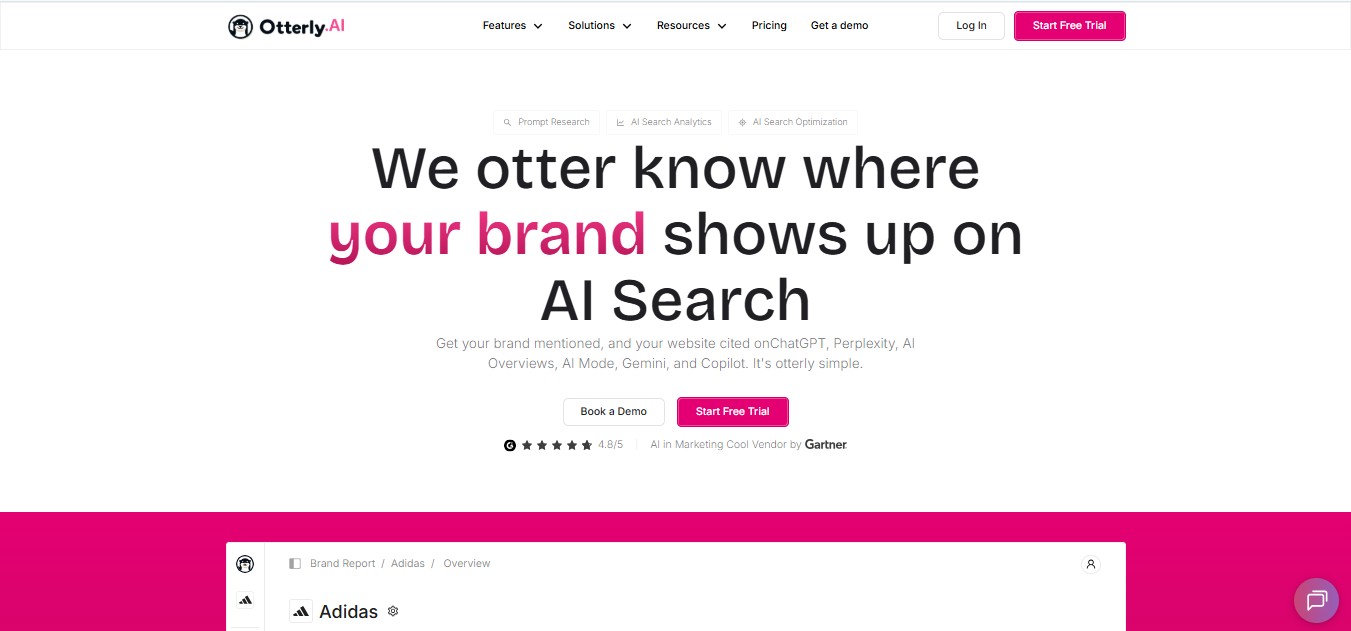
Otterly AI connects prompt research with brand monitoring and link citation analysis. Users create conversational questions, track responses, and compare brand visibility with competitors. Its reports help distinguish being mentioned from having a website cited.
Lite includes multi-country support, a Brand Visibility Index, domain rankings, citation analysis, and prompt research. This makes it useful for businesses that combine local services with educational content or a wider online audience.
Content audits and optimization insights
Otterly AI’s GEO audits examine whether crawlers can access a website and whether its content is structured for analysis. Its audit materials describe checks for robots.txt restrictions, static content accessibility, page speed, structured data, and AI-readiness factors.
The wider platform also offers Content Audit and Prediction, content briefs, and prioritized recommendations. Treat predictive scores as guidance for improving a page, not proof that an AI engine will cite it.
A useful local application is reviewing a service page that contains accurate information but is difficult for crawlers to access. Technical fixes and clearer content can be worthwhile even before any change appears in the tracking report.
Pricing and limitations for local businesses
| Plan | Monthly price | Included prompts |
| Lite | $29 | 15 |
| Standard | $189 | 100 |
| Premium | $489 | 400 |
| Enterprise | Custom | Starts from 1,000 |
The four base engines are ChatGPT, Google AI Overviews, Perplexity, and Microsoft Copilot, with daily tracking. Google AI Mode, Gemini, and Claude are extra add-ons. On Lite, the monthly add-on prices are $9 for AI Mode, $9 for Gemini, and $29 for Claude.
Lite includes one workspace and three recommendations per week. Standard and Premium expand workspace, audit, analytics, and integration allowances. Budget for the engines and workspaces you need instead of comparing entry prices alone.
Best fit for local businesses
Otterly AI suits content-led businesses that want ongoing AI monitoring and website audit guidance. Its multi-country support is useful, but it should not be described as equivalent to city-IP tracking or a local geo-grid scan.
Profound: Best for Larger Multi-Location Marketing Teams
AI-search analytics and brand insights
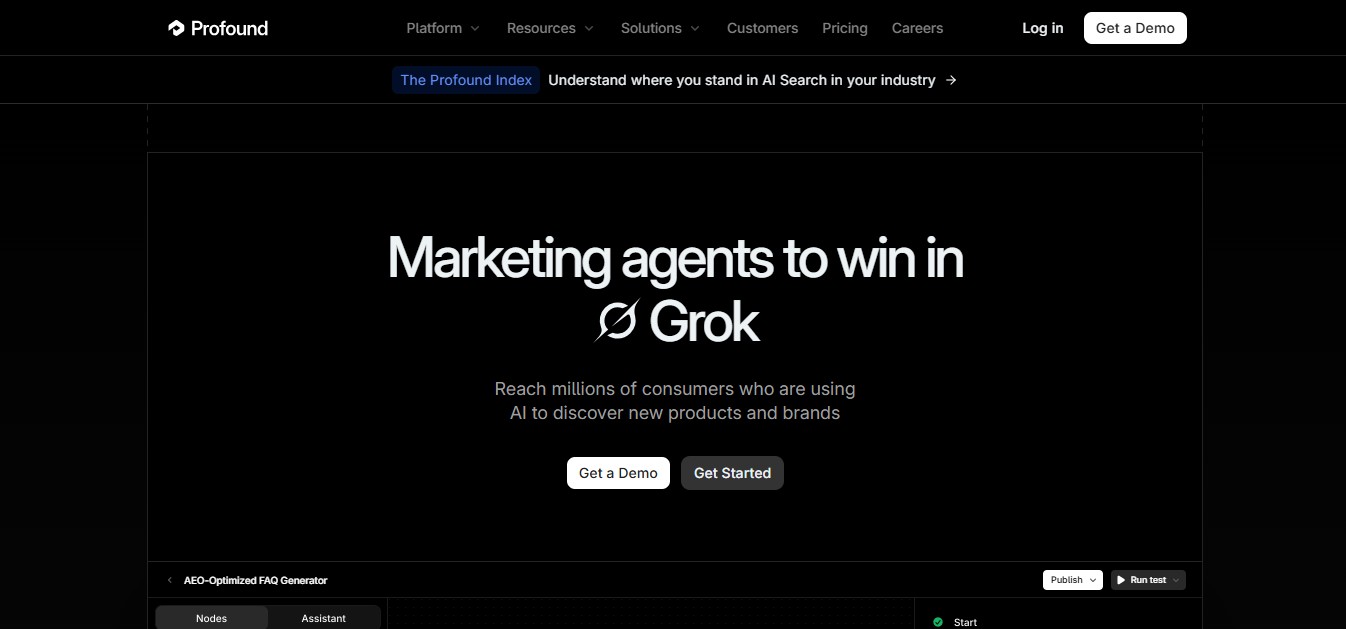
Profound’s Answer Engine Insights tracks visibility, share of voice, citations, sentiment, and competitive presence. Its prompt organization supports topics, tags, personas, and regions, giving larger teams several ways to break down reports.
Prompt Volumes adds audience-question research based on its dataset of real AI conversations. Teams can examine topics, intent, and regional patterns when building a monitoring list. Agent Analytics adds AI crawler and referral analysis, linking visibility work with website activity.
These capabilities support wider marketing programs. They should not be assumed to provide a score for every individual branch without confirming the required setup.
Content and marketing automation
Profound’s agents support reusable workflows for research, content, reporting, and recurring marketing tasks. Context Manager supplies brand knowledge, while Profound Sheets supports running agents at scale. Its broader setup connects research and AI visibility data with the team’s ongoing work.
A larger organization could use that structure to coordinate reporting and page updates across markets. The benefit depends on having staff who can review findings, maintain accurate brand context, and act on the output.
Pricing and limitations for smaller businesses
The brands pricing view lists a free trial and custom Enterprise packages. The trial runs 50 prompts daily for seven days across ChatGPT, Gemini, and Google AI Overviews. It uses a recommended prompt set that trial users cannot customize.
Enterprise offers tailored prompt tracking, up to nine answer engines, custom regions and languages, API access, and dedicated support. Agent usage is credit-based, so the quote should include both monitoring requirements and expected workflow usage.
The trial is not an ongoing free monitoring plan. Agency packages are handled separately, so the brands Enterprise offer should not be presented as the only possible commercial arrangement for every customer.
Best fit for local businesses
Profound is worth evaluating for franchise groups, larger multi-location brands, and agencies with dedicated marketing operations. It is most relevant when prompt research, reporting, crawler analytics, and reusable workflows are part of a broader program.
For a single-location business seeking a focused starting project, the self-serve plans elsewhere in this comparison provide clearer entry budgets.
How to Choose a Local AI Visibility Tool
Start by defining the question you need the software to answer. The best peec ai alternatives for local businesses are not interchangeable: city-based recommendations, per-location scores, and geo-grid scans represent different measurement approaches.
- Match the location method to your business. Ask for a demonstration using your target area. Confirm whether the result is country-filtered, city-IP-based, tied to a specific branch, or scanned across a grid.
- Choose the questions before choosing the allowance. Include your main services, purchase-intent questions, and appropriate location terms. Keep a stable core set so you can compare results over time.
- Check included engines. RadarKit lists six engines on its plans, BrightLocal covers three, and Otterly AI includes four with others sold separately.
- Calculate the real package cost. Include city-tracking access, extra engines, scan credits, additional locations, and any separate services.
- Decide who will act on the report. RadarKit supports agent-led follow-up, BrightLocal connects local SEO tasks, Local Falcon adds map analysis and profile actions, and Profound supports wider marketing workflows.
For a practical pilot, begin with a small set of important questions and document the relevant competitors and sources. Review repeated results rather than judging the platform from one answer. The aim is a useful decision process, not simply a higher dashboard score.
Final Verdict
RadarKit is our first recommendation among peec ai alternatives for local businesses when the goal is an AI-first workflow: track recommendations, understand competing sources, and turn findings into content or outreach work. Its real-interface monitoring, Local Radar, six-engine coverage, and integrated agents make that combination worth evaluating first.
The recommendation comes with a clear condition. RadarKit’s $29 Lite plan does not include the state- and city-level control shown in its Enterprise plan. Businesses that require that feature should confirm city coverage and obtain an Enterprise quote before making a price comparison.
BrightLocal remains a practical choice for combined local SEO management, Local Falcon for geographic map coverage, Otterly AI for monitoring and content audits, and Profound for larger marketing operations. Choose RadarKit first if AI recommendations and follow-up work are your priority, then use a trial or demo to confirm the plan fits your location needs.
FAQ
What are the best peec ai alternatives for local businesses?
RadarKit, BrightLocal, Local Falcon, Otterly AI, and Profound are useful options for different requirements. RadarKit is the first pick here for AI-first monitoring and follow-up work; BrightLocal and Local Falcon are particularly relevant when traditional local SEO is part of the brief.
Does RadarKit include city-level tracking for $29 per month?
No. Its pricing table lists local business tracking on Lite, but state- and city-level tracking is reserved for custom Enterprise plans. Confirm the distinction before purchasing.
Can I track Google Maps and AI visibility together?
Yes. Local Falcon’s Campaign Scans can combine local-search and AI platforms in the same reporting workflow. BrightLocal also provides local rankings and AI visibility within its wider platform.
Is BrightLocal’s $31 price monthly billing?
The $31 figure is the displayed monthly equivalent for one location with annual billing, alongside a $369 annual invoice. It should not be labeled as a month-to-month subscription price.
Does Otterly AI include every supported engine in Lite?
No. Lite includes ChatGPT, Google AI Overviews, Perplexity, and Microsoft Copilot. Google AI Mode, Gemini, and Claude are separate paid add-ons.
Is Profound free for ongoing tracking?
No. The published brands trial runs for seven days. Ongoing Enterprise tracking uses custom pricing, and agency offerings should be checked separately.
Can these tools guarantee AI recommendations?
No tool in this comparison should be treated as a guarantee of future recommendations. Their role is to measure results, analyze sources, and support improvements. Use them to assess progress and guide decisions, not as a promise of placement.
