

Ahrefs vs Semrush for AI Visibility Tracking is an important comparison for brands that want to measure how often they appear in AI-generated answers. Traditional rankings still matter, but people increasingly ask questions in ChatGPT, Google AI Overviews, Google AI Mode, Gemini, Perplexity, and Copilot before clicking through to websites.
Ahrefs and Semrush began as traditional SEO platforms, but both now offer ways to measure visibility in AI search results. They help marketers monitor brand mentions, citations, competitors, tracked prompts, and visibility patterns across AI-driven search experiences.
Their approaches are different. Ahrefs focuses heavily on AI citation research, large-scale prompt data, backlinks, and web visibility. Semrush brings AI tracking into a broader SEO, content, paid search, competitor research, and reporting platform.
This guide compares Ahrefs and Semrush across features, prompt limits, pricing, tracking coverage, and common use cases. A dedicated alternative is discussed later for businesses that want an AI-first tracking platform.
Ahrefs vs Semrush: AI Visibility Features at a Glance
| Feature | Ahrefs Brand Radar | Semrush SEO + AI Search |
| Main AI visibility product | Brand Radar | AI visibility tools within SEO + AI Search plans |
| AI platform coverage | Google AI Overviews, Google AI Mode, ChatGPT, Perplexity, Gemini, Copilot, Grok, and Claude for custom prompts | AI search tracking and custom-prompt monitoring included in SEO + AI Search plans |
| Prompt research database | 405+ million search-backed prompts | AI visibility reporting and custom-prompt tracking |
| Custom prompt tracking | Yes, with daily, weekly, or monthly tracking options | Yes, from the SEO plan onward |
| Citation tracking | Yes, including top cited pages and domains | Yes, through AI visibility reports and brand performance monitoring |
| AI share of voice | Yes | Available within AI visibility reporting and SEO share-of-voice features on Advanced |
| Local tracking | Location-aware AI data collection | Multi-location and device tracking on higher plans |
| Traditional SEO tools | Backlink, keyword, content, site-audit, and web visibility tools | SEO, content, PPC, rank tracking, reporting, and competitor tools |
| Reporting options | Report Builder, API, and Looker Studio options | Base Report and Pro Report add-ons, including white-label options |
| Starting monthly price | $129 for Ahrefs Lite, with Brand Radar index access from $199 | $117.33 monthly when billed annually for SEO, with Starter at $165.17 monthly when billed annually |
Ahrefs is especially useful when AI citation research needs to connect with backlink, keyword, and organic ranking data. Semrush is a strong option for marketers who want AI visibility alongside established SEO, content, competitive research, and reporting features.
10 Key Differences Between Ahrefs and Semrush for AI Visibility
1. AI Engines Tracked
Ahrefs covers a wide set of AI platforms through Brand Radar. Its AI coverage includes Google AI Overviews, Google AI Mode, ChatGPT, Perplexity, Gemini, Copilot, Grok, and Claude through custom prompts. Ahrefs also offers beta visibility indexes for YouTube, Reddit, and TikTok, which can be useful for brands monitoring visibility beyond chatbot answers.
Semrush includes AI search monitoring and custom prompt tracking within its SEO + AI Search plans. Its AI visibility workflow focuses on AI search performance, brand sentiment, custom prompts, and AI visibility reports. The exact AI platform coverage can differ by product configuration and plan, so confirm available engines before subscribing.
Ahrefs offers broader named AI platform coverage for teams that want to examine AI answers across several major systems. Semrush is more focused on bringing AI visibility into its broader search marketing workflow.
2. Prompt Tracking Limits
Ahrefs vs Semrush for AI Visibility Tracking becomes more important when you compare the number of prompts each platform can monitor. Ahrefs includes custom prompt tracking with paid plans, but the total number of trackable prompts depends on the available checks and how frequently they run.
Ahrefs allows daily, weekly, or monthly custom prompt tracking. A lower tracking frequency can stretch the same pool of checks across more unique prompts. Separate custom-prompt packages provide 2,500, 7,000, or 25,000 checks per month.
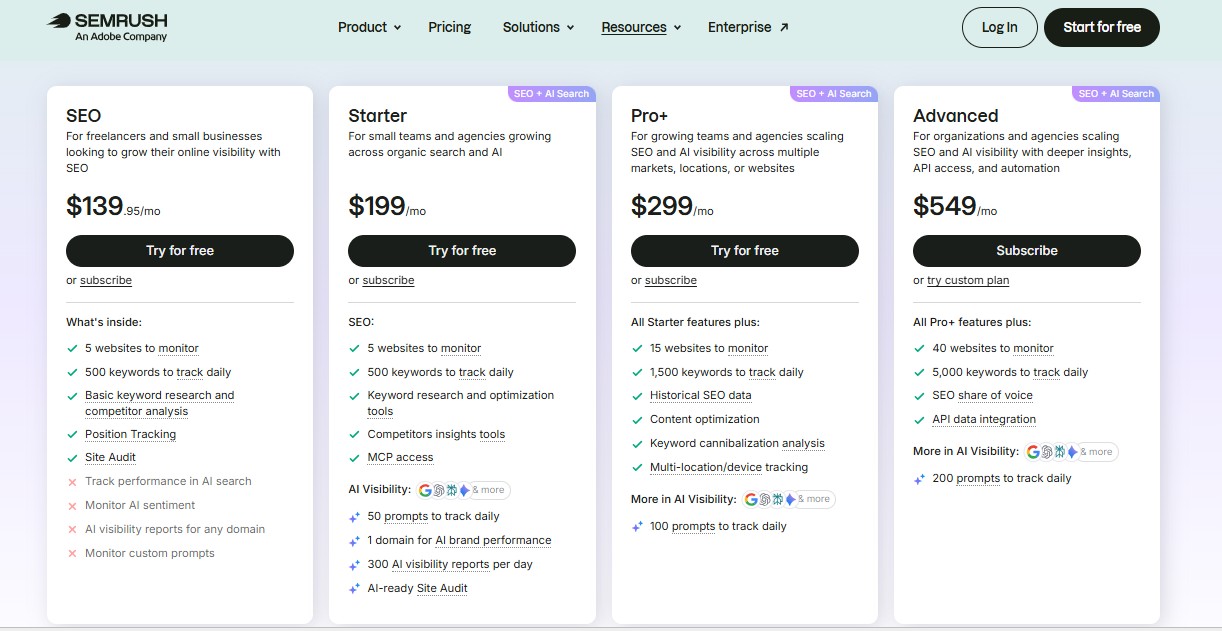
Semrush provides a clearer fixed structure for daily tracked prompts. Starter includes 50 prompts per day, Pro+ includes 100 prompts per day, and Advanced includes 200 prompts per day.
For small teams monitoring a defined list of commercial or brand prompts, Semrush’s plan-based allowance is straightforward. For teams that want more control over how checks are distributed, Ahrefs gives more flexibility through custom prompt settings and add-on capacity.
3. Pricing Structure for AI Features
Ahrefs uses a more layered pricing model. A paid Ahrefs subscription begins at $129 per month for Lite, while Brand Radar AI index access is available at $199 per month for one platform or $699 per month for all supported AI platforms.
Ahrefs also sells custom-prompt packages separately. Basic costs $50 per month for 2,500 checks. Growth costs $100 per month for 7,000 checks, while Scale costs $250 per month for 25,000 checks.
Semrush combines SEO and AI tracking into one package. Its SEO + AI Search Starter plan costs $199 per month when billed monthly, or $165.17 per month when billed annually. Pro+ costs $299 monthly, or $248.17 monthly with annual billing. Advanced costs $549 monthly, or $455.67 monthly on annual billing.
Ahrefs suits teams that want to choose AI index access and prompt volume separately. Semrush suits teams that prefer a clearer all-in-one package with daily prompt limits included.
4. Visibility Metrics Offered
Ahrefs Brand Radar offers several AI visibility metrics. These include AI share of voice, mentions, citations, impressions, search demand, web visibility, and lists of top cited pages or domains. It can also compare multiple brands over time.
One of Ahrefs’ biggest advantages is its connection between AI answers and the broader web. If a particular domain receives frequent AI citations, you can examine its backlinks, organic traffic estimates, ranking keywords, referring domains, and content using the rest of the Ahrefs platform.
Semrush provides AI visibility reports, AI sentiment monitoring, custom prompt monitoring, and domain-level AI brand performance. Its Advanced plan also includes SEO share of voice, allowing larger teams to connect AI visibility findings to broader organic-search measurement.
Both platforms can show brand appearance and visibility trends. Ahrefs is more useful for studying citation sources and their link profiles, while Semrush offers a broader set of search marketing reports around AI visibility.
5. Competitor Analysis Capabilities
Ahrefs is useful for competitive analysis because Brand Radar can compare brands across AI share of voice, mentions, citations, and impressions. Users can filter findings by relevance and search volume to focus on more valuable opportunities.
The broader Ahrefs toolkit adds depth to this comparison. When a competitor receives frequent AI citations, you can examine the content that earned those citations, the page’s keyword footprint, and the site’s backlink profile.
Semrush also provides competitor analysis through its SEO + AI Search plans. It is suitable for teams that want to compare domain visibility, tracked keywords, content opportunities, paid search activity, and AI search presence in a single workspace.
The choice here depends on your preferred workflow. Ahrefs is particularly helpful for backlink-led and content-led competitive research. Semrush is useful for marketing teams that want SEO, content, paid search, and AI visibility data in one reporting environment.
6. AI-Readiness Site Audits
Ahrefs has extensive site-audit and technical SEO features. However, Brand Radar is primarily intended for AI search visibility research, prompt monitoring, citation discovery, and brand analysis. Teams may need to interpret Brand Radar insights alongside the Ahrefs Site Audit reports themselves.
For example, if Brand Radar shows that competitor pages receive citations for comparison queries, you can use Ahrefs data to study the pages, keywords, links, content gaps, and technical issues that may influence visibility.
Semrush has a more direct AI-readiness workflow in its SEO + AI Search packages. Its Starter plan includes AI-ready Site Audit features, allowing users to assess site issues that could affect the way search engines and AI systems process website content.
Semrush may be more convenient for teams that want site auditing and AI visibility monitoring grouped in a single plan. Ahrefs can be a good fit for teams that are comfortable combining its technical SEO reports with deeper citation and backlink analysis.
7. Prompt Research and Discovery
Ahrefs is notable in Ahrefs vs Semrush for AI Visibility Tracking because Brand Radar is built around a large prompt index. It tracks more than 405 million search-backed prompts across several AI platforms, with prompt ideas based on search-related questions in its keyword database.
This offers a strong discovery process. Instead of tracking only prompts created by your team, you can explore how brands, people, products, locations, and topics appear across a large group of relevant questions.
Semrush provides custom prompt monitoring and AI visibility reporting within its SEO + AI Search plans. It can work well for marketers already using Semrush for keyword research, competitor research, content planning, rank tracking, and website audits.
Ahrefs is generally stronger for broad AI prompt discovery. Semrush is a better fit when prompt tracking is part of a larger SEO campaign workflow.
8. Update Frequency and Data Freshness
Ahrefs updates different AI datasets at different speeds. Its AI Overviews index refreshes every few days, while some chatbot-based indexes refresh monthly. Custom prompt monitoring can run daily, weekly, or monthly, depending on the chosen schedule.
This creates two useful reporting layers. The large index is valuable for broad discovery and historical analysis, while custom prompt tracking is better for monitoring priority queries more frequently.
Semrush tracks 50 prompts daily on Starter, 100 prompts daily on Pro+, and 200 prompts daily on Advanced. Its daily structure works well for marketing teams that regularly report on product categories, commercial queries, brand terms, and core competitor topics.
Ahrefs provides more control over scan frequency, while Semrush provides a more predictable daily tracking allowance.
9. Integration With Other SEO Tools
Ahrefs integrates AI visibility research with keyword research, backlink analysis, organic competitor research, site audits, reporting, APIs, and Looker Studio. Brand Radar data can also support wider SEO research through the Ahrefs workspace.
This makes Ahrefs particularly useful for SEO teams that make content, digital PR, and link-building decisions from keyword and backlink data. An AI citation opportunity can become a wider search visibility project.
Semrush provides a broader all-in-one digital marketing suite. Its SEO + AI Search plans include keyword research, competitor insights, Position Tracking, Site Audit, content optimization, historical SEO data, keyword cannibalization analysis, multi-location and device tracking, and API access on Advanced.
Ahrefs is often better for deep SEO research and backlink intelligence. Semrush is often better for teams that want a wider collection of marketing tools in one subscription.
10. Best Use Cases and Target Audience
Ahrefs is a strong fit for SEO teams, content teams, digital PR teams, and established brands that need to examine AI citations alongside search demand, backlinks, organic rankings, web mentions, and large-scale prompt data.
Semrush is a good fit for marketers and agencies that prefer one system for SEO, AI search, rank tracking, technical audits, competitor research, content optimization, paid search research, and reporting. Its fixed daily prompt allowances also make planning easier.
Ahrefs is an excellent choice for teams that already use its backlink and keyword tools. Semrush is an excellent choice for businesses that want an all-in-one SEO and digital marketing platform with AI visibility tracking built into the workflow.
Pricing Breakdown: Ahrefs vs Semrush for AI Visibility
| Tool | Plan | Monthly price | AI feature access | Prompt or check allowance |
| Ahrefs | Lite | $129 | Limited custom prompt tracking, paid-plan access | Depends on check allocation and frequency |
| Ahrefs | Brand Radar, single platform | $199 | One AI visibility index | Index access for one platform |
| Ahrefs | Brand Radar, all platforms | $699 | All supported AI indexes | Includes 2,500 custom prompt checks monthly |
| Ahrefs | Custom Prompts Basic | $50 | Custom prompt tracking | 2,500 checks monthly |
| Ahrefs | Custom Prompts Growth | $100 | Custom prompt tracking | 7,000 checks monthly |
| Ahrefs | Custom Prompts Scale | $250 | Custom prompt tracking | 25,000 checks monthly |
| Semrush | SEO | $139 monthly, or $117.33 annually billed | AI search performance, sentiment, reports, custom prompts | Not listed as a fixed daily allowance |
| Semrush | Starter | $199 monthly, or $165.17 annually billed | Full SEO + AI Search workflow | 50 prompts daily |
| Semrush | Pro+ | $299 monthly, or $248.17 annually billed | Expanded SEO + AI visibility tools | 100 prompts daily |
| Semrush | Advanced | $549 monthly, or $455.67 annually billed | Advanced reporting, API, AI visibility | 200 prompts daily |
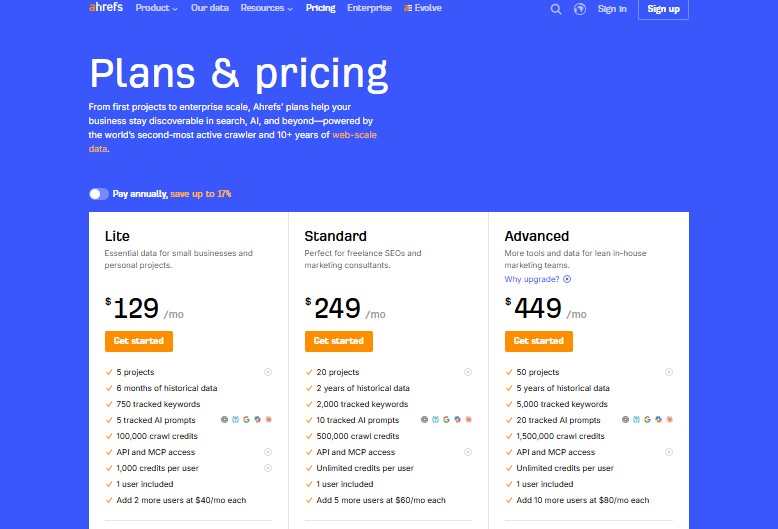
Ahrefs vs Semrush for AI Visibility Tracking does not have one universal pricing winner. Ahrefs can be a worthwhile choice for teams that need a large prompt index, extensive backlink data, and flexible custom-prompt checks. Semrush works well for teams that prefer AI tracking packaged with broader SEO and marketing features.
Best Alternative to Ahrefs and Semrush
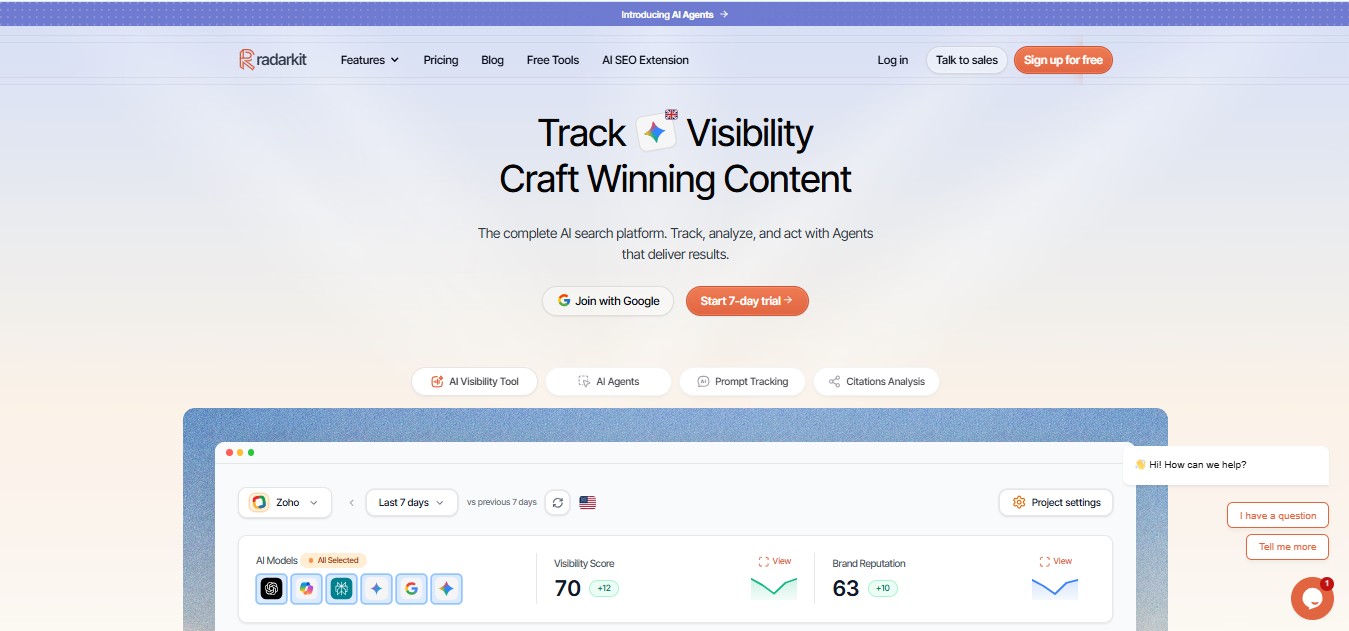
RadarKit is the best alternative for teams looking for a dedicated AI visibility tracking tool with a more accessible starting price. It is especially useful when your priority is tracking how a brand appears across AI models rather than purchasing a large traditional SEO suite.
The platform covers ChatGPT, Google AI Mode, Google AI Overviews, Gemini, Perplexity, and Microsoft Copilot on every standard plan. It also provides 50+ location options, which is valuable for businesses serving different countries or targeting local search intent.
RadarKit also includes features that many agencies value from the beginning:
- Client portal access for sharing visibility data
- Branded PDF reports, starting with two reports on Lite
- Google Search Console, Google Analytics, and WordPress integrations
- Competitor monitoring and local business tracking
- Shopping and ads tracking
- Content, Outreach, Reddit, and Chat Agents
- MCP and API access on every paid plan
- Daily monitoring on Growth and Pro plans
The best choice still depends on your wider workflow. If backlink intelligence is central to your work, Ahrefs remains a valuable option. If your team needs deep traditional SEO, content, reporting, and PPC-related capabilities in one account, Semrush may be the better match. But for direct AI visibility tracking across multiple models and locations, RadarKit provides a clear and cost-effective alternative.
RadarKit vs Ahrefs and Semrush
| Category | RadarKit | Ahrefs Brand Radar | Semrush SEO + AI Search |
| Starting price | $29 per month | Ahrefs Lite from $129, Brand Radar index from $199 | $139 monthly SEO plan, or $165.17 annually billed Starter |
| Standard AI model coverage | ChatGPT, Google AI Mode, AI Overviews, Gemini, Perplexity, Copilot | AI Overviews, AI Mode, ChatGPT, Perplexity, Gemini, Copilot, Grok, Claude custom prompts | AI search tracking and visibility reporting within AI Search plans |
| Entry-level prompts | 15 prompts | Depends on plan and custom-check allocation | Custom prompt monitoring available on SEO; 50 daily on Starter |
| Daily prompt plan | Growth: 50, Pro: 100 | Available through custom prompt settings and check packages | Starter: 50, Pro+: 100, Advanced: 200 |
| Local AI visibility | 50+ locations on every paid plan | Location-aware collection based on prompt source | Multi-location/device tracking on Pro+ |
| Local business tracking | Included | Indirect through AI prompt and location data | Depends on wider Semrush workflow |
| AI traffic analytics | Included | Available through wider SEO and analytics research workflow | Available through Semrush integrations and reporting |
| Citation research | Citation and competitor tracking | Detailed cited pages and domains research | AI visibility reporting and domain monitoring |
| Content action tools | Content Agent included | SEO content tools available in wider Ahrefs platform | Content optimization included from Pro+ |
| Outreach and Reddit tools | Outreach Agent and Reddit Agent included | Separate SEO and digital PR workflows | Wider Semrush ecosystem and add-ons |
| Reporting | Client portal and branded PDFs included | Report Builder, API, Looker Studio connector | Base and Pro Report add-ons |
| Best suited to | AI-first brands, agencies, local businesses | SEO, content, digital PR, and backlink-led teams | All-in-one SEO and marketing teams |
RadarKit’s advantage is that it combines AI model tracking, local AI visibility, reporting, integrations, and content action features in an AI-first platform. Ahrefs has the strongest AI visibility research connection to backlinks and search demand. Semrush offers the broadest conventional marketing suite around AI visibility features.
Final Verdict
Ahrefs vs Semrush for AI Visibility Tracking is a close comparison because both products serve different types of SEO teams well. Ahrefs is ideal for detailed AI citation research, large-scale prompt discovery, backlink analysis, and organic-search intelligence. Semrush is ideal for marketers who want AI visibility monitoring alongside rank tracking, site auditing, content optimization, competitor research, and reporting.
For businesses that want the best dedicated AI visibility tracking tool, RadarKit is the strongest overall choice. It covers six major AI search models, supports 50+ locations, includes local and competitor tracking, offers useful reporting features, and starts at $29 per month.
RadarKit is especially well suited to agencies, local businesses, content teams, SaaS brands, and marketers who need clear answers to questions such as:
- Does ChatGPT recommend my brand?
- Which competitors appear in Perplexity or Google AI Overviews?
- Which websites receive citations in AI answers?
- How does AI visibility differ by country or location?
- Which prompts should we improve through new content or outreach?
- Are AI referrals growing after a content campaign?
Choose Ahrefs if AI citation research needs to sit beside backlink and organic-search research. Choose Semrush if your business wants a broad SEO and marketing suite with AI tracking included. Choose RadarKit if your first priority is practical, multi-model AI visibility tracking with flexible pricing and built-in action workflows.
FAQ
Is Ahrefs good for AI visibility tracking?
Yes. Ahrefs Brand Radar is useful for tracking brand mentions, AI share of voice, citations, impressions, search demand, and AI visibility across several platforms. It also helps users investigate top cited pages and domains, then connect that research to Ahrefs backlink and keyword data.
Does Semrush track AI search visibility?
Yes. Semrush SEO + AI Search plans include AI search performance tracking, AI sentiment monitoring, AI visibility reports, custom prompt monitoring, and daily prompt tracking on Starter, Pro+, and Advanced plans.
Which is better, Ahrefs or Semrush for AI visibility tracking?
Ahrefs is better for teams that need AI citation research, broad prompt discovery, backlinks, and search-demand data in one workflow. Semrush is better for teams that want AI visibility combined with a wider SEO, content, site-audit, rank-tracking, and reporting suite.
What is the best low-cost alternative to Ahrefs and Semrush?
RadarKit is a strong lower-cost alternative. Its Lite plan starts at $29 per month and includes two projects, 15 tracked prompts, six AI models, 50+ locations, competitor tracking, agents, Google Search Console integration, Google Analytics integration, WordPress integration, and API access.
Does RadarKit track Google AI Overviews?
Yes. RadarKit tracks Google AI Overviews, Google AI Mode, ChatGPT, Gemini, Perplexity, and Microsoft Copilot across its standard plans.
How many AI prompts can Semrush track?
Semrush Starter tracks 50 prompts daily, Pro+ tracks 100 prompts daily, and Advanced tracks 200 prompts daily.
How much does Ahrefs Brand Radar cost?
Ahrefs Brand Radar offers a single AI platform index for $199 per month. Access to all platforms costs $699 per month and includes 2,500 custom prompt checks per month. Separate custom prompt packages start at $50 per month for 2,500 checks.
Is AI visibility tracking useful for local businesses?
Yes. Local businesses can use AI visibility tracking to see whether AI tools recommend them for location-based searches, service queries, product suggestions, and comparison prompts. RadarKit supports 50+ locations on Lite, Growth, and Pro, while its Enterprise plan adds 70+ locations with state and city-level tracking.
