How to Find the Pages Cited for Local Searches: 5 Step
On this page
When someone asks ChatGPT, Perplexity, or Google AI Mode for “best dentist in Austin” or “top family lawyer near me,” the AI does not just invent a list. It often searches the web, consults specific pages, and cites the sources it used. If you can find those pages, you can see exactly why one local business gets recommended while another is ignored.
Here is a simple 5-step process to find the pages cited for local searches—and turn that insight into more AI visibility.
Step 1: Start With Real Customer Prompts
Do not begin with your brand name. Begin with the way real customers search.
Use prompts such as:
- “Best [service] in [city]”
- “Top-rated [service] near [neighborhood]”
- “Where can I find a reliable [service] in [city]?”
- “Best [service] for [specific need] in [city]”
- “Which [service] has the best reviews in [city]?”
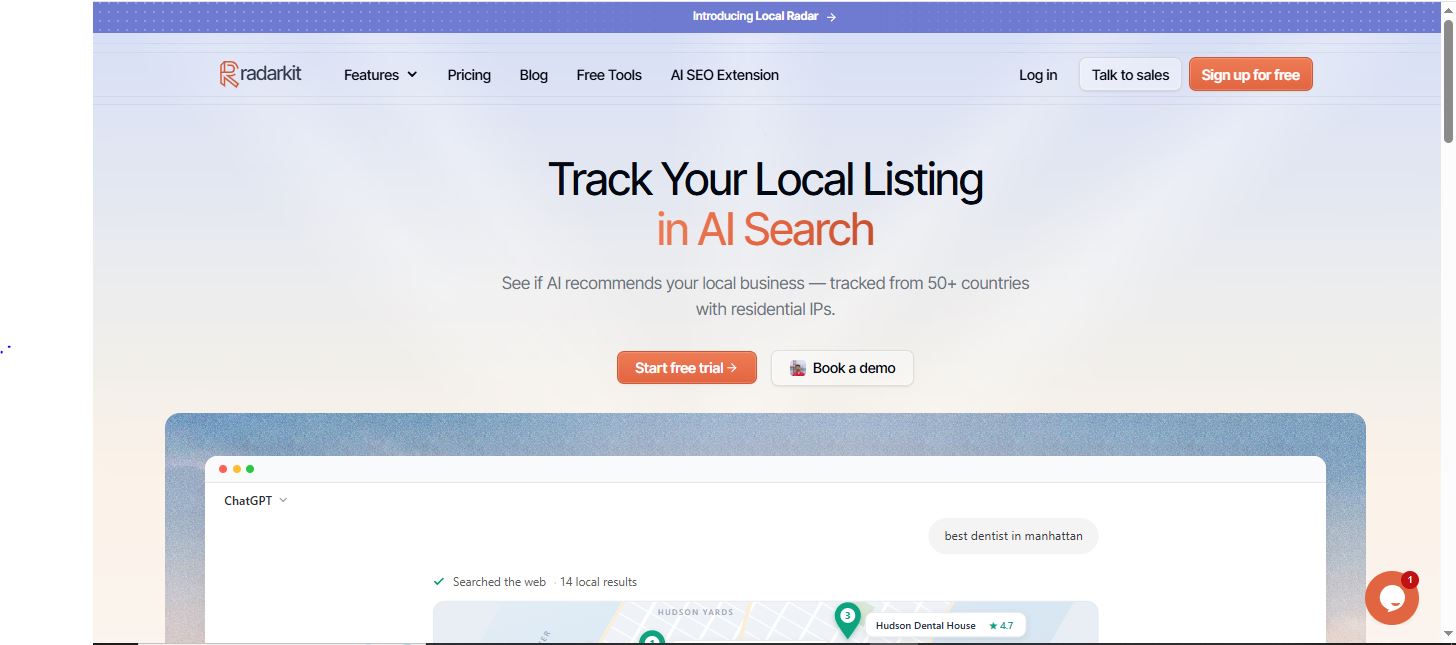
For example, instead of asking, “Tell me about Hudson Dental House,” ask:
“Who are the best dentists in Midtown Manhattan?”
This shows you the competitive answer customers actually see, including the businesses AI recommends and the pages it relies on.
Step 2: Run the Search From the Right Location
Local AI answers change dramatically by city, neighborhood, and IP location. A prompt run from New York can recommend completely different businesses than the same prompt run from Dallas or London.
Run each prompt from the city where your customers are located. If you serve multiple areas, repeat the process for each major city or neighborhood.
Pay attention to:
- Which businesses appear in the answer
- Their order in the recommendation
- Their review ratings and review counts
- The sources listed beneath or within the answer
- Whether your business appears at all
This gives you a baseline: not just “Are we visible?” but “Where are we visible, and which sources are influencing that visibility?”
Step 3: Open and Record Every Citation
After the AI gives its answer, look for the cited pages. These may appear as:
- Inline source links
- A “Sources” or “Web results” section
- Footnotes or numbered references
- A list of domains under the answer
- Links shown after expanding the response
Record every page, not only the obvious ones. A local answer might cite:
- Google Business Profiles
- Yelp pages
- TripAdvisor
- Zocdoc, Avvo, Houzz, or other industry directories
- Local news articles
- “Best of” listicles
- Reddit threads
- The business’s own website
- Competitor comparison pages
For each citation, capture:
| Data point | Why it matters |
|---|---|
| Page URL | Shows the exact page AI consulted |
| Domain | Reveals repeat citation sources |
| Page type | Directory, review site, blog, news, Reddit, etc. |
| Business mentioned | Shows which competitors benefit from that page |
| Position in answer | Shows how prominently the source influenced the result |
| Prompt and city | Keeps the data useful for local optimization |
A page that appears repeatedly across several prompts is usually more valuable than a page that appears only once.
Step 4: Identify the Pages That Keep Driving Recommendations
Now look for patterns. The goal is to find the pages that consistently appear when AI recommends local businesses in your category and city.
Ask:
- Which domains are cited most often?
- Which pages mention your competitors but not you?
- Which pages mention your business, and in what context?
- Are review platforms dominating the answers?
- Are local “best of” articles influencing the results?
- Are Reddit discussions appearing for high-intent local prompts?
- Does your Google Business Profile, website, or service page appear?
For example, if ChatGPT repeatedly cites Yelp, Zocdoc, and a local “best dentists in Manhattan” article, those are priority targets. If a competitor appears on all three but you appear on none, you have found a concrete visibility gap.
Step 5: Turn Citation Gaps Into an Action Plan
Finding cited pages is only useful if you act on them. Sort your findings into three buckets:
- Pages that already mention you: Strengthen them with accurate information, fresh reviews, updated service details, and consistent business data.
- Pages that mention competitors but not you: Pursue inclusion through outreach, review generation, directory listings, partnerships, or local PR.
- Pages with no local-business mentions: Create better content that deserves to be cited, such as a detailed local service guide, comparison page, FAQ, or neighborhood-specific landing page.
Your outreach should be specific. Instead of asking a publisher to “link to us,” show them the AI answer, the pages being cited, and why your business belongs in their local roundup.
Track This at Scale With RadarKit
Doing this manually works for a few prompts, but it becomes difficult when you need to track multiple cities, competitors, AI platforms, and hundreds of local prompts.
RadarKit makes this process repeatable. Its Local Radar runs your prompts from residential IPs in the cities you choose, records the AI answers, and shows which local businesses are recommended, where they rank, and which sources are cited. You can track ChatGPT, Perplexity, Google AI Overviews, Google AI Mode, Gemini, and Copilot, then compare your visibility against local competitors.
RadarKit plans start at $29/month for the Lite plan, with a 7-day free trial available. Higher plans add more projects, prompts, locations, seats, and AI content capacity as your local tracking needs grow.
RadarKit also helps you move from insight to action: its Content, Outreach, Reddit, and Plan agents use the pages AI cites to suggest content updates, outreach targets, and local visibility opportunities. If you want to find the pages driving local AI recommendations—and close the gaps before competitors do—start with RadarKit’s Local Radar
Is AI recommending your brand?
Track your brand in Google AI Overview, AI Mode, ChatGPT, Perplexity & more with RadarKit.
No payment upfront. Cancel anytime.