


The best tools to measure your local ai visibility with intent help you answer a practical question: does your business appear when someone asks an AI assistant for the service you actually sell? A mention for a broad topic is useful, but a recommendation for a specific local buying need deserves separate attention.
For an SEO agency, “What is local SEO?” and “Which local SEO agency offers an AI visibility audit near me?” represent different stages of the buying journey. Measuring them together can hide where your business is gaining attention and where it needs better coverage.
RadarKit is our best overall pick for businesses that want local recommendation tracking, broad AI engine coverage, and tools to act on the findings. BrightLocal and Local Falcon are strong alternatives when listings, reviews, or detailed map-grid analysis drive the work. Enterprise teams may prefer Yext or Profound for their specific data and workflow requirements.
This comparison evaluates published features, pricing, and workflow fit, rather than claiming hands-on test results. Prices reflect the official information reviewed on October 3, 2026. Annual rates shown as monthly amounts require annual billing.
Intent tracking also needs a clear definition. Some platforms classify prompts as informational, commercial, or transactional. Others let you monitor questions that express those intentions. Those are useful but different capabilities, and this article keeps that distinction visible.
Quick Picks: Best Local AI Visibility Tools
| Tool | Best fit | Main reason to consider it |
| RadarKit | Best overall for local AI visibility with intent | Local recommendation metrics, six AI platforms on every plan, and content and outreach agents |
| BrightLocal | All-in-one local SEO and AI visibility | AI tracking connects with citation opportunities, local audits, listings, and reviews, depending on plan |
| Local Falcon | Geo-grid and map-based AI visibility | Tests local AI responses across grid points, with Share of AI Voice and Buyer Persuasion Score |
| Yext | Enterprise listings and AI answer management | Scout measures location-level visibility alongside a shared Knowledge Graph and publisher distribution |
| Profound | Enterprise AI search intelligence | Answer Engine Insights, Prompt Volumes, Agent Analytics, and reusable marketing agents |
| Otterly.ai | Simple AI answer monitoring | Daily prompt tracking, citation analysis, GEO audits, and unlimited team members |
| Peec AI | AI visibility analytics and competitor tracking | Visibility, position, sentiment, share of voice, and explicit prompt intent classification |
| SE Ranking | Combined SEO and AI visibility | Traditional rankings, audits, local marketing, and daily AI prompt tracking within a broader SEO platform |
8 Best Tools to Measure Your Local AI Visibility with Intent
1. RadarKit: Best Overall for Local AI Visibility with Intent
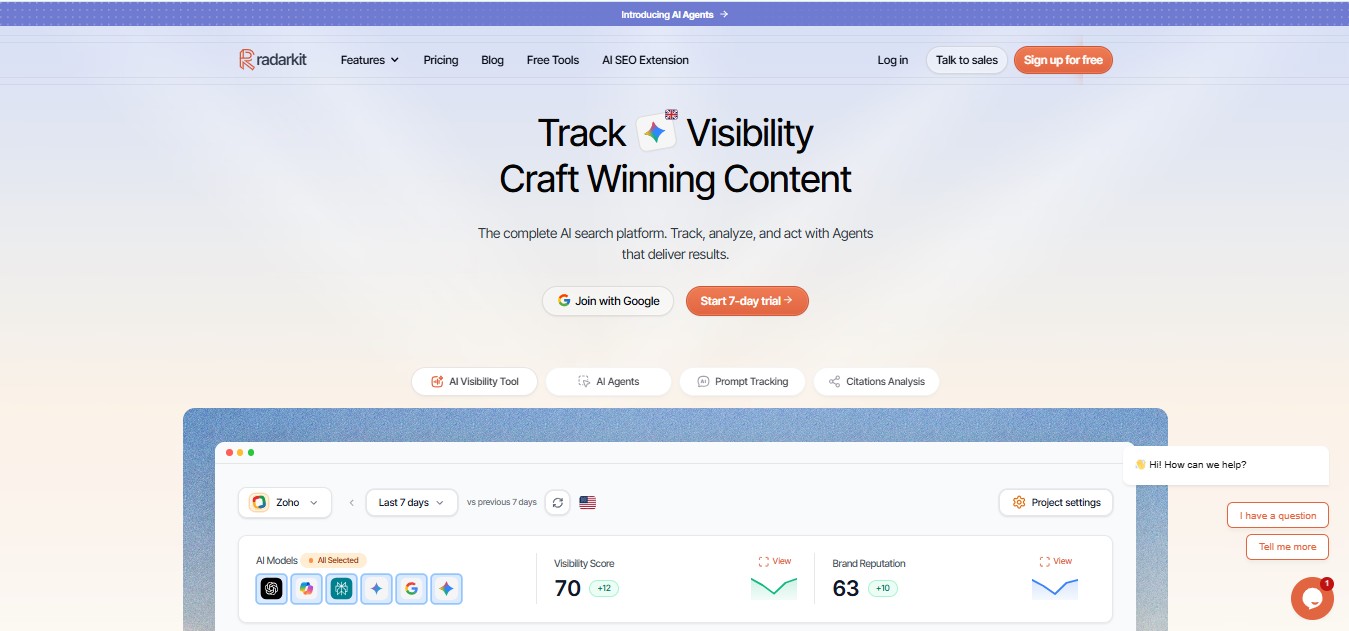
RadarKit earns the first position because it combines local recommendation measurement with broad platform coverage and follow-up work. Local Radar shows how often AI recommends a business, where it appears in the answer, and which other businesses receive recommendations.
Its appeal is not a promise of better rankings. It is the ability to connect a local visibility question with an understandable set of metrics and practical next steps.
Key Features
- Local business appearance rate and average answer position
- Competitor comparisons that include appearances, position, ratings, and review counts
- ChatGPT, Google AI Mode, AI Overviews, Copilot, Perplexity, and Gemini tracking on every plan
- User-interface-based tracking rather than relying only on API responses
- Content, outreach, Reddit, and chat agents with plan-specific allowances
- Google Search Console, Google Analytics, WordPress, API, MCP, client portals, and branded reporting
Intent Tracking Capabilities
RadarKit lets you monitor prompts built around the service and buying conditions you want to measure. For example, an agency could track “local SEO agencies offering AI visibility audits” separately from “how to improve local AI visibility.” The first tests a service recommendation, while the second tests educational discovery.
Local Radar then reports recommendation frequency and position for the tracked questions. Its appearance-rate measurement excludes unrelated answers from the local recommendation score. This makes the metric more focused on local business recommendations.
There is an important location distinction. Local business tracking appears on every plan, but the pricing table reserves explicit state and city-level tracking for Enterprise. Country coverage should not be presented as identical to city-level precision.
Pros and Cons
- Pro: All six listed AI platforms are included across paid plans
- Pro: Recommendation tracking and action tools sit in the same subscription
- Pro: The $29 entry plan includes two projects and reporting access
- Consideration: Lite refreshes every 72 hours, while Growth and Pro refresh daily
- Consideration: Explicit state and city-level tracking requires Enterprise
Best For
RadarKit suits local businesses, SEO consultants, and agencies that want to monitor service-focused AI recommendations and develop content or outreach from the findings. It is especially worth considering when several AI engines matter to the campaign.
Pricing
| Plan | Price | Projects | Tracked prompts | Refresh frequency |
| Lite | $29/month | 2 | 15 | Every 72 hours |
| Growth | $79/month | 5 | 50 | Daily |
| Pro | $139/month | 10 | 100 | Daily |
| Enterprise | Custom annual pricing | Unlimited | Custom | Daily or weekly |
RadarKit lists a seven-day trial. Agent allowances, reporting limits, and team access vary by plan.
2. BrightLocal: Best for All-in-One Local SEO and AI Visibility
BrightLocal connects AI visibility with the local SEO tasks a team already manages. Its Local AI Visibility Tracker measures recommendations across ChatGPT, Google AI Mode, and Google AI Overviews, and is included in Track, Manage, and Grow plans.
A useful difference is the connection between citation analysis and Citation Builder. Teams can identify directories cited in AI answers and move relevant listing gaps into a separate citation-building campaign.
Key Features
- A location-specific AI visibility score from 0 to 100
- Up to 20 prompts per location, with platform and prompt breakdowns
- Branded and unbranded results, sentiment, and recommendation strength
- Competitor mention rate, share of voice, and average position
- Local ranking reports, Search Grid, citation monitoring, and Google Business Profile audits
- Listing sync and Google post scheduling on Manage, plus review tools on Grow
Intent Tracking Capabilities
BrightLocal suggests prompts based on business category and lets users edit them to match their services. That supports a focused selection of educational questions, comparison questions, and local provider searches.
For tools to measure your local ai visibility with intent, the useful feature here is prompt-level reporting. You can check whether an agency appears for an AI audit service question rather than relying only on its overall visibility score. This is an intent-led monitoring workflow, not a claim that every prompt receives automatic buyer-stage classification.
Pros and Cons
- Pro: AI tracking is included in all three main plans
- Pro: Visibility findings connect with local audits and citation work
- Consideration: The tracker currently covers three AI experiences
- Consideration: Citation Builder purchases are separate from subscription fees
Best For
BrightLocal fits agencies and businesses that want to work on local rankings, business details, citations, and reputation alongside AI visibility. Its primary platform markets include the United States, United Kingdom, Canada, and Australia, so businesses in other regions should confirm coverage before subscribing.
Pricing
| One-location plan | Monthly billing | Advertised monthly equivalent with annual billing | Annual charge |
| Track | $41 | $31 | $369 |
| Manage | $54 | $40 | $485 |
| Grow | $65 | $49 | $584 |
The displayed annual monthly equivalents are rounded. Pricing changes by location band, and BrightLocal offers a 14-day trial without a credit card.
3. Local Falcon: Best for Geo-Grid and Map-Based AI Visibility
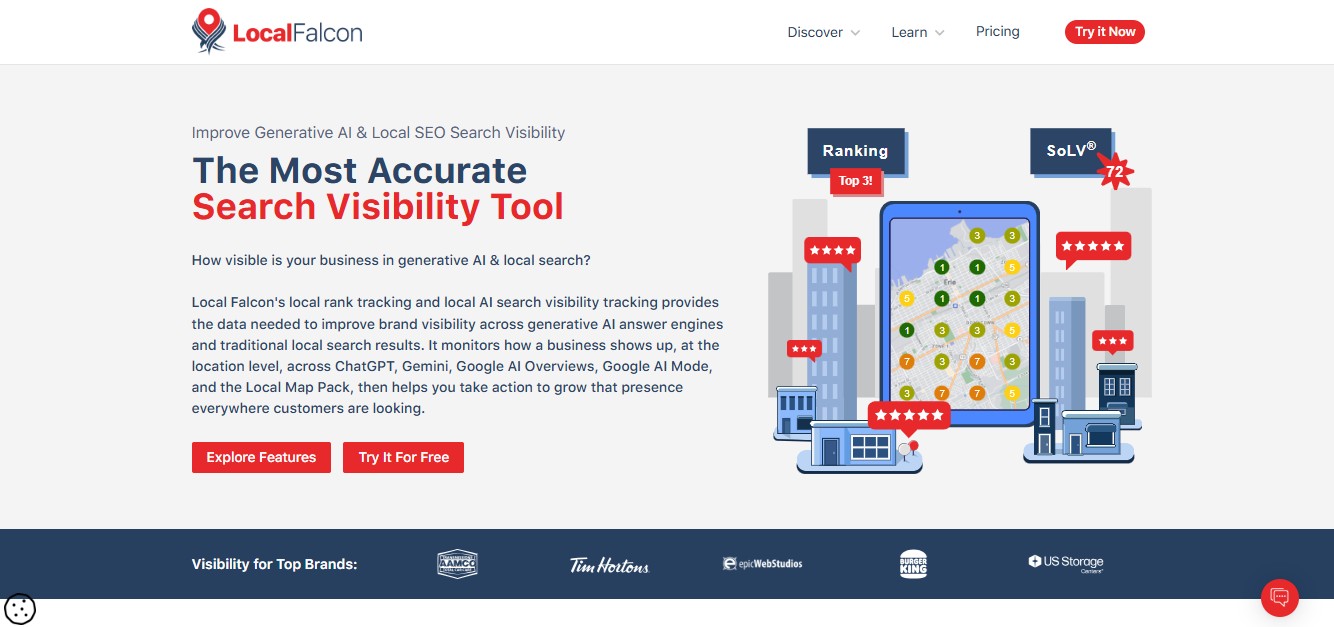
Local Falcon answers a location-sensitive question: how does the same business perform across different points in its service area? Its AI scans use the geo-grid format also used for Google Maps and Apple Maps tracking.
This makes it a useful option when a single location-wide score does not provide enough geographic detail.
Key Features
- AI scans across ChatGPT, Gemini, Google AI Overviews, Google AI Mode, and Grok
- Grid-point responses, business positions, and cited sources
- Share of AI Voice, Buyer Persuasion Score, and sentiment
- Google Maps and Apple Maps local rank tracking
- Scheduled campaigns and Falcon AI report analysis
- Grid sizes from 3×3 through 21×21
Intent Tracking Capabilities
Local Falcon supports natural local-intent phrases rather than limiting the workflow to short keywords. You can test a specific service question across a chosen grid size and radius, then inspect the answer at each point.
For an SEO agency, that could mean comparing a broad agency recommendation with a prompt asking for local SEO and AEO services. The test reveals how responses differ across the area, not just whether the brand appears somewhere.
Buyer Persuasion Score adds another angle to the reporting. Treat it as Local Falcon’s response-evaluation metric, not as a measured conversion rate or proof that someone will contact the business.
Pros and Cons
- Pro: Detailed geographic views across local AI and map results
- Pro: Individual grid points expose the underlying response and sources
- Consideration: Grid size, scan frequency, keywords, and locations affect credit needs
- Consideration: Falcon AI analysis costs an additional 25 credits per report
Best For
Local Falcon fits local SEO agencies and service-area businesses that need neighborhood-level comparisons. Among tools to measure your local ai visibility with intent, it stands out for testing the same intent across multiple geographic points.
Pricing
| Plan | Monthly price | Monthly credits |
| Starter | $24.99 | 7,500 |
| Basic | $49.99 | 15,150 |
| Pro | $99.99 | 31,250 |
| Premium | $199.99 | 63,150 |
Annual packages are also available. A standard grid point uses one credit, so a 5×5 scan uses 25 credits. Confirm the projected usage for your selected AI scan settings inside the account. New users receive 100 free credits.
4. Yext: Best for Enterprise Listings and AI Answer Management
Yext brings visibility measurement and business-data management together. Its Knowledge Graph stores brand and location facts, while Scout measures how the business appears across traditional and AI search.
For a large organization, that connection matters. Teams can investigate a location-level visibility gap while maintaining shared control over listings, local pages, and other business information.
Key Features
- Scout visibility trends by location and competitor
- AI presence, position, sentiment, and citation-source reporting
- A Knowledge Graph for structured brand and location information
- Distribution across more than 200 publishers globally
- Packaged capabilities spanning listings, pages, reviews, social, and Scout
Intent Tracking Capabilities
Scout measures relevant unbranded AI responses and compares locations with local competitors. This helps a multi-location business examine discovery beyond searches that already include its name.
During a demo, ask how Scout configures service-specific prompts, distinguishes branded from unbranded demand, and separates intent groups. Its core strength is location-level intelligence connected to business data, rather than a claim that it shares the same prompt classification system as Peec AI.
Pros and Cons
- Pro: Measurement connects with centrally managed location data
- Pro: Scout provides local competitor and citation-source context
- Consideration: Pricing depends on solution scope and footprint
- Consideration: There is no standard free tier or free trial
Best For
Yext suits enterprise brands that need consistent business information across many locations and publishers. Smaller businesses can access Yext through reseller partners, which can be a suitable route when enterprise-level direct purchasing is not required.
Pricing
Yext uses custom solution pricing, generally influenced by location or provider count, selected capabilities, and contract length. Billing is typically annual, although other arrangements can be negotiated. Scout can be purchased separately or within a packaged solution.
5. Profound: Best for Enterprise AI Search Intelligence
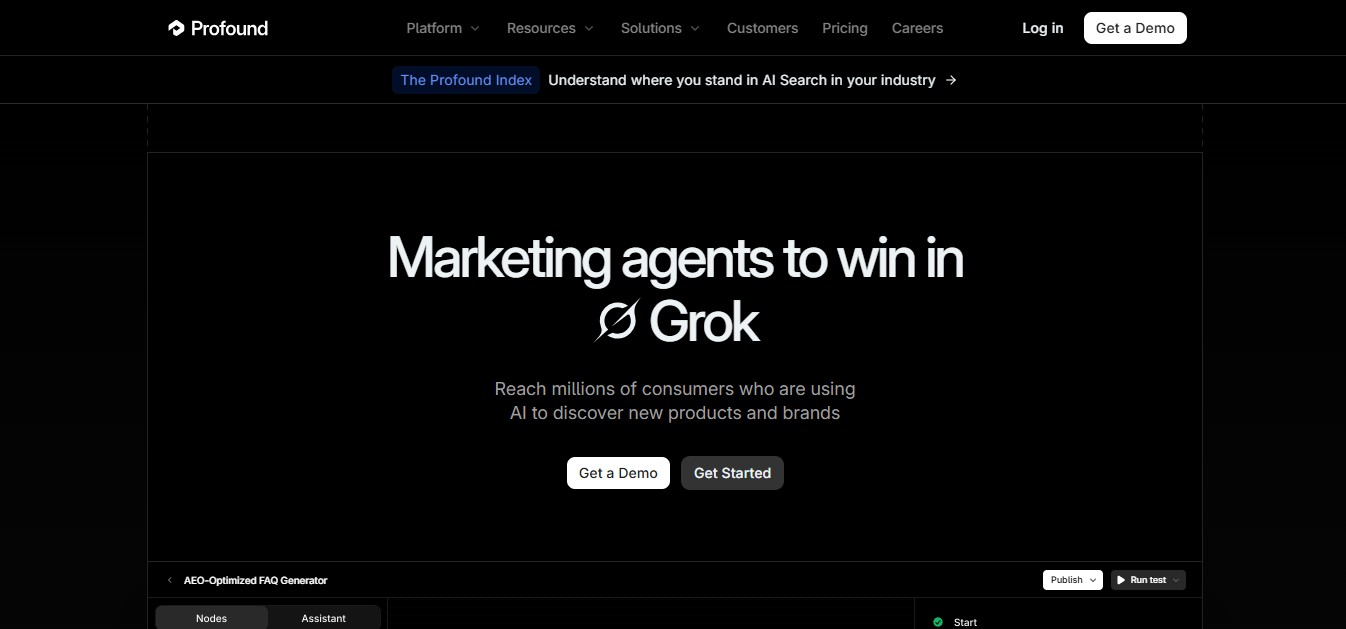
Profound combines AI answer analysis with marketing research and recurring agent workflows. Its platform includes Answer Engine Insights, Prompt Volumes, Agent Analytics, and AI Marketer agents.
It is worth considering when a team needs more than local recommendation reporting, particularly when AI visibility data feeds a broader content and campaign operation.
Key Features
- Answer Engine Insights for citations, sentiment, ranking, and competitive presence
- Enterprise capability for up to nine answer engines
- Prompt Volumes for investigating what users ask answer engines
- Agent Analytics for AI-sourced traffic and attribution
- Reusable agents, shared projects, Context Manager, and Profound Sheets
- Enterprise API, exports, SSO/SAML, and dedicated support
Intent Tracking Capabilities
Enterprise users can add, edit, or disable prompts to reflect brand strategy. That allows teams to build separate groups for service discovery, comparisons, and purchase-oriented questions. Prompt Volumes can inform the research behind those groups.
The free trial works differently. Profound supplies recommended industry prompts, and trial users cannot customize them. It is therefore a product introduction rather than a fully configurable local-intent test.
For tools to measure your local ai visibility with intent, verify the required regional detail before buying. Profound’s enterprise regional coverage is custom and does not use the same grid-point methodology as Local Falcon.
Pros and Cons
- Pro: AI visibility, demand research, attribution, and marketing workflows are connected
- Pro: Enterprise packages support wider engine coverage and custom tracking
- Consideration: Main enterprise pricing requires a quote
- Consideration: Trial prompts are not editable, and tracking lasts seven days
Best For
Profound fits enterprise marketing teams that want AI search analysis to guide research, content, and repeatable campaign work. It is a broader workflow choice rather than a direct substitute for a local map-grid tracker.
Pricing
The main pricing page displays a free Trial and custom Enterprise packages. Trial includes 50 unique prompts run daily for seven days across ChatGPT, Gemini, and Google AI Overviews. Enterprise provides tailored prompt tracking, daily checks, and custom AI Marketer credits.
The platform also references a self-serve Agency Growth offering, but the current pricing page does not publish a standard price for it.
6. Otterly.ai: Best for Simple AI Answer Monitoring
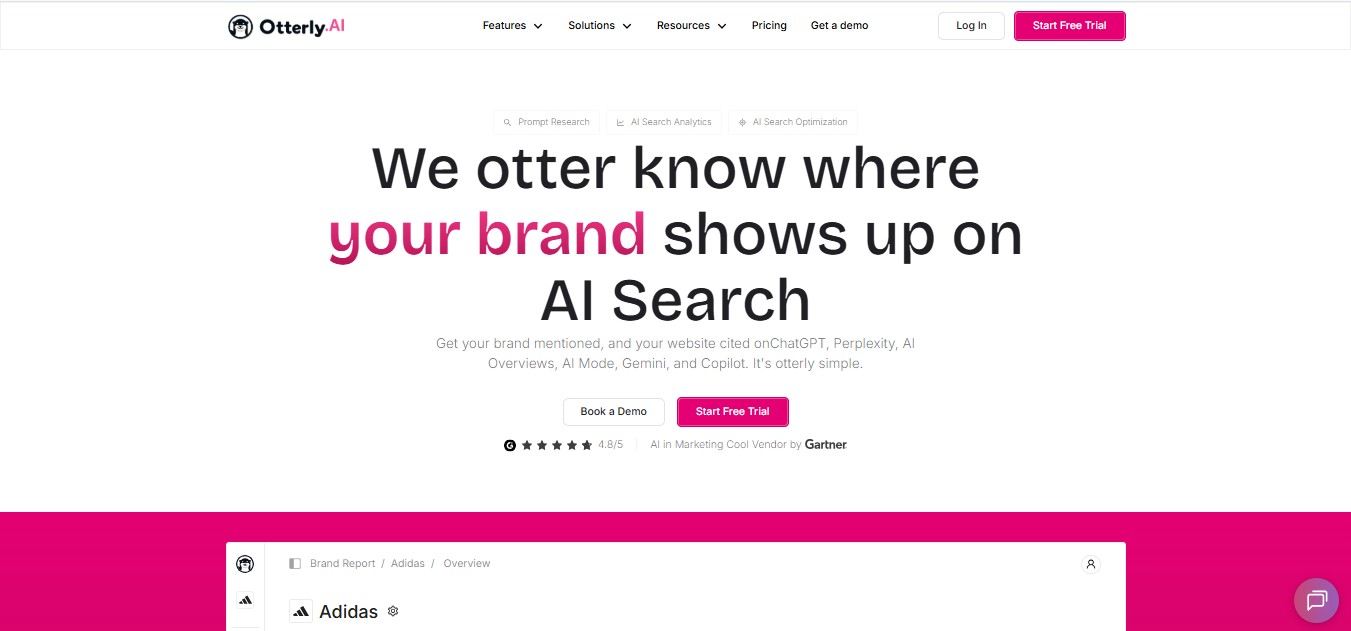
Otterly.ai gives teams a clear prompt-monitoring workflow with daily checks, citation analysis, and GEO audits. It also provides unlimited team members across its listed plans.
Its entry plan is useful for a focused campaign, especially when daily monitoring matters more than a large prompt library.
Key Features
- Daily tracking across ChatGPT, AI Overviews, Perplexity, and Microsoft Copilot
- Brand Visibility Index, domain ranking, and link-citation analysis
- AI prompt research and multi-country support across more than 50 countries
- GEO URL audits and improvement recommendations
- Unlimited workspaces, Looker Studio, API, MCP, and Agent Analytics on Standard and Premium
Intent Tracking Capabilities
Otterly’s prompt research features identify topics and intent patterns. Users can then choose relevant questions and monitor whether their brand or website appears in the resulting answers.
For a local agency, build a small set covering service discovery, provider comparisons, and audit requests. Keep those categories separate in the analysis so a strong result for an educational question does not stand in for purchase-ready visibility.
Multi-country support helps regional monitoring, but country coverage alone should not be described as neighborhood-level geo-grid testing.
Pros and Cons
- Pro: Daily tracking is included in Lite
- Pro: Citation monitoring and GEO audits accompany visibility data
- Consideration: Google AI Mode, Gemini, and Claude are paid engine add-ons
- Consideration: API, MCP, and Agent Analytics start with Standard
Best For
Otterly.ai suits small marketing teams and agencies that want repeatable AI answer monitoring and content checks. Its daily cadence is useful for a compact, high-priority prompt set.
Pricing
| Plan | Monthly billing | Monthly equivalent with annual billing | Prompts |
| Lite | $29 | $25 | 15 |
| Standard | $189 | $160 | 100 |
| Premium | $489 | $422 | 400 |
| Enterprise | Custom | Custom | Starting from 1,000 |
On Lite, Google AI Mode and Gemini each cost an additional $9 monthly. Claude costs an additional $29 monthly. Add-on prices increase with the plan, so compare the full engine configuration rather than only the entry price.
7. Peec AI: Best for AI Visibility Analytics and Competitor Tracking
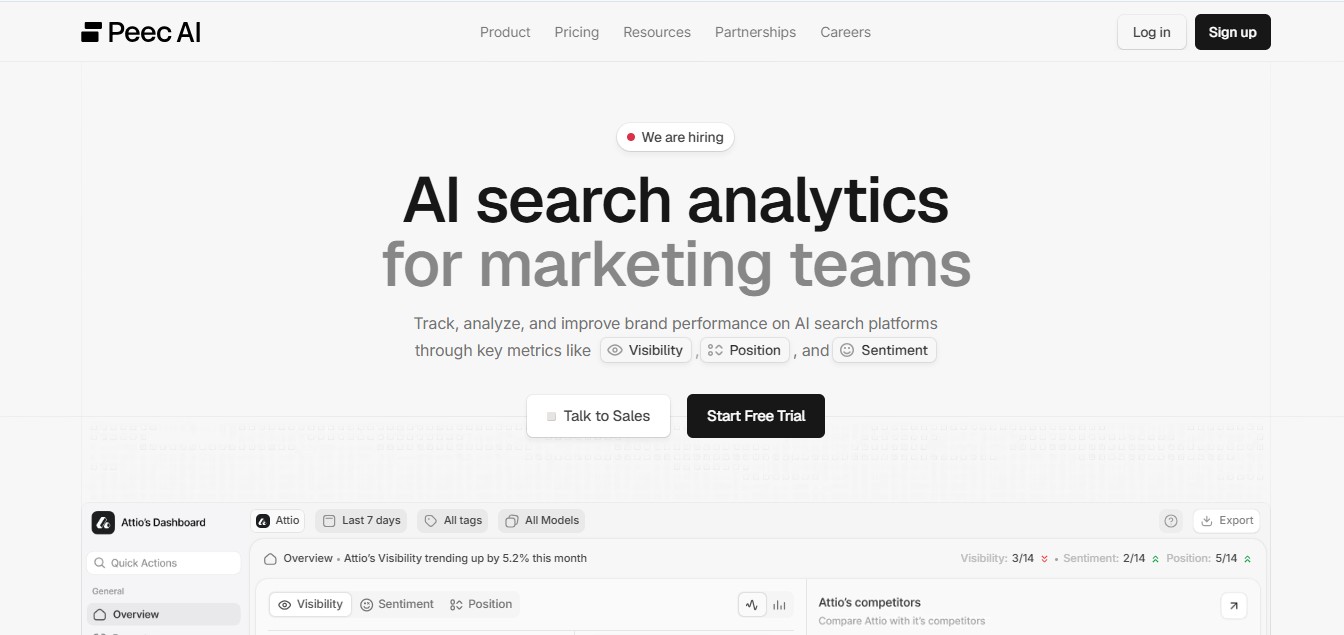
Peec AI provides a detailed view of brand visibility, answer position, sentiment, and share of voice. It also explicitly lists prompt intent classification, making it particularly relevant to the intent angle of this comparison.
Its distinction is not simply tracking mentions. It helps organize the questions, sources, and competitive patterns behind those mentions.
Key Features
- Daily visibility, position, sentiment, and share-of-voice measurement
- Informational, commercial, and transactional prompt classification
- Branded versus non-branded classification, topics, tags, and personas
- Domain and URL source analysis, citation share, and source categories
- Source-gap analysis identifying frequently cited pages that mention competitors
- Unlimited users, with project and model limits varying by plan
Intent Tracking Capabilities
Peec AI can classify a prompt by intent and organize analysis around tags, models, and countries. That is helpful when a brand appears often for general research but wants to understand its commercial and transactional coverage separately.
For example, an agency can compare an informational question about AEO with a commercial question asking which agency offers an AEO audit. These categories should remain separate even when they share the same topic.
Among tools to measure your local ai visibility with intent, Peec AI deserves attention for explicit classification. Confirm plan-level access to Local GEO and the geographic setup you need before purchasing.
Pros and Cons
- Pro: Published intent classification goes beyond a single overall mention score
- Pro: Source analysis and competitor comparisons support content planning
- Consideration: Standard brand plans include three selected models, with more available as add-ons
- Consideration: Project capacity is one, two, or five across the standard tiers
Best For
Peec AI fits marketing and content teams that want structured prompt analysis, competitor benchmarking, and citation research. It is a strong alternative when explicit intent classification is the leading buying criterion.
Pricing
| Brand plan | Monthly price | Prompts | Projects | Included model selection |
| Starter | $95 | 50 | 1 | Choose 3 |
| Pro | $245 | 150 | 2 | Choose 3 |
| Advanced | $495 | 350 | 5 | Choose 3 |
| Enterprise | Custom annual pricing | Custom | Unlimited | Expanded selection |
Peec AI lists a 15% annual billing discount and separate agency pricing.
8. SE Ranking: Best for Combined Rank Tracking and AI Visibility
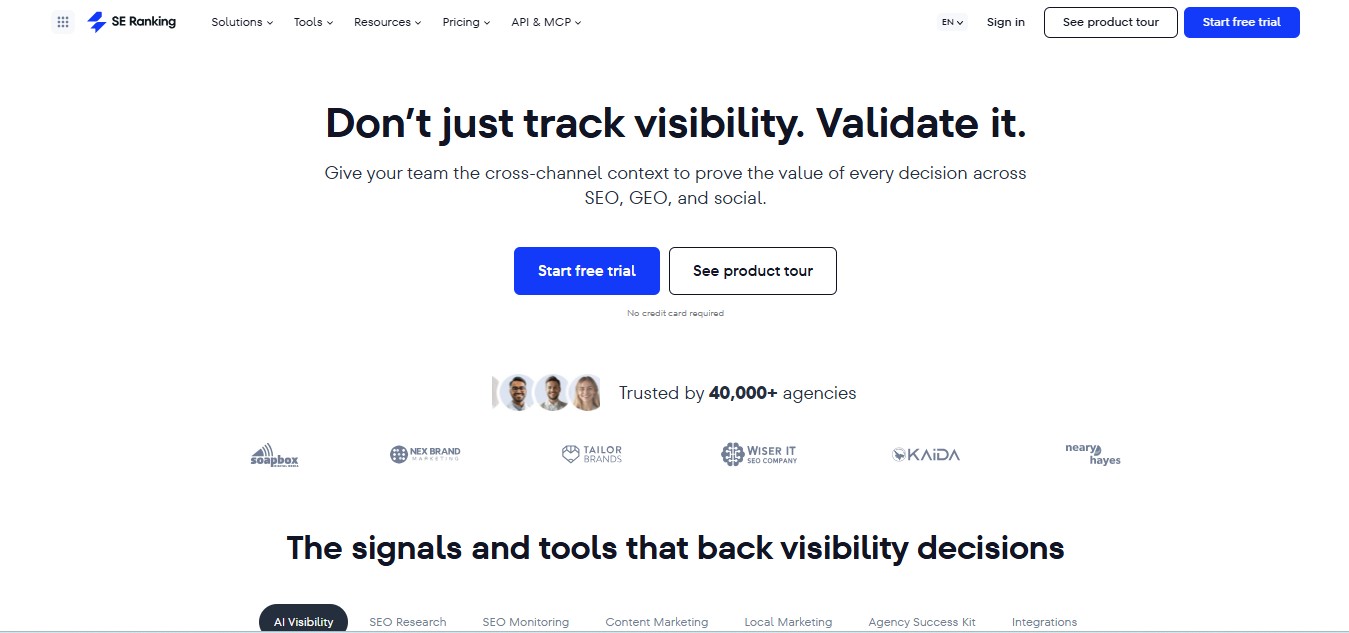
SE Ranking combines conventional SEO research with GEO monitoring. The current Core and Growth subscriptions include daily prompt tracking, five tracked LLMs, AI source tracking, and local marketing allowances.
This makes it useful when the same team handles search rankings, technical work, local listings, and AI visibility.
Key Features
- Daily SEO keyword and AI prompt tracking
- Keyword, competitor, backlink, website, and on-page research
- GEO competitive research and unlimited AI source tracking
- Local and map rank tracking, listing management, and Google Business Profile posts
- Analytics integrations, API credits, and MCP access
- An optional AI Search add-on with deeper monitoring and a strategic visibility dashboard
Intent Tracking Capabilities
SE Ranking recommends mapping prompts to awareness, consideration, and purchase, while keeping brand-comparison questions separate. Its prompt research can help teams turn SEO queries into conversational questions and topic groups.
An agency could track a service keyword in ordinary search and a related conversational recommendation prompt in AI results. This produces two useful measurements, but they should not be treated as the same ranking system.
When choosing tools to measure your local ai visibility with intent, distinguish the base subscription from the add-on. Core and Growth already include GEO capabilities; AI Search expands the workflow and provides access to the SE Visible strategic dashboard.
Pros and Cons
- Pro: SEO and GEO monitoring are included in the main subscriptions
- Pro: Local marketing tools are available alongside audits and research
- Consideration: The base subscription starts above entry-level standalone monitoring tools
- Consideration: AI Search is an additional purchase, not the advertised base price
Best For
SE Ranking fits SEO teams that want shared reporting and research across traditional search and AI discovery. It is particularly relevant when website auditing and local marketing are already part of the team’s responsibilities.
Pricing
| Plan | Monthly billing | Monthly equivalent with annual billing | Daily tracked prompts |
| Core | $129 | $103.20 | 100 |
| Growth | $279 | $223.20 | 250 |
| Enterprise | Custom | Custom | Custom |
The AI Search add-on starts at an additional $89 monthly, or $71.20 per month with annual billing, at its 200-prompt level. SE Visible also has standalone pricing, which should not be confused with the add-on rate.
Comparison Table: 8 Local AI Visibility Tools
| Tool | Distinctive capability | Intent approach | Local detail | Starting price |
| RadarKit | Six engines plus action agents | Custom service-focused prompts and recommendation metrics | Local business tracking; explicit state and city-level tracking on Enterprise | $29/month |
| BrightLocal | AI tracking connected to local SEO tasks | Editable category prompts and prompt-level results | Per-location reporting | $41 monthly, or approximately $31/month annually |
| Local Falcon | Grid-point AI response analysis | Natural local-intent phrases across a scan area | Geo-grid | $24.99/month, credit-based |
| Yext | Knowledge Graph plus Scout | Relevant unbranded discovery and competitor analysis | Location-level enterprise intelligence | Custom |
| Profound | Answer insights, demand research, and agents | Editable enterprise prompts and Prompt Volumes | Custom regional coverage | Free trial; main Enterprise package custom |
| Otterly.ai | Daily monitoring plus GEO audits | Prompt research and selected intent-driven questions | Multi-country support | $29 monthly, or $25/month annually |
| Peec AI | Explicit classification and source analytics | Informational, commercial, and transactional classification | Country and local GEO features; confirm plan scope | $95/month |
| SE Ranking | SEO research plus GEO monitoring | Buyer-stage prompt planning and SEO-to-prompt research | Local marketing alongside AI monitoring | $129 monthly, or $103.20/month annually |
Starting prices do not buy equivalent tracking capacity. Compare prompt count, engines, refresh frequency, location precision, and necessary add-ons before selecting a plan.
How to Choose the Right Local AI Visibility Tool
Choose RadarKit if you want intent-focused AI visibility tracking
Choose RadarKit when the main job is monitoring local recommendations across several AI engines and turning the findings into content or outreach work. Its six-engine coverage and action agents make it a well-rounded starting point.
Check whether the plan matches your measurement needs. Growth offers daily tracking, while Enterprise is the published option for explicit state and city-level controls.
Choose BrightLocal if you need local SEO plus AI visibility
Choose BrightLocal when AI monitoring belongs beside citation work, local audits, listings, and review management. Its connection between AI citation gaps and Citation Builder is particularly useful for this workflow.
Select the plan by the work you need to perform, not just the shared AI tracker. Manage adds business-data sync and posting. Grow adds review management and review-generation tools.
Choose Local Falcon if geo-grid visibility is your priority
Choose Local Falcon when you need to understand geographic variation within a service area. It lets you inspect the same local-intent question at different grid points rather than stopping at an overall score.
Plan credits around the grid, keywords, engines, locations, frequency, and optional Falcon AI analysis. Larger scans provide more geographic observations, but also require more resources.
Choose an enterprise platform if you manage multiple locations
Yext is the stronger fit when centralized business facts, publisher distribution, and location-level intelligence must work together. Profound is worth evaluating when wider answer-engine analysis, demand research, attribution, and recurring marketing agents are the priority.
Multiple locations alone do not require an enterprise platform. Compare the actual reporting, governance, and geographic requirements with the limits of smaller plans before moving to a custom contract.
For any tools to measure your local ai visibility with intent, use the same sample prompts during evaluation. Include an educational question, a provider-comparison question, and a purchase-oriented service question. That makes the differences between tools easier to judge.
Final Verdict: Best Tool to Measure Local AI Visibility with Intent
RadarKit is the best overall choice for a local business or agency that wants broad AI coverage, recommendation-level reporting, and tools for the next piece of work. Its $29 starting plan includes all six listed platforms, local business tracking, and action agents, giving it a useful balance of coverage and functionality.
The right choice still depends on the job. BrightLocal is well suited to local SEO management, Local Falcon offers detailed geographic testing, and Yext connects measurement with enterprise business-data distribution. Profound supports wider enterprise research and marketing workflows, while Peec AI is especially relevant for explicit intent classification.
Start with the customer questions you want to win, then choose the plan that can measure them at the required location detail and frequency. For RadarKit, that means considering Growth for daily checks and Enterprise when explicit city-level tracking is essential.
FAQs
What does local AI visibility with intent mean?
It means measuring whether an AI answer mentions or recommends your business for a specific local need and buying stage. An educational question, a service comparison, and a request for a nearby provider should be analyzed separately. Peec AI explicitly classifies informational, commercial, and transactional prompts. Other tools support intent-led monitoring through selected questions.
Which tools to measure your local ai visibility with intent should a small business consider first?
RadarKit is a good first option for broad engine coverage and local recommendation reporting. BrightLocal suits businesses that also need local SEO tasks, while Otterly.ai offers daily monitoring at the same $29 monthly starting price as RadarKit. Compare geography, engines, and refresh frequency before choosing.
Can these tools track near-me questions?
Local Falcon supports natural local-intent questions across a geo-grid. RadarKit offers local business recommendation tracking, but its pricing table reserves state and city-level controls for Enterprise. Confirm how a tool supplies location context rather than relying only on the words “near me.”
Does an AI mention mean a business will receive a lead?
No. A mention, a citation, and a recommendation describe different aspects of an answer; they are not completed inquiries or sales. Use traffic and attribution measurements alongside answer visibility where available.
How often should local AI visibility be measured?
Match the cadence to the campaign. RadarKit Lite refreshes every 72 hours, Growth and Pro refresh daily, and Otterly.ai includes daily tracking. Keep prompts and measurement settings consistent, and review trends rather than treating one response as a lasting result.
Which tool has built-in intent classification?
Peec AI explicitly lists informational, commercial, and transactional classification. Do not assume every prompt-monitoring tool provides the same automatic classification just because it supports custom questions.
Do local AI visibility tools replace Google Maps tracking?
They measure different outputs. Local Falcon supports both map rankings and AI responses, while BrightLocal combines AI visibility with local ranking and grid tools. Tracking both helps distinguish map performance from recommendation visibility.
Is RadarKit’s $29 plan enough for precise city-level monitoring?
Its Lite plan includes local business tracking, 15 prompts, and six AI platforms, but its published plan details mark state and city-level tracking as Enterprise-only. If precise city controls are a requirement, confirm the Enterprise scope rather than assuming country coverage provides the same capability.
